


A courtroom in New York has become the latest front in a growing clash between crypto innovation and the reach of U.S. law.
Federal prosecutors and industry advocates are now locked in a standoff over how far criminal liability can extend when code, competition, and money collide on the blockchain.
At the center of the case are Anton and James Peraire-Bueno, two brothers accused of manipulating Ethereum’s infrastructure to pull off a $25 million trading exploit in 2023. Prosecutors claim the pair engineered a high-speed “bait-and-switch” that tricked automated trading bots — an act they describe as outright fraud. Defense attorneys call it something else entirely: an aggressive trading strategy made possible by blockchain design.
Policy Meets Prosecution
The case, being heard in the Southern District of New York, took an unexpected turn this week when federal lawyers moved to block the participation of Coin Center, a Washington-based crypto policy organization. Coin Center had filed an amicus curiae brief urging the court to consider the broader implications of the government’s arguments for blockchain users at large.
Prosecutors quickly shot back, warning that the filing was an attempt to inject political debate into a criminal trial. In their letter to the court, they insisted that questions of digital-asset regulation “belong in Congress, not in a jury room.”
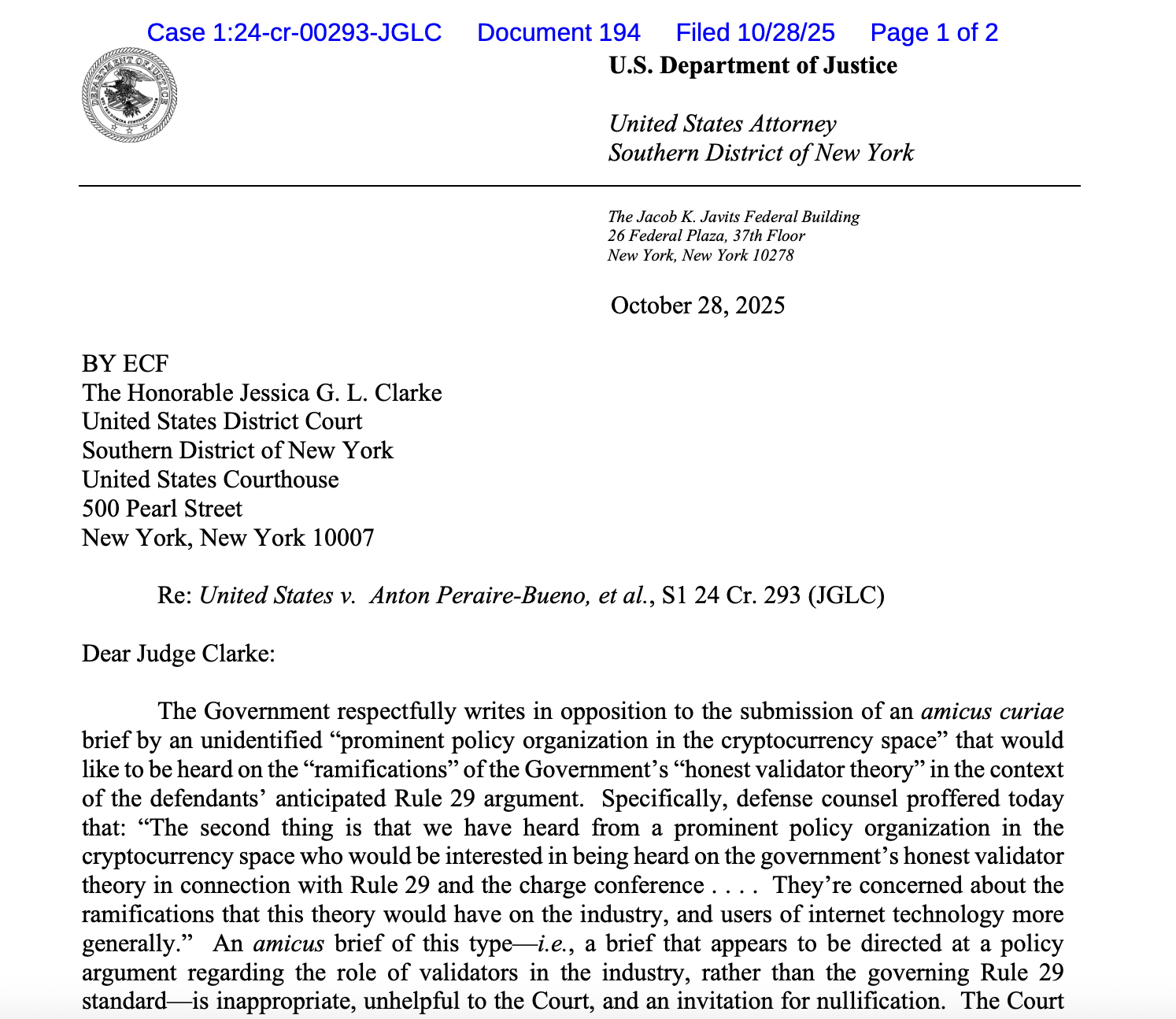
The government’s tone left little room for ambiguity: allowing the policy brief, it said, would open the door to “jury nullification” and shift the focus away from evidence toward industry ideology.
Defense Counters With Broader Stakes
Lawyers for the brothers pushed back, arguing that the policy perspective is crucial to understanding the technological and economic context of the case. They said the government’s stance risks criminalizing routine blockchain activity — from algorithmic trading to validator operations — by framing them as deceptive simply because they exploit market inefficiencies.
“If the government’s theory stands,” one defense filing warned, “any deviation from a blockchain’s default behavior could be treated as criminal conduct.”
They argued that Ethereum users engage in inherently competitive behavior — and that the brothers targeted not innocent victims, but “sandwich bots”, automated traders that seek to profit from frontrunning other users’ transactions.
An Industry Watching Closely
The outcome could reverberate far beyond a single trial. A guilty verdict could redefine how the U.S. views maximal extractable value (MEV) — the process through which validators or traders reorder transactions to gain profit. Regulators have long wrestled with whether MEV represents legitimate arbitrage or systemic manipulation.
According to a European Securities and Markets Authority report released in July, Ethereum-based MEV activity generated roughly $963 million in total revenue and about $417 million in profit between late 2022 and early 2025. The Peraire-Bueno case marks the first time such practices have been tested in a criminal court.
Trial Moves Forward Amid Industry Tension
Opening arguments began on October 15, over a year after the indictment was issued. The brothers face charges including wire fraud, money laundering, and receipt of stolen property — each carrying a potential 20-year prison sentence.
Inside the courtroom, the legal arguments may revolve around evidence and code, but outside, the trial has become symbolic. For policymakers, it’s about whether the U.S. legal system can adapt to decentralized technologies. For the crypto industry, it’s about ensuring innovation isn’t mistaken for intent to deceive.
Coin Center has yet to respond publicly to the government’s effort to silence its input. But the organization’s involvement has already underscored the case’s larger importance: it is no longer just a dispute over one exploit — it’s a question of how far the definition of “fraud” should stretch in a world governed by algorithms.
As the trial continues into November, the crypto community is watching closely. The verdict could determine not only the fate of two brothers but the legal boundaries of blockchain competition itself.


