

Mastercard posted another upbeat quarter for the three months ended September 30, 2025, fueled by resilient consumer and business outlays and a bigger contribution from its services portfolio.
Net revenue rose 17% year over year (15% currency-neutral) to $8.6 billion, while GAAP diluted EPS increased 23% to $4.34. Adjusted diluted EPS came in at $4.38.
CEO Michael Miebach highlighted momentum across “value-added services,” which delivered 25% net-revenue growth (22% currency-neutral) as the company rolled out the Mastercard Commerce Media network, new cyber threat-intelligence offerings, and expanded “agentic commerce” capabilities.
Q3 highlights at a glance
• Net income: $3.9B (up 20%); adjusted net income: $4.0B (up 10%)
• Operating income: $5.1B (up 26%); GAAP operating margin: 58.8% (up 4.5 pts)
• GDV: $2.7T, up 9% (local); purchase volume up 10% (local)
• Cross-border volume: up 15% (local)
• Switched transactions: up 10%
• Cards in circulation: 3.6B Mastercard and Maestro branded
Payments engine strong; services even stronger
Payment-network net revenue increased 12% (10% currency-neutral), driven by 9% GDV growth, a 15% cross-border rebound and 10% switched-transaction growth. Rebates and incentives rose 16% (15% currency-neutral) reflecting higher volumes and new/renewed deals. Services and solutions outpaced the core network again, up 25% (22% currency-neutral), with security, digital authentication, consumer engagement and data/insights all cited as growth drivers; acquisitions contributed ~3 percentage points.
Margins, expenses and taxes
GAAP operating expenses rose 5% as lower litigation provisions partly offset higher G&A. On an adjusted basis, operating expenses increased 15% (14% currency-neutral), including a 4-point contribution from acquisitions. GAAP operating margin expanded to 58.8%; adjusted operating margin edged up to 59.8%. The effective tax rate stepped up to 21.5% (adjusted 21.4%) from 15.6% a year ago, largely due to 2025 implementation of the 15% global minimum tax (Pillar 2) in Singapore and other jurisdictions and a change in geographic earnings mix.
Capital returns remain sizable
Mastercard repurchased 5.8 million shares for $3.3 billion and paid $687 million in dividends during Q3. Through October 27, it repurchased an additional 2.1 million shares for $1.2 billion, leaving $5.8 billion under existing authorizations.
Year-to-date picture
For the first nine months of 2025, net revenue rose 16% to $24.0 billion, GAAP net income increased 14% to $10.9 billion, and GAAP diluted EPS grew 17% to $12.00 (adjusted EPS $12.25, up 14%). Key business drivers remained consistent with Q3: GDV up 9% (local), cross-border up 15% (local), and switched transactions up 10%.
Mastercard Stock
Mastercard shares traded around $557–558 late morning, up about 0.6% on the day, after opening at $551.56 and ranging between $545.64 and $562.92. The stock sits roughly 7% below its 52-week high of $601.77 and well above the 52-week low of $465.59.
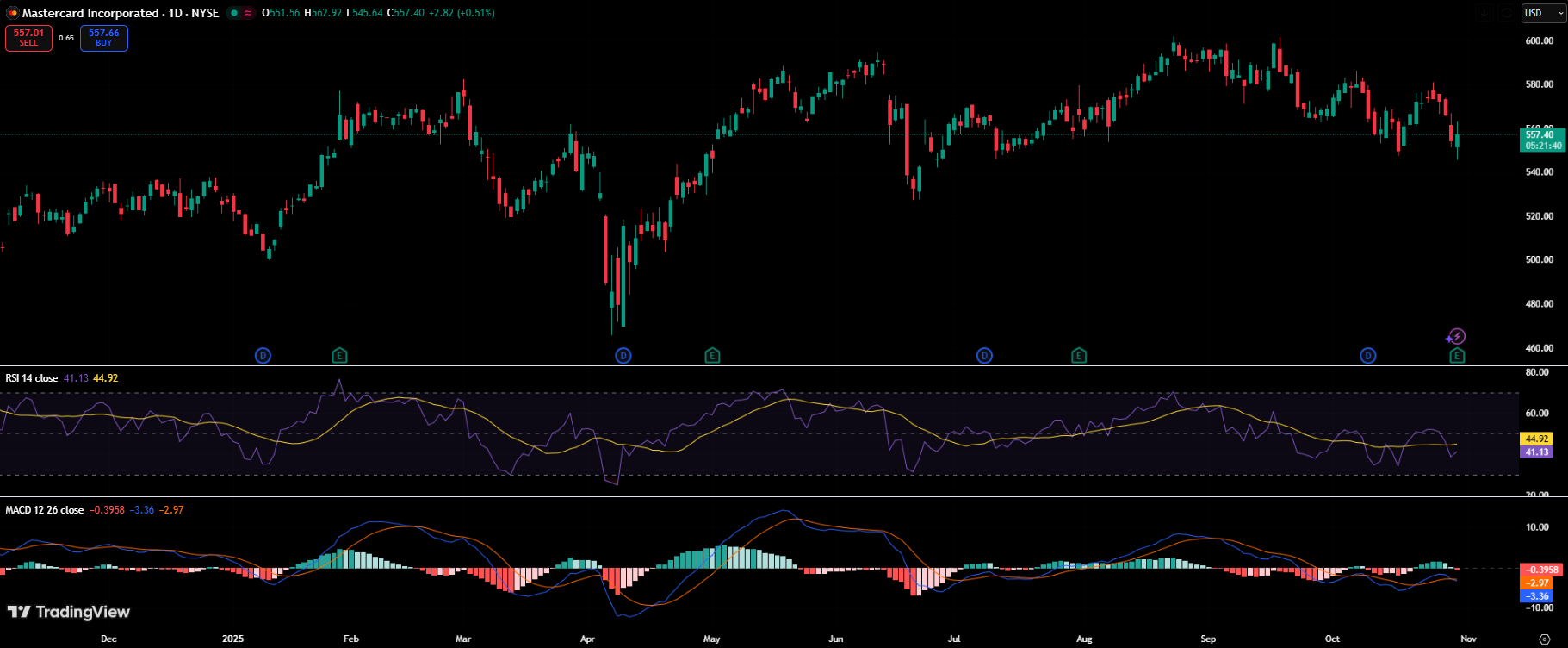
On the daily chart, RSI hovers in the mid-40s (neutral/slightly weak), while MACD is flattening near the zero line with a modestly improving histogram—signals that momentum is stabilizing but not yet trending. Near-term, $545–550 looks like first support from recent lows, with $565–570 as the next area to watch on the upside.
What to watch next
Management is leaning on high-growth services (security, data/insights, media/marketing and digital authentication) to diversify beyond pure transaction fees, while travel-related cross-border volumes continue to support the top line. Investors will monitor the trajectory of rebates/incentives amid competitive deal activity, any further impact from Pillar 2 on the tax rate, and integration of recently acquired capabilities that added ~1 percentage point to Q3 revenue growth.


