

In the first week of February, a researcher at CryptoQuant, Julian Moreno, highlighted how BTC network activity was at an 11-month low.
The average daily transactions on the BTC blockchain have fallen to 400,000 over the past two months. The mempool has seen a steep drop in transactions waiting for block inclusion, and the number of transactions in blocks has declined dramatically. In one case, block 881931 had only 31 transactions in it. As a result, the transaction fee has fallen sharply, sitting under $1 at press time.
Why is this happening? BTC holders anticipate a bull market and are holding on for dear life (HODLing). With a Bitcoin-friendly government in the United States and financial giants like BlackRock (NASDAQ: BLK) hoovering up coins, BTC maximalists are hoping for a cash bonanza and refusing to part with or even use their coins.
Why is this a problem for the BTC network?
BTC bull runs have historically occurred after halving events. Every 210,000 blocks, or roughly every four years, the number of coins in the Bitcoin block reward halves. It’s currently at 3.125 coins after the most recent halving event in April 2024.
BTC maximalists interpret this as BTC becoming more scarce and thus valuable. However, that wasn’t Satoshi Nakamoto’s intention. He programmed Bitcoin to have a block subsidy to bootstrap the network and give miners a reason to expend hash power, but he ultimately intended for transactions to replace it.
This quote from Satoshi reveals two things. First, he intended for nodes to earn fees (mine) and the transaction fee to replace the block subsidy. Hence, he programmed it to halve every 210,000 blocks. Kurt Wuckert Jr. calls this “Satoshi’s ticking time bomb,” meaning it incentivizes people to use Bitcoin for the network to remain sustainable.
However, as we can see, the opposite is happening. As BTC increases in fiat value, the number of transactions is dropping. So, there are fewer coins in each block, and although they are worth more in fiat terms today, there are fewer transactions and smaller fees to compensate miners.
This can be seen in the share prices of major BTC miners. Take a look at this stock chart for MARA Holdings (NASDAQ: MARA), one of the largest publicly traded block reward miners.
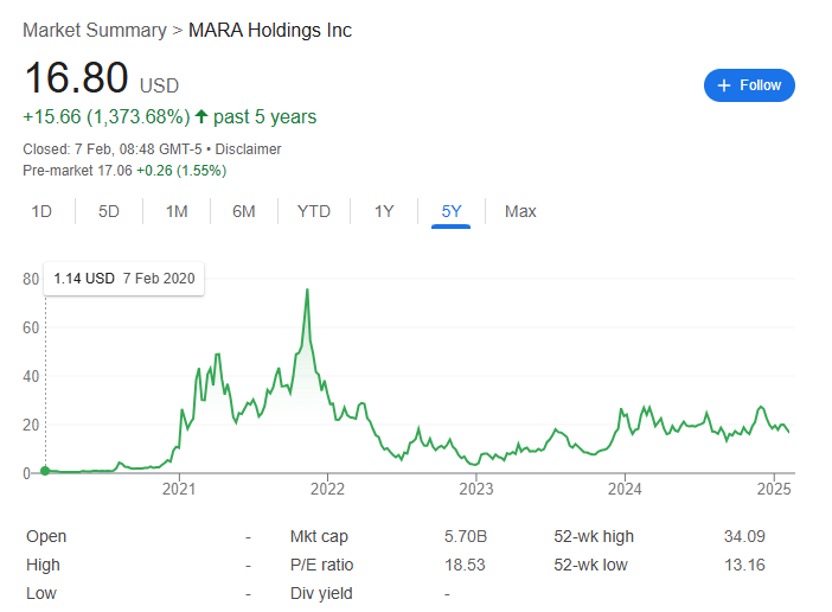
The free market, the ultimate decentralized network, is giving its opinion here. BTC miners are struggling, and it will only get worse.
Lightning Network is not the answer
BTC maximalists paint Satoshi Nakamoto as a once-in-a-generation genius, but they also claim he was wrong to release Bitcoin as set in stone.
Fixated on their interpretation of decentralization, they have created complexity out of simplicity and have destroyed the economics of Bitcoin. Solutions like the Lightning Network are complicated and unsecure. Worse still, they reintroduced the third-party middleman Bitcoin eliminated. Since opening and closing lightning channels is already more expensive than most across the globe can afford, transacting on this network will require using trusted third-party custodial funds, which will entail a fee.
Small blocks require the price of BTC to at least double with every halving forever to compensate miners for the 50% reduction in coins in the block reward. They also require users who wish to transact to pay ever-higher fees, and they centralize control of the network into the hands of fewer and fewer miners (nodes) as less efficient players drop out with each halving.
The big block alternative
The alternative is big blocks, as Satoshi intended. The version of the Bitcoin protocol with unbounded blocks (BSV) offers miners an alternative to the small-block dilemma.
Since BSV can now process 1 million transactions per second (TPS) for fees of $0.000001, thanks to Teranode, anyone can transact on it without using custodial channels controlled by the already wealthy Bitcoin holders who fund Lightning Network channels. Since the fees are so tiny, microtransactions and nanotransactions are possible, leading to many innovative and useful applications. For example, check out how Sentinel Node is revolutionizing cybersecurity with the BSV blockchain.
Big blocks also avoid the economic trap of ever-smaller miner revenue we’re seeing on the BTC network today. If Bitcoin is used as electronic cash, there’s no HODL mentality, so there’s a constant flow of transactions for miners to process and earn fees. Ever-increasing numbers of transactions can make up for the reduced block subsidy after every halving, and an abundance of apps utilizing micropayments, which could not exist before BSV restored the original protocol, can ensure the number of transactions is continually growing.
There was never a need for third-party solutions like the Lightning Network to play the middleman in Bitcoin transactions. That was the empire striking back as Mastercard (NASDAQ: MA) and others who stood to lose stepped in with bags of cash to reinsert themselves into the equation.
However, as the BTC mempool sits virtually empty and miners struggle to generate enough revenue to survive, the battle they won is turning into the war they were always destined to lose. BTC can not double after every halving forever, and so BTC transaction fees must increase to compensate, making it even less useful than it is today. Of course, they could always increase the coin supply, laying to waste the scarcity meme, but that will cause the network’s demise.
In the long run, BTC is doomed, and the original Bitcoin protocol is just getting started on BSV. The next few decades will be fun to watch as real Bitcoin takes its rightful place and devours the world. Economic reality is unavoidable and finally catching up with those who failed to acknowledge it from the outset.


