


Ethereum has entered one of its most difficult phases of the year, sliding to the $2,700 zone after another round of heavy selling.
Key Takeaways:
Ethereum’s drop to the $2,700 range accelerated after more than $413 million in long liquidations.
ETF outflows hit $261.6 million on Nov 20, adding strong sell pressure from institutions.
Weak on-chain activity and rising ETH supply continue to weigh on price sentiment.
The move wasn’t gradual — over $413.9 million in leveraged ETH positions were liquidated in just one day, and longs absorbed $381 million of that hit, meaning bulls were forced out of the market while price collapsed. The cascade selling amplified downward momentum and erased any intraday recovery attempt.
Technical Indicators Signal No Immediate Relief
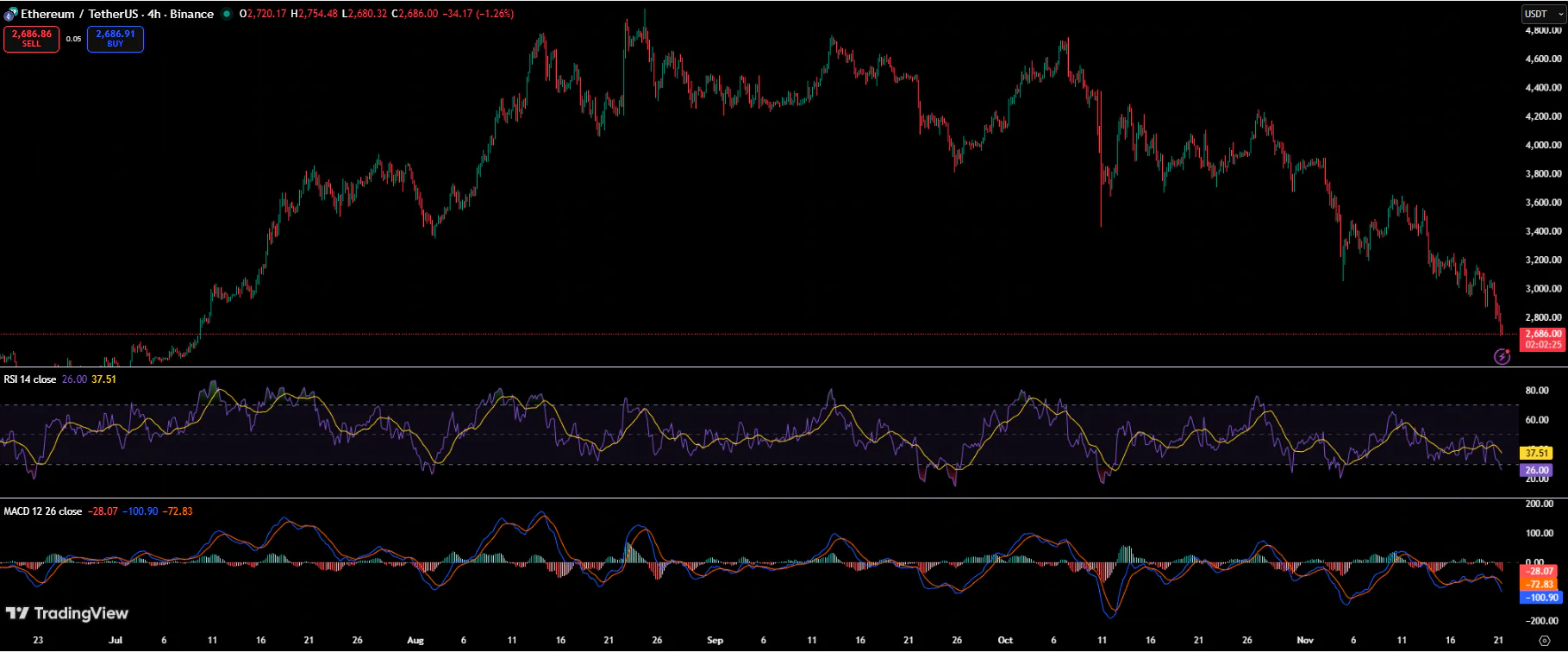
The latest 4-hour chart paints a worrying picture. The RSI sits near 26, indicating deep oversold conditions yet not flashing a proper bottom structure. The MACD histogram continues to expand to the downside, while the signal lines remain widely separated — clear signs that bearish momentum is still dominating.
Every bounce over the past two weeks has failed to break declining resistance, and the structure of lower highs remains intact.
ETF Market Turns Against Ethereum
Institutional flows added fuel to the decline. On November 20, Ethereum ETFs recorded $261.6 million in net outflows, marking one of the heaviest red days of the month. The Grayscale Ethereum Trust once again led withdrawals, followed by Bitwise and BlackRock products. This reinforces a theme that institutions are still reducing exposure rather than averaging down.
On-Chain Weakness Now at the Center of the Narrative
For months, analysts have hinted that Ethereum’s biggest risk wasn’t competition — it was stagnation. Transaction fees are lower, yet activity has not returned to Ethereum’s main chain. Core revenue drivers like DeFi participation, NFT trading, and on-chain speculation never recovered to previous bull-market levels. Even the shift toward Layer-2 networks failed to translate into stronger mainnet usage, leaving the blockchain quieter and less profitable.
Deflation Promise Stalls as Supply Continues to Grow
The burn mechanism was once expected to make ETH steadily deflationary, but with weak network usage, burning has not kept pace with issuance. Over the past three years, more ETH has been created than destroyed, making the asset net inflationary at a time when demand is already limited. An expanding supply during a period of low activity is one of the worst-case combinations for valuation — and price action now reflects that.
What Ethereum Needs for a Real Recovery
According to analysts, the path forward is still open but requires meaningful adoption, not sentiment-driven speculation. Two triggers have the potential to shift momentum:
• Regulatory clarity in the United States that allows institutional DeFi participation
• A new wave of Web3 adoption capable of restoring high usage and fee revenue
According to 10x Research, the price issue is not simply the result of leverage washouts or ETF pressure — it’s the consequence of a network that is no longer generating the economic activity needed to sustain ETH’s valuation. Their analysts emphasize that Ethereum’s weakness is structural, not emotional: without demand for blockspace, without high-value DeFi flows, and without sustainable on-chain fees, price appreciation becomes speculation rather than a reflection of productivity.
On Ethereum:
Since the summer of 2024, DeFi activity has been extremely muted, resulting in very limited fee generation on the Ethereum network.Part of this is due to Layer-2 migration and network upgrades, but the more important point is that activity simply hasn’t recovered.… pic.twitter.com/xJKbmKrLS6
— 10x Research (@10x_Research) November 21, 2025
10x Research believes that relief rallies may appear in the short term, but lasting upside requires real usage returning to the chain. In their view, Ethereum’s next sustainable bull phase will only begin if the network reclaims its role as the central economic hub of Web3 — either through institutional DeFi or a large-scale revival of decentralized applications.
Until one of those catalysts materializes, markets may continue to treat ETH as a high-beta risk asset rather than a productive and revenue-generating network.


