


What is Virtual ?
Virtuals Protocol, often referred to by its token VIRTUAL, is a decentralized infrastructure protocol. It aims to revolutionize how artificial intelligence (AI) interacts with blockchain technology.
Specifically, it enables AI agents to operate autonomously within blockchain networks. These AI agents can own assets, execute transactions, provide services, and even learn from their on-chain interactions—all without direct human intervention.
The main objective of Virtuals Protocol is to create an ecosystem where AI agents can not only exist but thrive, generating value and actively participating in the decentralized economy. The protocol provides the necessary framework for the deployment, management, and monetization of these AI entities, emphasizing co-ownership and tokenization of these agents.
This opens unprecedented possibilities for applications in various fields such as gaming, entertainment, decentralized finance (DeFi), and decentralized autonomous organizations (DAOs). In essence, Virtual seeks to be the foundation upon which future decentralized and autonomous AI applications will be built.

The History of Virtuals Protocol
The history of Virtuals Protocol is intrinsically linked to the emergence and convergence of two major technological domains : artificial intelligence and blockchain. Although precise details about its genesis and initial founders are sometimes diffuse, as is often the case in the decentralized universe, the protocol emerged in response to a growing need to more deeply integrate AI capabilities within blockchain networks.
The fundamental idea was to move beyond simply using blockchain as an immutable database. The goal is to explore its potential as an execution environment for intelligent and autonomous agents.
The development of Virtuals Protocol accelerated with the realization that AI agents could play a significant role in managing digital assets, automating complex tasks within DAOs, or creating innovative user experiences in the metaverse and video games.
The Early Versions of VIRTUAL
The early versions of the protocol focused on establishing a robust infrastructure. This enabled the creation, deployment, and management of these AI agents. An important milestone was the introduction of the concept of co-ownership of AI agents, materialized through tokenization. This not only helped fund the development of these agents but also aligned the interests of creators, users, and investors.
Over time, the protocol evolved, integrating new features such as the GAME (Generative Autonomous Multimodal Entities) framework, which offers more sophisticated tools to equip AI agents with planning and learning capabilities.
The community around Virtuals Protocol has also played a crucial role in its development, contributing to identifying relevant use cases and continuously improving the protocol. Notable projects, such as the AI influencer Luna or the market intelligence platform aixbt, have demonstrated the concrete potential of Virtuals Protocol.

The launch of the VIRTUAL token marked a key milestone, providing a governance mechanism and a means of value exchange within the ecosystem. The history of Virtuals Protocol is therefore one of continuous innovation, seeking to push the boundaries of what is possible at the intersection of AI and blockchain.
Who Created Virtuals Protocol ?
Identifying a single “creator” for Virtuals Protocol is complex, as it is often a collaborative effort, typical of decentralized projects. However, several key figures emerge from publicly available information.
Jansen Teng is frequently cited as the Co-founder and CEO of Virtuals Protocol. His experience, particularly as a former BCG consultant, is highlighted as an asset for the strategic direction of the project.

Another recurring name is that of Wee Kee (sometimes mentioned under the pseudonym ‘everythingempty’), also designated as a Co-founder. Interviews and articles highlight his involvement in the vision and development of the protocol, emphasizing continuous exploration in the field of AI.
Other personalities such as Prakash Somosundram, co-founder of Enjinstarter, and Bernard Leong, CEO and co-founder of Dorje AI, are listed as part of the ecosystem or having advisory roles, indicating a network of expertise supporting the project.
It’s important to note that the very nature of Web3 projects favors a community-based and evolutionary approach, where the contribution of numerous developers, researchers, and community members shapes the protocol beyond its initiators. The project is the result of a broader ecosystem.
What is the Virtual Crypto Used For ?
The Virtual (VIRTUAL) cryptocurrency is the cornerstone of the Virtuals Protocol ecosystem. It fulfills several essential functions that facilitate the operations of AI agents and the governance of the protocol. Understanding its utility is crucial to grasp the value proposition of the entire project.
AI Agents
First, the VIRTUAL token is used for the creation and deployment of AI agents. To launch a new AI agent on the protocol, a certain amount of tokens VIRTUAL is typically required. This mechanism serves as a barrier to entry to ensure a certain seriousness of projects, but also as a means to prime the value of the newly created agent. Often, these new agent tokens are then paired with VIRTUAL in liquidity pools, creating an economic interdependence.
A Governance Token
Second, VIRTUAL functions as a governance token. Holders of VIRTUAL tokens have the opportunity to participate in important decisions regarding the evolution of the protocol. This can include votes on technical updates, modifications to protocol parameters, or allocation of funds from the ecosystem treasury. This decentralized approach to governance aims to align community interests with the long-term development of the project.
Buy the VIRTUAL token now
A Payment Method
Third, the VIRTUAL token serves as a payment method for services provided by AI agents. Users who wish to interact with specific AI agents or benefit from their capabilities (data analysis, content creation, automated task execution, etc.) may need to pay for these services in VIRTUAL tokens. These payments are then transferred to the AI agent’s wallet, thus contributing to its own economy and the remuneration of its creators or co-owners.
A Liquidity Provider
Finally, VIRTUAL plays a key role in providing liquidity within the ecosystem. As mentioned earlier, AI agent tokens are often associated with VIRTUAL in liquidity pools on decentralized exchanges (DEX). This ensures a certain fluidity for buying and selling agent tokens, and VIRTUAL acts as the main base pair for these exchanges. Liquidity providers can also be rewarded for their contribution, thus strengthening the stability and attractiveness of the ecosystem.
In summary, the crypto Virtual is not simply a speculative asset. It is an indispensable multifunctional tool for the proper functioning, growth, and decentralized governance of Virtuals Protocol and its AI agent economy.
Which Blockchain Does Virtuals Protocol Run On ?
Virtuals Protocol has chosen to rely on robust and scalable blockchain foundations to support its ambitious vision of a decentralized AI agent economy. It is built on Base, an Ethereum Layer 2 network, and this choice is not coincidental. As a layer 2 scaling solution for Ethereum, Base (developed by Coinbase) offers several significant advantages for a project like Virtuals Protocol.
First, it allows to benefit from the security and decentralization of the main Ethereum network while offering much faster and less costly transactions. This is crucial for AI agent operations, which may require numerous on-chain interactions with low latency and controlled cost. An AI agent performing micro-transactions or frequent state updates would greatly benefit from the efficiency of a L2.
Second, by being built on the Ethereum ecosystem, Virtuals Protocol benefits from compatibility with the Ethereum Virtual Machine (EVM). This facilitates integration with a multitude of existing tools, wallets, smart contracts, and other decentralized applications (dApps) in the Ethereum ecosystem. This interoperability is essential for Virtuals Protocol‘s AI agents to interact seamlessly with other protocols and digital assets.
While Base is the main blockchain mentioned, it’s important to note that the architecture of Web3 protocols may sometimes involve interactions with multiple chains or future evolutions to other networks for specific reasons (e.g., cost optimization for certain features, access to specific ecosystems).
Advantages and Disadvantages of Virtuals Protocol
Like any crypto project, Virtuals Protocol and its VIRTUAL token present a set of potential advantages that attract users and investors, but also disadvantages or challenges that are important to consider.
Advantages of Virtual
Innovation at the Intersection of AI and Blockchain : One of the main strengths of Virtuals Protocol is its unique positioning at the frontier of two of the most dynamic technological sectors. By enabling the creation of autonomous and tokenized AI agents on the blockchain, the protocol opens the way for entirely new applications and use cases, ranging from intelligent video games to decentralized financial assistants and virtual influencers.
Co-ownership and Monetization of AI Agents : The Virtuals Protocol model allows for co-ownership of AI agents via tokenization. This means that creators, developers, and even users can own a stake in an AI agent and potentially share in the revenue it generates.
Autonomy and Transparency of AI Agents : Thanks to blockchain, AI agents operating on Virtuals Protocol can function autonomously and transparently. Their actions, transactions, and even decision-making processes (to a certain extent, depending on their design) can be verified on-chain. This enhances trust and predictability compared to centralized and opaque AI systems.
Use of a Layer 2 (Base) : By relying on Base, an Ethereum Layer 2, Virtuals Protocol benefits from faster transactions and considerably reduced fees compared to the Ethereum mainnet. This scalability is crucial for the frequent and sometimes low-value operations of AI agents, making the ecosystem more viable and accessible.
Growing Ecosystem and Active Community : Although relatively young, Virtuals Protocol shows signs of a developing ecosystem with concrete projects (such as Luna or aixbt) and an engaged community. A dynamic ecosystem is often an indicator of the health and long-term potential of a crypto project.
Disadvantages and Challenges of Virtual
Technological Complexity : The integration of AI and blockchain is a complex and still largely experimental field. Developing and maintaining robust, secure, and truly autonomous AI agents on a decentralized infrastructure represents significant technical challenges.
Adoption and Mainstream Use Cases : Although the potential is enormous, the mass adoption of Virtuals Protocol and its AI agents will depend on the creation of compelling and accessible use cases for the general public. For now, much of the interest may come from a niche of tech-savvy users and investors.
Volatility of the VIRTUAL Token : Like most cryptocurrencies, and particularly those associated with innovative but still young projects, the VIRTUAL token is likely to exhibit high volatility in price. Investments in VIRTUAL therefore carry significant financial risk.
Regulatory Uncertainties : The regulatory framework surrounding both cryptocurrencies and artificial intelligence is still evolving in many jurisdictions. Regulatory changes could impact the development, use, and legality of protocols like Virtuals Protocol.
Competition : The field of decentralized AI (DeAI) is beginning to attract numerous players. Virtuals Protocol faces potential competition from other projects seeking to integrate AI and blockchain, each with different approaches and technologies.
In conclusion, Virtuals Protocol offers a fascinating value proposition with notable advantages in terms of innovation and new economic models. However, potential investors and users must also be aware of the technical challenges, market risks, and uncertainties that accompany this type of pioneering project.
Virtual Price and Predictions
The price of the Virtual (VIRTUAL) token, like most cryptocurrencies, is subject to significant volatility. It is influenced by a multitude of factors such as the general sentiment in the crypto market, news specific to the Virtuals Protocol project, technological advances, adoption of its services, and macroeconomic conditions.
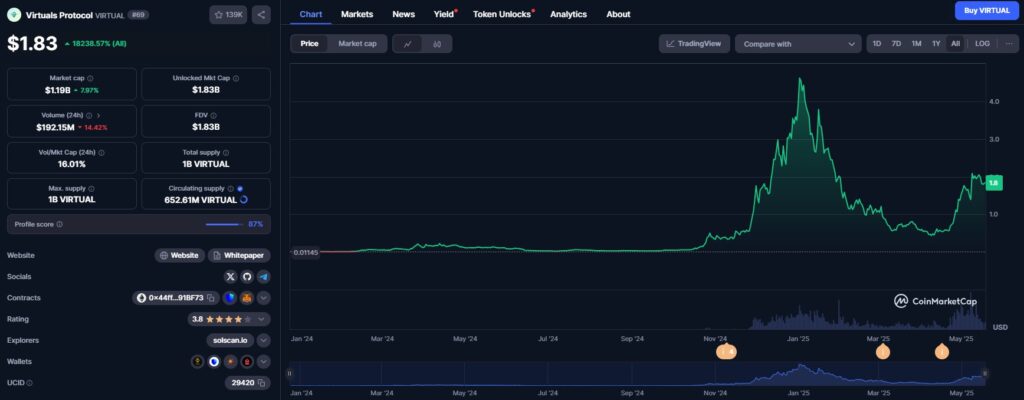
As of May 2025, the price of VIRTUAL is around $2, with a market capitalization of approximately $1.29 billion USD and a maximum supply of 1 billion.
Regarding price predictions for VIRTUAL, it is crucial to emphasize that these are speculative in nature and should not be considered as investment advice under any circumstances.
Several sources indicate growth prospects for VIRTUAL in 2025 and beyond. For example, some predictions for the end of 2025 suggest that the price of VIRTUAL could reach levels ranging from $0.69 (according to a Changell forecast) to levels exceeding $3, $4 (99bitcoins), and even $6.63 by June 2025 according to the most optimistic.
The future price of VIRTUAL will largely depend on the ability of the Virtuals Protocol project to achieve its objectives, develop its ecosystem, attract users and developers, and navigate an ever-evolving technological and regulatory environment.
Potential investors must absolutely do their own research (DYOR – Do Your Own Research), consider the inherent risks of investing in cryptocurrencies, and never invest more than they can afford to lose.
Invest in Virtuals Protocol !
Key Moments in the History of Virtuals Protocol
The history of Virtuals Protocol (VIRTUAL), although relatively recent, is already marked by several significant stages and events that have shaped its development and market perception. Understanding these key moments provides better insight into the project’s trajectory.
Project Foundation (October 2021)
One of the first milestones often mentioned is the founding of the project. It is sometimes dated around October 2021, as indicated by some sources (for example, an article on Medium).
Evolution into an AI Launchpad on Base (October 2024)
There are also reports of an introduction as an AI-focused launchpad in October 2024 on the Base Layer 2 network. This could correspond to a more public launch phase or a major evolution of the project, potentially after an initial development period or under another name. Messari mentions that Virtuals Protocol was formerly known as Path DAO.
New Price Record (January 2025)
The beginning of 2025 marked a prosperous period for Virtuals Protocol. In January 2025, the VIRTUAL token reached a record price (ATH) of approximately $5.15 USD. This performance coincided with growing enthusiasm for the AI agent sector and decentralized AI, a narrative driving the cryptocurrency market during this period.
Genesis Launchpad Update (May 2025)
More recently, in May 2025, Virtuals Protocol carried out an update of its Genesis launchpad. This update introduced important features, notably transparency on token vesting and staked agent points. According to Messari and other market observers, this announcement was followed by a notable increase in the price of the VIRTUAL token, illustrating the market’s sensitivity to concrete developments of the protocol.
Beyond these specific milestones, the history of Virtuals Protocol is also punctuated by various announcements of partnerships, technical integrations, and launches of new AI agents on its platform. These events, although sometimes less publicized than price movements, contribute essentially to building the ecosystem and demonstrating the viability of its technology.
The evolution of Virtuals Protocol is therefore worth following closely, as the project continues to develop in a sector in full effervescence. Future important moments will likely include the launch of new features, expansion of its community, and reaching new adoption milestones for its AI agents.
How and Where to Buy VIRTUAL ?
Acquiring VIRTUAL tokens is an essential step for those looking to invest in the project, participate in its governance, or use the applications of its ecosystem. Due to its recent explosion, the token is available on some centralized exchange platforms (CEX), but not all.
It’s important to distinguish between specialized exchange platforms (like those mentioned above) where you actually buy and hold cryptocurrencies, and brokers that sometimes offer derivative products like CFDs (Contracts For Difference) on cryptocurrencies. For direct ownership and total control of your assets, it’s preferable to use a specialized exchange platform.
How to Buy VIRTUAL on Bitget ? Mini Tutorial
Here’s how to buy Virtuals Protocol in 5 steps on the best platform in our ranking.
Create an account on Bitget :
Go to the official website
Click on “Sign Up”
Fill out the form with your email and password
Complete KYC verification :
Prepare a valid ID
Follow the instructions for verification
Deposit funds :
Fund your account on the platform. Via bank transfer, credit card, or other cryptocurrencies for example.
Buy VIRTUAL :
Navigate to “Spot Trading”
Search for the VIRTUAL/USDT or VIRTUAL/EUR pair
Place a buy order specifying the amount of VIRTUAL you wish to acquire or the amount you want to spend.
You can generally choose between a market order (buying at the current price) or a limit order (buying at a specific price you set).
Secure your VIRTUAL :
After purchase, it is strongly recommended to transfer your VIRTUAL tokens from the exchange platform to a secure personal wallet (see next section) to have total control over them.
Buy the Virtuals Protocol (VIRTUAL) token on Bitget !
Choose a platform that meets your needs in terms of fees, security, ease of use, and regulatory compliance in your jurisdiction.
How to Store Your VIRTUAL ?
Once you have acquired VIRTUAL tokens, the question of their secure storage becomes paramount. Leaving your cryptocurrencies on an exchange platform (CEX) carries significant risks : you don’t directly control your private keys, and your funds could be lost in case of platform hacking, regulatory issues, or company bankruptcy.
Using a Personal Wallet
This is why it is strongly recommended to transfer your VIRTUAL to a personal wallet (wallet) for which you alone hold the private keys. “Not your keys, not your coins” is a fundamental adage in the ecosystem.
There are mainly two types of wallets for storing your VIRTUAL :
Cold Wallets (Hardware Wallets) : These are hardware devices that store your private keys offline, thus offering the highest level of security against online hacking. They often resemble secure USB keys. Recognized brands like Ledger (for example, Ledger Nano S Plus or Ledger Nano X) are the safest solutions for storing significant amounts or for long-term storage.
Hot Wallets (Software Wallets) : These are software (mobile or desktop applications, browser extensions) that store your private keys on a device connected to the Internet. They are more convenient for frequent use and for interacting with decentralized applications (dApps), but are inherently more vulnerable to malware and phishing than cold wallets. Popular wallets like MetaMask or Trust Wallet can be configured to manage VIRTUAL tokens.
Store your VIRTUAL tokens via Ledger !
The choice between a cold wallet and a hot wallet depends on your specific needs : prioritize a cold wallet (like Ledger) for maximum security of your main investments, and possibly use a hot wallet (like MetaMask or Trust Wallet) for smaller amounts intended for regular interactions with the Core DeFi ecosystem. The essential thing is to always carefully secure your recovery phrase (seed phrase) and never share it or store it digitally.
How to Get Virtual for Free ?
Obtaining Virtual (VIRTUAL) tokens for free typically involves active participation in the Virtuals Protocol ecosystem, such as interacting with the protocol, participating in community programs, or contests.
Potential airdrops may reward early or active users, often for interactions with the protocol or specific AI agents. Point systems like “Virgen Points” may also offer access to tokens.
It is crucial to remain vigilant against scams : never share your private keys and always verify information through official Virtuals Protocol channels. Participating in these opportunities requires time and sometimes transaction fees.
Is Virtual Legal ?
The legality of Virtuals Protocol (VIRTUAL) and cryptocurrencies related to decentralized AI is a complex question that varies greatly by country. Currently, VIRTUAL, like many cryptocurrencies, is subject to the regulations of each country on a case-by-case basis. Exchange platforms generally comply with these rules.
AI regulation is also evolving rapidly, with ethical and transparency concerns that could influence protocols like Virtuals. The decentralized nature of the project and the lack of a specific framework for tokenized AI agents add to the legal uncertainty.
It is therefore imperative for users and investors to research the laws of their country of residence, follow regulatory developments, and exercise due diligence. Although the technology itself is not illegal, its use is governed by a changing legal environment.
Who Holds the Most Virtual ?
Precisely identifying the largest holders of Virtual (VIRTUAL) tokens is difficult due to the relative pseudonymity of blockchains. However, on-chain analyses and specialized reports indicate a notable concentration of VIRTUAL among whales (large wallets). They would hold a majority share of the circulating supply, possibly more than 90%. This concentration among whales can influence governance, market volatility, and the perception of decentralization of the project. Investors monitor these distributions via blockchain explorers.
Furthermore, the Virtuals Protocol whitepaper describes an initial distribution of 1 billion VIRTUAL, with 60% for public distribution, 5% for liquidity, and 35% for the ecosystem treasury.
Our Opinion on Virtuals Protocol (VIRTUAL) in 2025
Virtuals Protocol presents itself as a bold and potentially transformative project at the intersection of AI and blockchain. Its ambition to create an economy of autonomous, co-owned, and monetizable AI agents on the Base network is relevant given the growing interest in decentralized AI.
The emerging use cases, such as AI influencers or market analysis tools, demonstrate tangible potential, although the path to mass adoption is still long and fraught with technical and regulatory challenges.
However, the strong concentration of VIRTUAL tokens in the hands of a few whales and the inherent volatility of the cryptocurrency market, especially for such innovative projects, call for caution. Success will depend on the ability to attract a solid community of developers and users, and to navigate a competitive and regulatory landscape that is still being structured.


