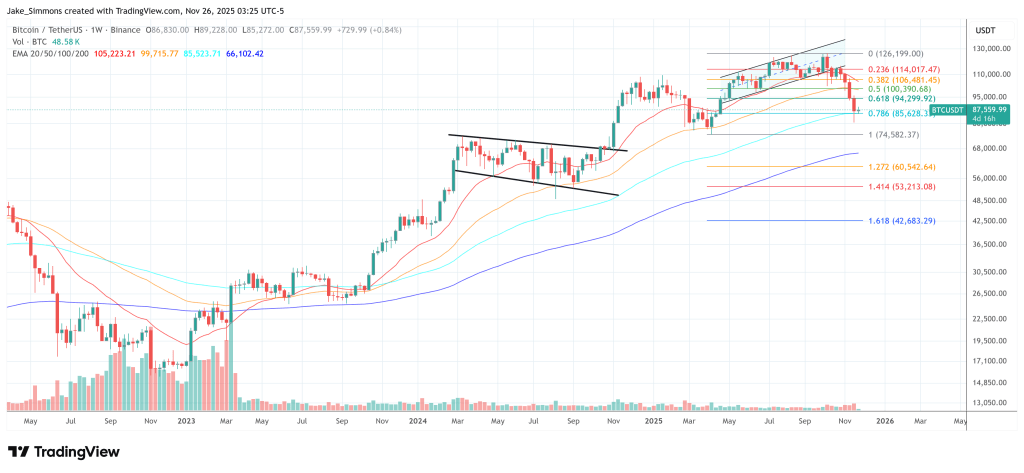
Bitcoin’s famous four-year halving rhythm is giving way to a shorter, ETF-driven performance clock, argues ProCap Chief Investment Officer (CIO) Jeff Park in a new Substack essay. In his view, the dominant force in Bitcoin’s boom-bust dynamics is shifting “from mining economics to fund-manager economics,” with a new “two-year cycle” anchored in ETF flows and institutional return hurdles.
Park starts by declaring that the traditional pattern built around halvings belongs to “the old Bitcoin.” Historically, programmed supply cuts compressed miner margins, pushed weaker operators out and reduced structural sell pressure. Combined with a powerful narrative, each halving triggered a reflexive loop of “early positioning, rising prices, media virality, retail FOMO and leveraged mania” that ended in a bust.
That mechanism, he argues, is now significantly diluted. With most of Bitcoin’s eventual supply already circulating, each halving shaves off a smaller fraction of the total float. The “diminishing marginal inflation impact” means the issuance shock is too small to reliably drive the next cycle on its own.
The ETF-Driven 2-Year Bitcoin Cycle Begins
Instead, Park contends that Bitcoin is increasingly governed by how professional allocators behave inside ETF wrappers. He openly labels his framework as resting on “three heavy-handed, contestable assumptions.”
First, most institutional investors are de facto evaluated over one- to two-year horizons because of how liquid fund investment committees operate. Second, new net liquidity into Bitcoin will be dominated by ETF channels, making them the main footprint to watch. Third, the selling behavior of legacy “OG whales” remains the largest supply variable, but is treated as exogenous to his ETF-centric analysis.
Within this lens, two concepts matter most: common-holder risk and calendar-year P&L. Park notes that when “everyone owns the same thing,” flows can amplify both rallies and drawdowns. But he focuses on something easier to observe: the way annual performance crystallizes on December 31. For hedge funds in particular, “when volatility increases towards the end of the year” and there isn’t enough P&L “baked in,” managers become more willing to sell their riskiest positions. The choice, he writes, is often “the difference between getting another shot to play in 2026, or getting fired.”
Park leans on Ahoniemi and Jylhä’s 2011 paper Flows, Price Pressure, and Hedge Fund Returns, highlighting its finding that a large share of hedge-fund “alpha” is flow-driven and that return–reversal cycles stretch “almost two years.” This, he says, offers a blueprint for how liquidity and performance feedbacks could structure Bitcoin’s ETF era.
He then sketches how a CIO might sell Bitcoin internally: as an asset expected to deliver something like a 25–30 percent compound annual return. On that basis, a position must generate roughly 50 percent over two years to justify its risk and fee drag. Park references Michael Saylor’s “30% CAGR for the next 20 years” as a rough institutional hurdle.
From there he builds a three-cohort thought experiment. Investors who bought via ETFs from inception through year-end 2024 are up around 100 percent in a single year, effectively having “pulled forward 2.6 years of performance.”
A second cohort that entered on 1 January 2025 is roughly 7 percent underwater, now needing “80%+ over the next year, or 50% over the next two years” to hit the same hurdle. A third group, holding from inception through the end of 2025, is up about 85 percent over two years—only slightly ahead of its 30 percent CAGR target. For that group, Park says, the live question becomes: “Do I sell and lock it now, or do I let it run longer?”
ETF flow data sharpen the picture. Park highlights that Bitcoin now trades near “an increasingly important price, $84k,” which he characterizes as roughly the aggregate cost basis of ETF flows to date. While 2024 inflows carry substantial embedded gains, “almost none of the ETF flows in 2025 are in the green,” with March as a partial exception.
October 2024, the largest inflow month, saw Bitcoin around $70,000; November 2024 closed near $96,000. On a 30 percent hurdle, Park estimates one-year targets of roughly $91,000 and $125,000 dollars for those vintages. June 2025 inflows near $107,000 imply a $140,000 target by June 2026.
He argues that Bitcoin ETF AUM is now at an “inflection point,” where a 10 percent price drop would drag total AUM back to roughly its level at the start of the year. That would leave the ETF complex with little to show, in dollar P&L, for 2025 despite taking on meaningful risk and inflows.
The key takeaway, Park writes, is that investors must track not only the average ETF cost basis, but also “the moving average of that P&L by vintage.” Those rolling profit profiles will, in his view, become the main “liquidity pressures and circuit breakers” for Bitcoin, eclipsing the old four-year halving template.
His second conclusion cuts against retail intuition: “If Bitcoin price doesn’t move, but time moves forward, this is ultimately bad for Bitcoin in the institutional era.” In a fee-and-benchmark world, flat is not neutral; it is underperformance versus the 30 percent ROI that justified the allocation. That alone can trigger selling.
“In summary,” Park concludes, “the 4-year cycle is definitely over.” Bitcoin will still be driven by marginal demand, marginal supply and profit-taking. But “the buyers have changed,” and with halving-driven supply shocks less decisive, it is the more “predictable” incentives of ETF managers—expressed over roughly two-year windows—that may now define Bitcoin’s market cycle.
At press time, Bitcoin traded at $87,559.