

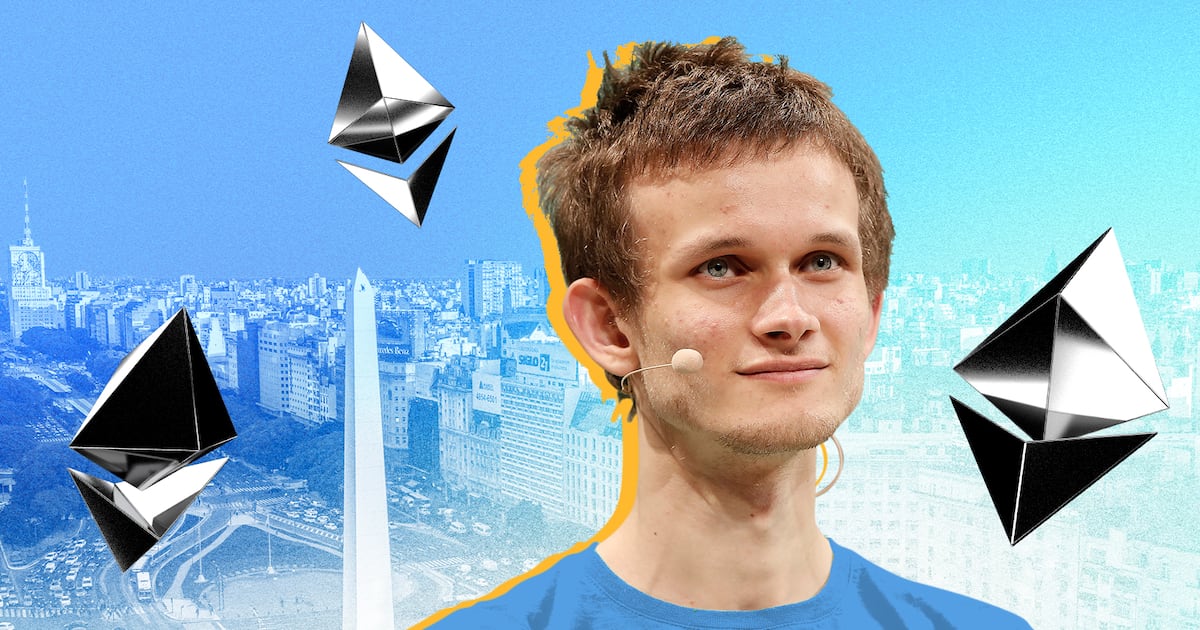
Just after breakfast at the sprawling La Rural exhibit hall in Buenos Aires on a November morning when Vitalik Buterin lumbered on stage, sporting a button-up shirt with a colourful baby hippopotamus print and sunglasses. He glossed over the crowd with curiosity, fidgeting slightly in his chair.
The crowd of nearly 500 crypto enthusiasts, most of whom were local Argentines, stared back at Buterin, in awe that their hero was in their city speaking about his creation: The 10-year-old blockchain network, Ethereum.
Ethereum, over its ten-year lifespan, has gone through herculean changes. From the DAO hack in 2016 that spawned Ethereum Classic to a comprehensive move to proof-of-stake mid-flight with no downtime, the network has had a knack for spotting necessary changes and implementing them.
Constant change is in the network’s very DNA.
Now, it’s 31-year-old Canadian-Russian creator wants to slow things down.
“More and more ossification over time is good for Ethereum,” Buterin said. “We have a much lower rate of surprises now.”
And what better time to announce a change of pace than the Ethereum community’s largest gathering in the world.
Welcome to Devconnect.
Over 16,000 true believers descended on Buenos Aires for a week of talks, workshops, and over 200 side events that sprawled across the city.
Conversations at Devconnect revolved around technical roadmaps, Layer-2 rollups, and — more than anything — privacy.
“Privacy is so hot right now because it finally works,” Masa, a six-year smart contract developer from openbands.xyz, told DL News between sessions.
Whether zero-knowledge proofs, private transactions, or encrypted messaging, privacy infrastructure dominated the agenda.
Conspicuously absent from Devconnect? Any mention of Ether’s price.
An especially notable fact given that during the time of the convention, Ether lost around 20% of its price in just a matter of days.
Ether, in fact, has been unable to pick up steam, barely topping its previous record of $4,850 once before tumbling.
It now trades at $2,900, a staggering 30% drop this month alone.
But speculation felt immaterial.
The only thing that seemed to matter was what got built.
Top of mind
At Devconnect, every one of Buterin’s talks mentioned ZK technology.
Zero-knowledge proofs — cryptographic methods that let users prove something is true without revealing the underlying data — have been in development since Ethereum’s first days.
He first wrote about them in 2016, envisioning a future in which Ethereum transactions could be both verifiable and private.
One decade later, that future has arrived.
Projects like Aztec and Railgun now offer private transactions on the network, shielding wallet balances and transaction amounts from public view. Other teams are building encrypted messaging protocols that run entirely on-chain, replacing the transparent-by-default nature of smart contracts.
The shift is fundamental.
Ethereum’s transparency was always a bug disguised as a feature — useful for auditability, but a nightmare for anyone who didn’t want their financial life readable by anyone with a block explorer.
The demigod
Walking through La Rural, a vast 45,000m2 fairgrounds with multiple halls typically used for livestock shows, you could hear attendees chattering about when Vitalik would speak and where.
His presence at Devconnect carried an almost religious quality.
That’s because for many in the crowd — particularly the Argentinians who made up a significant portion of attendees — Buterin isn’t just a tech founder.
He’s the architect of a system that offered an alternative to their country’s failed monetary institutions, a moribund peso, and the inability for local citizens to access secure and long-lasting financial instruments.
“If you’re not here, do you even believe in Ethereum?” one attendee, a young 25-year Argentine developer, asked DL News.
When attendees emerged from a room where he had just spoken, their faces were flush with a giddy smile. Still others would loiter, hoping to catch a closer glimpse – perhaps even a picture – with Buterin himself.
Crypto’s role model
Choosing Buenos Aires as Devconnect’s host city wasn’t arbitrary.
For years, Argentina has become crypto’s obvious role model. It’s a country where hyperinflation, currency controls, and economic instability have, at times, brought the country to its knees.
For instance, in 2001, the government froze bank accounts in a desperate attempt to stop capital flight — a measure known as the “corralito” or little fence. From one day to another, millions of Argentinians couldn’t withdraw their own savings. The peso, pegged to the dollar, collapsed. Middle-class families lost their life savings overnight. The crisis scarred a generation and created deep distrust of traditional banks that persists today.
That’s created the perfect conditions for grass-roots, broad-based cryptocurrency adoption.
Unlike the rest of the world, locals don’t use crypto for speculation. They use it for survival. Stablecoins like USDT offer protection against the peso’s collapse.
Peer-to-peer networks enable cross-border payments. DeFi protocols provide access to dollar-denominated savings accounts that Argentine banks can’t freeze or seize.
Bitcoin, a staple of many Argentine asado conversations, is a household name discussed by people from the elderly to schoolchildren.
Crypto is rampant here — not necessarily for good reason.
Still, some say Argentina should be at the centre of the crypto industry.
“Argentina is crypto’s role model,” a Devconnect volunteer told DL News.


