

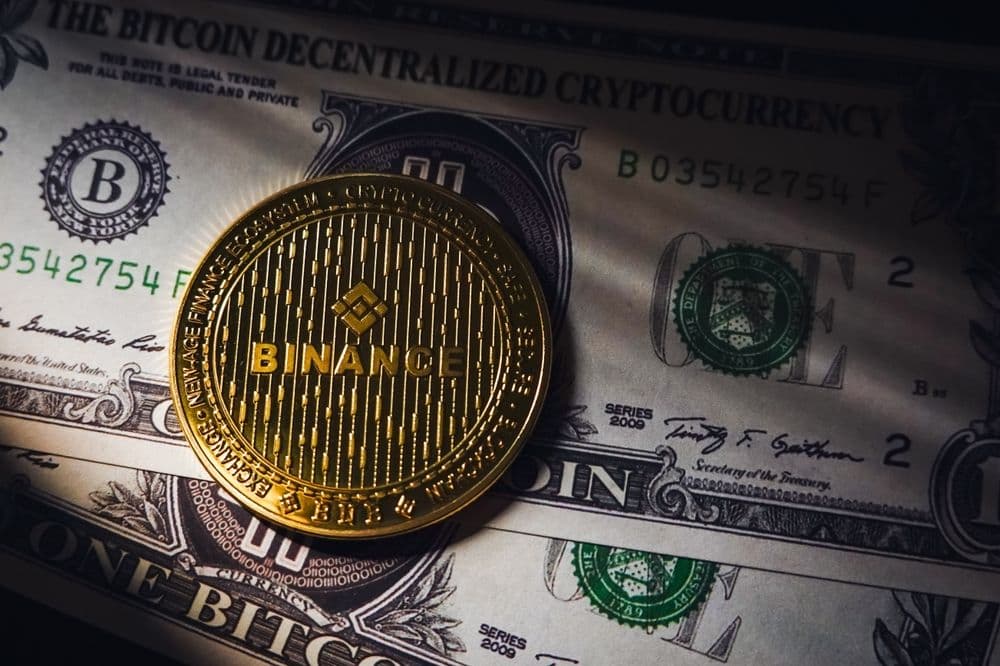
BNB price has stabilized below $900 despite a sharp deterioration in on-chain activity that saw daily transactions collapse by nearly 50% since October's peak.
The disconnect between price resilience and weakening network fundamentals reflects tension between near-term usage decline and longer-term institutional catalysts including VanEck's recent exchange-traded fund filing and BNB Chain's ambitious 2025-2026 upgrade roadmap.
According to BscScan data, daily transactions on BNB Chain dropped to approximately 15.1 million in late November from a peak of 31.3 million on October 8, when BNB traded near $1,334. Network utilization plunged from 51% to 19% over the same period, confirming reduced demand across the ecosystem. Trading at $893.70 as of November 27 according to CoinMarketCap, BNB has gained 4.38% over the past 24 hours while maintaining a $123 billion market capitalization.
The price stability comes despite dramatic declines in decentralized finance activity. DEX trading volume on BNB Chain fell from $6.31 billion on October 8 to approximately $1.29 billion in late November - a $5.02 billion contraction that AMBCrypto reports signals traders rotating capital to competing blockchains. Stablecoin supply on BNB Chain dropped to $13.27 billion, down roughly $98 million from its November 18 peak.
What Happened
BNB Chain's activity slowdown coincides with broader cryptocurrency market weakness that saw Bitcoin briefly drop below $82,000 in November. The network's transaction peak on October 8 aligned with frenzied memecoin trading that temporarily attracted over 100,000 new traders and pushed BNB to an all-time high of $1,370. However, forced liquidations triggered by subsequent volatility flushed participants from the market, causing sustained activity decline.
Despite weakening fundamentals, BNB received institutional validation through VanEck's November 25 filing with the Securities and Exchange Commission for a spot BNB ETF. The proposed VBNB fund would list on Nasdaq and hold physical BNB tokens directly, offering traditional investors regulated access to the fifth-largest cryptocurrency by market capitalization. The amended S-1 registration marks the second update to VanEck's original May filing, suggesting active regulatory dialogue.
However, VanEck's latest amendment removes previously mentioned staking rewards, with the firm stating unequivocally that the trust "will not employ its BNB in Staking Activities." The decision reflects regulatory caution around whether staking-based tokens could be classified as securities - a concern heightened by ongoing SEC scrutiny of Binance. VanEck acknowledged that BNB "may currently be or may later be deemed a security" by regulators, creating potential dissolution risk if classification occurs.
The BNB Foundation completed its 33rd quarterly token burn on October 27, destroying 1.44 million BNB worth approximately $1.2 billion - the largest quarterly burn in dollar terms to date. The auto-burn mechanism reduced total supply to 137.74 million BNB, advancing toward the long-term target of 100 million tokens. BNB Foundation data shows the average price of burned tokens was $838.07 during the quarter.
The burn temporarily boosted BNB price above $1,160 before subsequent market weakness pulled it below $900. An additional 1.24 million tokens worth $1.41 billion are scheduled for destruction in the fourth quarter, continuing the deflationary supply pressure. However, lower on-chain activity may weaken the pace of future burns, which adjust quarterly based on network block production and token price.
Also read: Nano Labs Launches NBNB Program to Build Real-World Asset Infrastructure on BNB Chain
Why It Matters
The divergence between declining network usage and stable price action highlights competing forces shaping BNB's trajectory. Near-term fundamentals have clearly deteriorated, with transaction volumes, DEX activity, network utilization and stablecoin supply all pointing to capital rotation away from the BNB ecosystem. These metrics typically correlate with price direction, making the current stability unusual.
However, several longer-term catalysts could support BNB valuation independent of current network activity. VanEck's ETF filing represents potential institutional demand that would flow through traditional brokerage accounts rather than requiring direct blockchain interaction. If approved, VBNB would join recently launched spot ETFs for Bitcoin, Ethereum, Solana, XRP and Dogecoin in providing regulated cryptocurrency exposure to mainstream investors.
BNB Chain's technical roadmap focuses on performance upgrades aimed at supporting institutional-grade decentralized finance and artificial intelligence applications. Network improvements including the Maxwell hard fork reduced block intervals to 0.75 seconds, while future upgrades promise to make the chain 20 times more powerful through Rust-based clients, super instructions and StateDB enhancements. The blockchain's state has grown over 30 times faster than Ethereum, reaching 3.43 terabytes by May 2025.
The token's deflationary mechanics create predictable supply reduction regardless of network activity levels. Since launching its auto-burn program in 2019, BNB has destroyed over 64 million tokens representing 31.8% of historical supply. Combined with BEP-95's real-time gas fee burning, which has eliminated over 276,000 additional tokens, the dual mechanism establishes scarcity dynamics similar to Bitcoin's halving principle but with greater flexibility.
Nevertheless, challenges remain substantial. The 50% transaction decline signals genuine loss of interest rather than temporary volatility. Network utilization dropping to 19% from 51% indicates the infrastructure is significantly underutilized relative to capacity. Capital flight to competing blockchains like Ethereum, Solana and emerging Layer-1 platforms suggests BNB faces intensifying competition for developer mindshare and user adoption.
Final Thoughts
BNB's current consolidation below $900 reflects a market attempting to balance deteriorating on-chain fundamentals against potential institutional catalysts and supply-side support. The 50% transaction collapse and $5 billion DEX volume decline demonstrate real weakness in ecosystem engagement, raising questions about whether recent price levels are sustainable without activity recovery.
The VanEck ETF filing provides a potential bullish catalyst, though approval remains uncertain given regulatory concerns around BNB's classification and ongoing SEC litigation against Binance. The firm's decision to exclude staking rewards acknowledges these risks, potentially limiting the ETF's appeal relative to competitors offering yield-bearing exposure. SEC review timelines remain unclear, with approval potentially taking months or facing rejection.
Token burns continue providing deflationary pressure, though their impact depends on sustained price levels. If network activity remains depressed, future quarterly burns will destroy fewer tokens in absolute terms based on the auto-burn formula's calculation methodology. The mechanism's effectiveness as a price support requires either activity recovery or stable valuations to maximize supply reduction.
BNB Chain's technical upgrade roadmap addresses scalability and performance issues that could reignite developer interest. However, execution risk remains high, and competing blockchains are simultaneously improving their infrastructure. The broader cryptocurrency market environment also matters significantly - if Bitcoin continues struggling near $80,000 and risk appetite stays suppressed, even strong fundamentals may prove insufficient to drive BNB higher.
Market participants are closely watching whether the current $850-$900 consolidation range represents accumulation by sophisticated investors anticipating institutional flows, or distribution by holders recognizing fundamental deterioration. The next six to twelve months will prove critical in determining whether BNB can reverse its activity decline or whether the ecosystem faces prolonged stagnation despite supply-side tailwinds.
Read next: VanEck Files Second Amendment For BNB ETF Seeking Nasdaq Listing Under VBNB Ticker


