

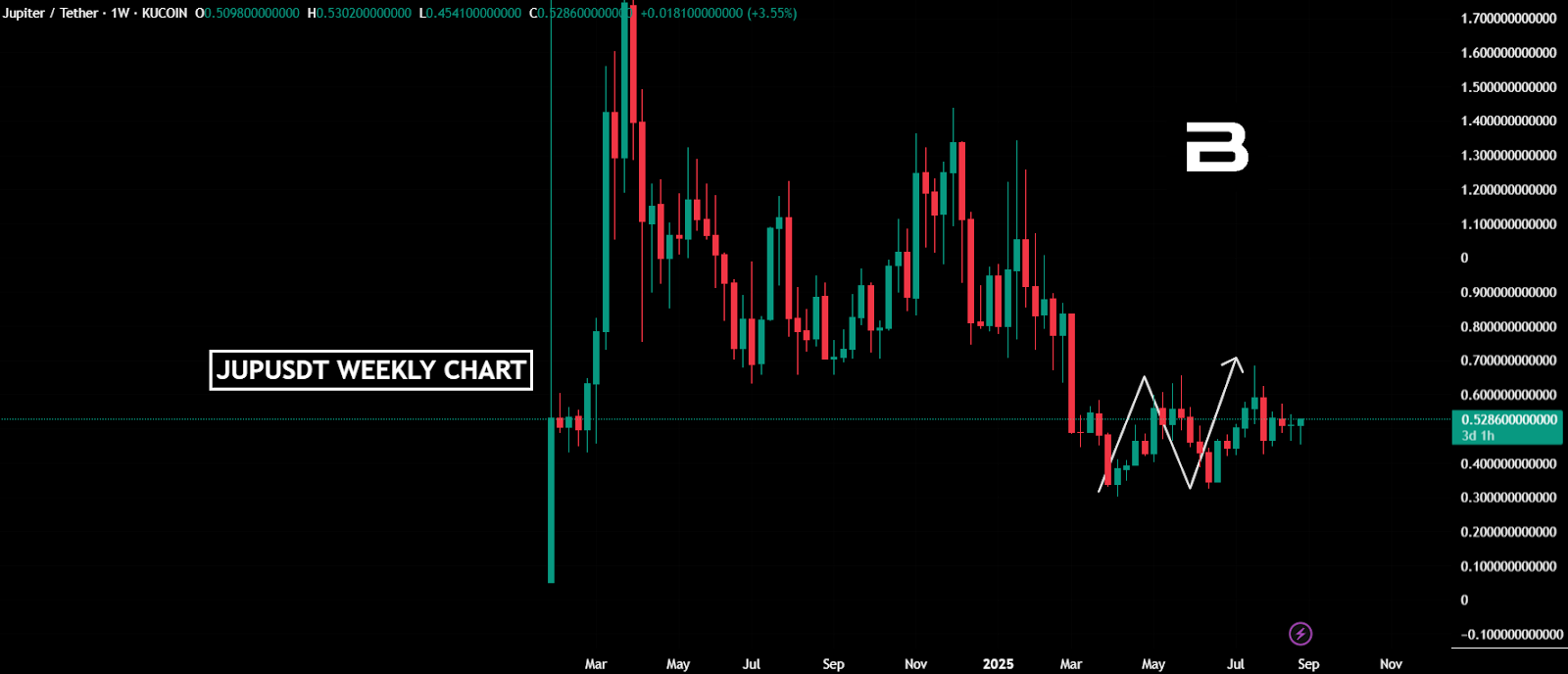
Jupiter (JUP), the liquidity aggregator built on Solana, has quickly become one of the most talked-about tokens in the ecosystem. At the time of writing, the JUP price sits around $0.52, after weeks of sideways action and hints of a bullish structure forming on the weekly chart.
Why are traders and investors so focused on long-term forecasts?
Because understanding where tokens like Jupiter might head by 2025 or 2030 helps frame whether this is just another speculative pump or a serious contender in the world of decentralized finance.
In this article, we’ll break down Jupiter’s history, examine factors influencing its future, and give a balanced Jupiter (JUP) price prediction 2025-2030.
Market Overview and Jupiter Historical Performance
Jupiter launched as a core liquidity layer for Solana, giving users the ability to find the best trade routes across the ecosystem. Unlike many tokens with uncertain utility, Jupiter has strong utility in DeFi because it is positioned as infrastructure: the “plumbing” of Solana’s ecosystem.
Historically, JUP has shown strong volatility.
After its early listings, price action closely mirrored Solana’s ups and downs. The most recent local low sat near $0.32, while the current recovery points toward a potential retest of the $0.68 resistance.
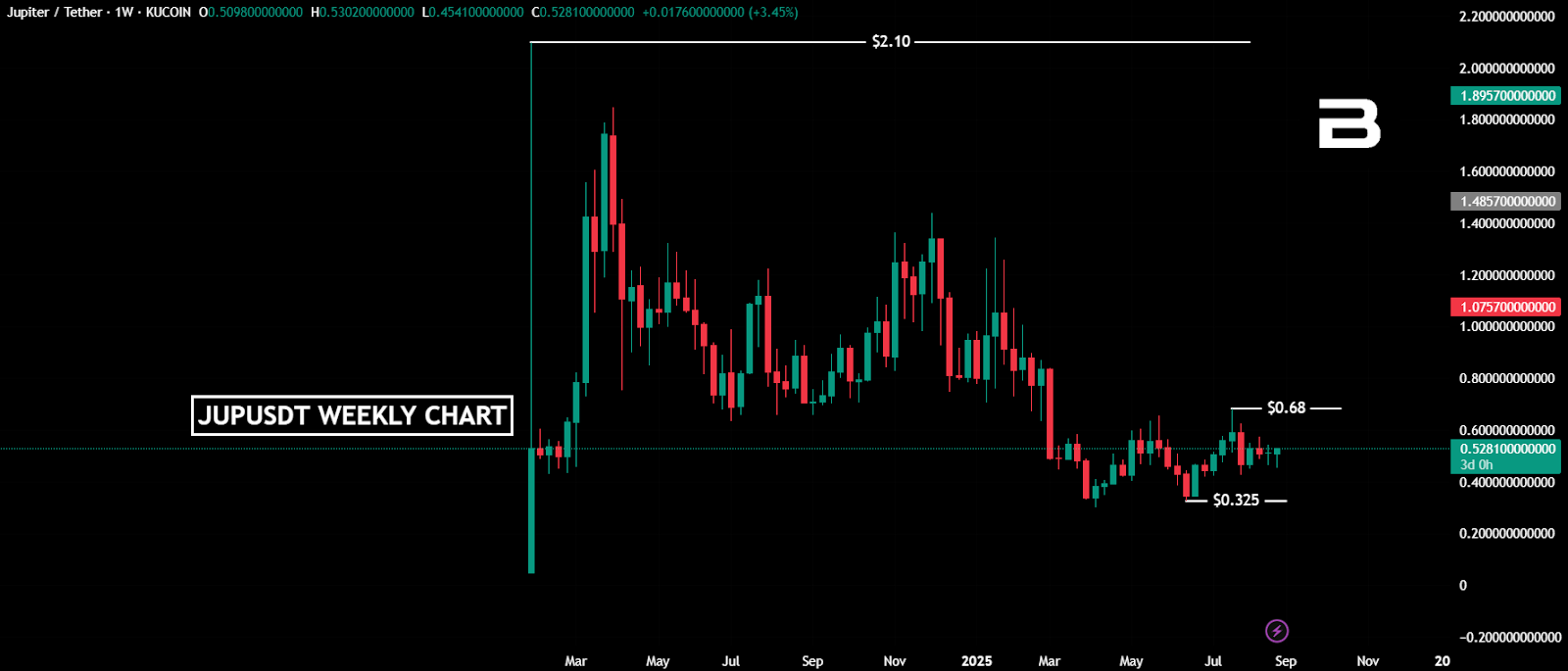
For those asking, “Has Jupiter ever reached a new all-time high?” — yes, JUP hit $2.10 in early 2024, which currently stands as its ATH milestone.
Key Factors Affecting Jupiter Long-Term Price
Technological Development and Innovations
Jupiter isn’t just another token; it’s part of Solana’s growing DeFi infrastructure. Continued innovation — such as better routing engines, integrations with lending protocols, or Layer 2 support — could directly strengthen the JUP token future value.
Market Adoption and Ecosystem Growth
Adoption is the lifeline of any crypto. With Solana expanding its role in NFTs, DeFi, and payments, will Jupiter benefit from Solana’s growth? Absolutely — its adoption rates are tied closely to Solana’s success.
Global Regulations and Institutional Investment
No forecast is complete without considering regulations.
If global frameworks recognize DeFi aggregators as legitimate financial tools, Jupiter could attract more capital inflows. On the flip side, harsh restrictions might limit usage. Institutional investors are increasingly exploring Solana, and by extension, Jupiter.
Expert Opinions and Price Predictions
Analysts have outlined multiple potential paths for Jupiter:
Short-term: If weekly bullish structures hold, JUP could revisit $0.68 in the coming weeks.
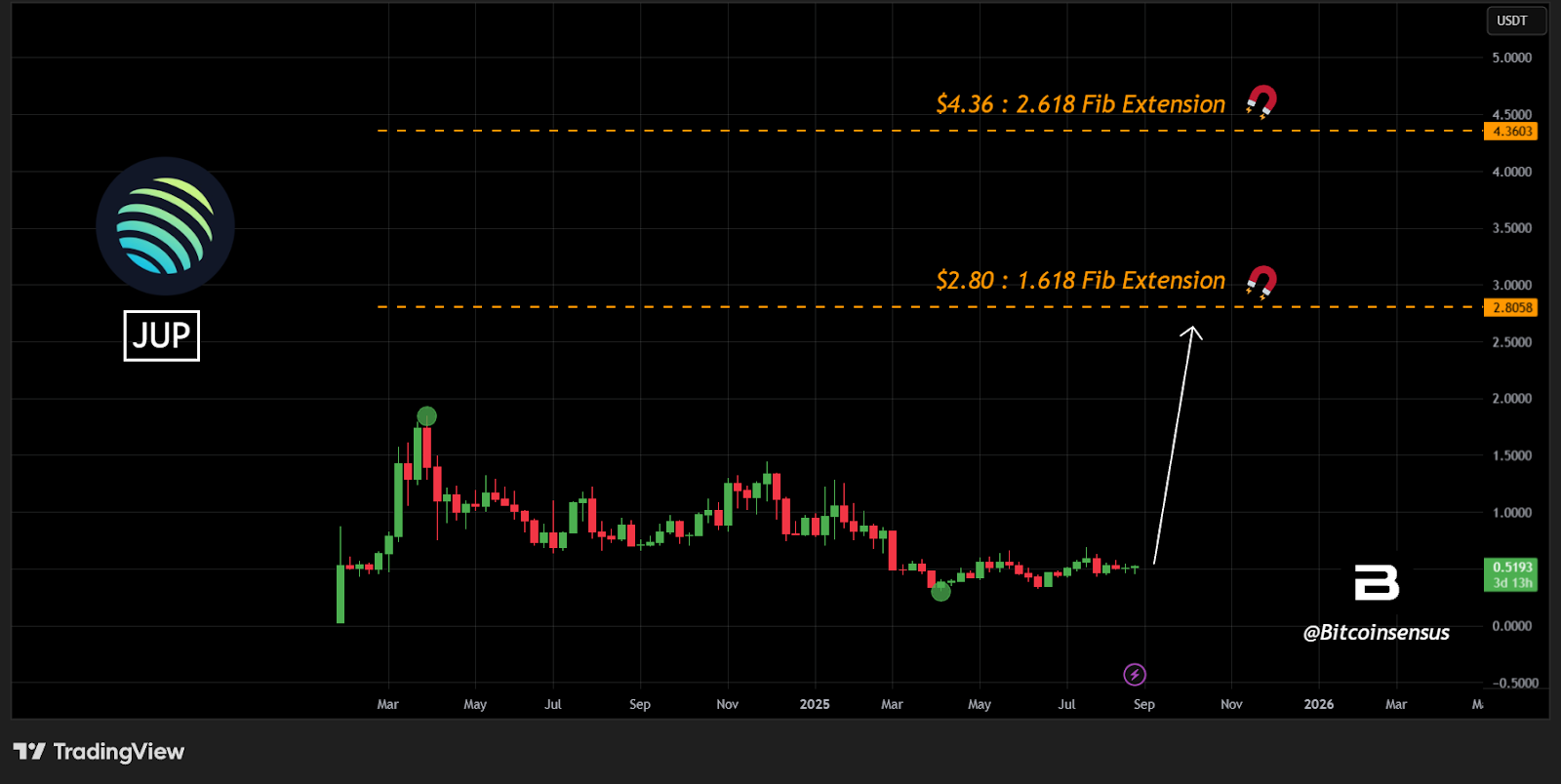
Medium-term (2025): A continuation toward the $2.10 ATH is possible. If that level is broken decisively, projections suggest $2.50–$2.80 as the next resistance zone.
Fibonacci Extensions: Using the 1.618 and 2.168 extensions, Jupiter’s potential targets extend toward $2.80 and $4.36.
Some investors ask: “How does Jupiter compare to other DEX tokens?”
At this stage, Jupiter’s main edge is that it isn’t a standalone DEX — it aggregates liquidity from all of Solana’s DeFi, which gives it broader utility compared to single-protocol tokens.
Future Price Forecast and Risk Factors
Jupiter Price Prediction 2025
By 2025, with continued Solana adoption, our Jupiter price prediction 2025 sits between $1.50 and $2.50.
If momentum pushes beyond the $2.10 ATH, a strong breakout could extend to $2.80. In line with this, many analysts expect Jupiter to follow the overall crypto bull market in 2025, making a higher range achievable.
Jupiter Price Prediction 2030
Looking further ahead, the Jupiter price prediction 2030 depends heavily on macro crypto trends and Solana’s survival as a major chain.
If adoption scales globally, JUP could trade in the $4–$7 range, with a speculative ceiling closer to $10 if everything aligns. So, can Jupiter reach $10 in the future? — Yes, but only under ideal bullish scenarios.
Risks to Consider
High dependency on Solana’s growth and stability.
Regulatory clampdowns on DeFi protocols.
Competition from other liquidity aggregators.
What risks should investors consider with JUP? Volatility, uncertain regulation, and ecosystem dependency are the biggest.
Some investors also wonder: “Does Jupiter have staking or rewards for holders?” — currently, JUP does not have a direct staking mechanism, but governance and incentive programs may evolve in future.
Investment Considerations
The JUP coin investment potential looks promising thanks to its strong role in Solana DeFi. That said, investors should weigh it against macro risks.
What is the market cap potential of Jupiter? If Solana keeps growing and DeFi adoption accelerates, JUP could realistically scale toward multi-billion market cap territory, putting it in competition with top DeFi tokens.
For those new to JUP, a common question is: “Where can I buy and trade JUP tokens?” Jupiter is already listed on major exchanges like Blofin and Weex, with growing liquidity on Solana-based DEXs.Claim 15%
Conclusion
Jupiter has carved itself a valuable spot in Solana’s ecosystem. With current price action hovering at $0.52, the setup looks cautiously optimistic, pointing first toward $0.68 and possibly the $2.10 ATH in the medium term.
Longer term, the JUP price prediction depends on Solana’s trajectory, overall DeFi adoption, and macro crypto cycles.
Our long-term Jupiter crypto forecast:
Jupiter price prediction 2025: $1.50 – $2.80 range.
Jupiter price prediction 2030: $4 – $7, with a stretch target of $10.
As always, while the outlook is promising, the Jupiter crypto future price is not a guarantee. Markets can and will surprise us — so investors should remain cautious.


