

DeFi is the only place where unicorns and cartoon sushi go head to head in the battle for liquidity. Uniswap is one of the most successful DeFi protocols for token swaps on Ethereum. The protocol was created by a small team of passionate developers who made the code open-source and forkable by anyone. That's exactly what SushiSwap does!
SushiSwap is a branch of Uniswap that aims to add the attractive SUSHI token. It grants control of the protocol to holders and helps them pay a portion of the fees. Let's see how to get SUSHI on your plate!
Introduce
As the Decentralized Finance (aka DeFi) space grows, more and more new financial platforms continue to emerge. We see investors taking advantage of methods like flash loans and yield farming (aka liquidity mining) to make money.
Uniswap has solidified its position as one of the core DeFi protocols thanks to one of the largest trading volumes. Despite its decentralized nature and heavy reliance on smart contracts, users still do not have much say when discussing the development direction of this protocol.
SushiSwap, a newcomer to the field, promises to change that. With over 1 billion USD locked in the protocol – just days after launch – we can see that many people will be interested in this change. In this article, we will discuss Uniswap's new branch that is taking the cryptocurrency space by storm.
What is SushiSwap?
SushiSwap was launched in September 2020 by two anonymous developers, Chef Nomi and 0xMaki. It is one of the most popular Decentralized Applications (DApps) on the Ethereum blockchain. SushiSwap applies the automated market maker (AMM) model to its decentralized exchange (DEX) protocol. Simply put, there is no order book on SushiSwap. Instead, users will use smart contracts to buy and sell cryptocurrencies.
SushiSwap started as a fork of Uniswap. The protocol uses Uniswap's code to build the platform while introducing some key differences – most notably rewards are distributed in the form of SUSHI tokens. Liquidity providers on SushiSwap are rewarded with the protocol's native SUSHI token, which is also the governance token. Unlike Uniswap (UNI), SUSHI holders can continue to earn rewards even if they stop providing liquidity.
When first launched, SushiSwap incentivized liquidity providers to stake tokens in its liquidity pool (LP) on Uniswap by paying additional SUSHI rewards with a high estimated annual yield percentage (APY). Within a week, SushiSwap successfully attracted over 1 billion USD in liquidity and the total value locked exceeded 150 million USD. The staked LP tokens will then be transferred from Uniswap to SushiSwap after two weeks. This means that all Uniswap LP tokens staked on SushiSwap are redeemed on Uniswap for the tokens they represent. New liquidity pools were also created on SushiSwap, marking the launch of the SushiSwap exchange.
In Q2 2021, the SushiSwap ecosystem announced its latest addition, a Non-Transactional Token (NFT) platform called Shoyu. In fact, the idea of Shoyu came from a SUSHI admin member who proposed making Shoyu an easy-to-use NFT platform. The platform aims to compensate for the current shortcomings of the NFT market such as limited file format options, limited image sizes, and high transaction fees on Ethereum.
What is SUSHI?
SUSHI is the native token of SushiSwap. It is an ERC-20 token allocated to liquidity providers on SushiSwap via liquidity mining. SUSHI has a maximum supply of 250 million tokens. The supply of SUSHI depends on the block rate. As of November 2021, this token is created at a rate of 100 tokens/block and its circulating supply has reached approximately 50% of the token supply at 127 million tokens.
SUSHI gives holders governance rights and a portion of the fees paid to the protocol. In simple terms, the SUSHI community owns this protocol. Why has this attracted so much interest? Well, community governance is inextricably linked to the ethos of DeFi. The growth of liquidity mining (yield farming) as a valid method for token allocation has brought an abundance of new token launches.
Those fair token launch models aim to level the playing field for everyone involved, and they typically require no upfront money, require little to no allocation to founders, and distribute it evenly based on on the amount each user provides. In most cases, allocated tokens also grant governance rights to token holders.
Okay, but what can token holders do with these governance rights? On SushiSwap, anyone can submit suggestions for improving SushiSwap (SIP) and SUSHI holders can vote. These can be considered minor or even major changes to the SushiSwap protocol. Instead of a traditional team like Uniswap, SushiSwap's development is in the hands of SUSHI token holders.
A strong community is a valuable asset to any token project, this is especially true for DeFi protocols. For example, MISO aka minimum SushiSwap offering was initially a product that came from a governance proposal. This is a token launchpad platform in the SushiSwap ecosystem tailored to meet the expectations of the SUSHI community. MISO allows individuals and communities to launch their new project tokens through the SushiSwap platform.
How does SushiSwap work?
As mentioned, SushiSwap is an automated market maker (AMM) protocol that operates as a decentralized exchange. There is no centralized order book or authority. Cryptocurrency trading on SushiSwap is handled by smart contracts in liquidity pools. The liquidity pool is where SushiSwap users become liquidity providers (LPs) by locking up their crypto assets. Anyone can become a liquidity provider on SushiSwap and earn rewards proportional to their stake in the pool. This is done by depositing an equivalent value of two tokens into the pool. Each pool operates like a marketplace where other users can come to buy and sell tokens. For a more comprehensive explanation of how AMM works in DEX protocols, see our Uniswap article.
On SushiSwap, you can swap ERC-20 tokens as you would on other DEX protocols. For example, you can exchange stablecoins like USDT and BUSD into cryptocurrencies like bitcoin (BTC) and ether (ETH). Additionally, there are many sushi-themed functions for you to earn passive income. For example: You can stake SUSHI to SushiBar and receive xSUSHI. xSUSHI staked allows holders to earn 0.05% in fees of all transactions from all liquidity pools. Once Shouyu launches, SUSHI holders who staked tokens for xSUSHI will also be eligible to receive 2.5% with every NFT transaction on the NFT marketplace.
BentoBox is another feature to earn rewards on SushiSwap. This is an innovative vault that allows users to take advantage of all the yield tools available on SushiSwap. This means that by depositing assets into BentoBox, you can automatically receive interest from staking on SushiBar, as well as from lending to other users. At the same time, xSUSHI holders can also earn rewards from trading fees accumulated from BentoBox.
Uniswap vs. SushiSwap
It is not a secret that cryptocurrencies are deeply embedded in the spirit of open source. Many people think that Bitcoin and the growing number of permissionless DeFi protocols operate as a new public good in the form of software. Since these projects are easily copied and can be relaunched with only slight changes, this naturally leads to competition between similar products. However, we think this will ultimately lead to the best products for the end user.
There is no doubt that the DeFi space brings significant advancements to the Uniswap team. But we can see a future where both Uniswap and SushiSwap (or other forks) thrive. Uniswap may still be at the forefront of innovation in the AMM space, and SushiSwap may offer an alternative that is more focused on the features the community wants to see.
With that said, fragmented liquidity among similar protocols is not ideal. If you've read our Uniswap article, you know that AMMs work best when there's as much liquidity in the pools as possible. If a lot of liquidity in DeFi is split between many different AMM protocols, it could lead to a worse experience for end users.
How to provide liquidity to SushiSwap
So you have decided that you want to stake tokens for SUSHI. The first step is to win these tokens. You can buy cryptocurrency to stake from centralized cryptocurrency exchanges like Binance or decentralized exchanges like Uniswap and 1inch.
In this example, we will provide liquidity to BNB-ETH and the same applies to other pairs (of course, provided that the LP token is usable on SushiSwap).
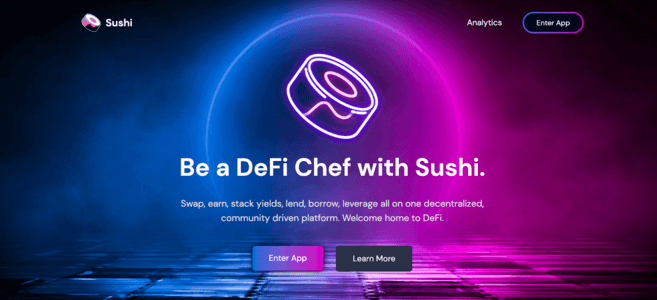
1. Go to Sushi and click [Import Application] to enter SushiSwap.
2. Go to the [Pool] page from the top navigation bar. You will need to connect your wallet to get started. You can use Binance Wallet, MetaMask, WalletConnect or any wallet that supports Ethereum. In this example, we will use the Binance wallet.


