

A step-by-step guide to buying LILPEPE tokens during the presale, breaking down what makes this project different from other meme coin ICOs.
Little Pepe (LILPEPE) is a meme coin with its own Layer-2 network built on top of Ethereum’s, so traders get access to lower fees and higher speeds.
The project has raised over $26 million in its presale so far and is expected to reach its $28.1 million hard cap within the next couple of weeks.
LILPEPE is currently in its 13th presale stage, with tokens priced at $0.0022. However, that stage is nearly 95% sold out, so we can expect the next price jump soon.
How to Buy LILPEPE Token – Quick Guide
Here’s a quick overview of how to buy Little Pepe during its presale:
Set Up a Wallet – Download Best Wallet or another compatible wallet. Store your recovery phrase in a safe place offline.
Add Funds – Buy ETH or USDT and send it to your wallet on the Ethereum network (ERC20). Keep extra ETH for gas fees.
Visit the Presale – Go to littlepepe.com and connect your wallet to the presale widget.
Buy LILPEPE – Enter the amount you want to spend using ETH, USDT, or a debit/credit card. Confirm the transaction.
Claim Your Tokens – After the presale ends, return to the website and claim your LILPEPE tokens.
What Is Little Pepe?
Little Pepe is a Layer 2 blockchain designed for meme traders and decentralized applications. The project is being marketed as “the newborn EVM Layer 2 machine” that combines fast transactions with low fees.

Little Pepe’s branding features baby Pepe character. Source: Little Pepe
The platform runs on an EVM-compatible chain, which means developers can deploy Ethereum-based smart contracts without rewriting code. This compatibility opens the door for DeFi protocols, NFT marketplaces, and other decentralized apps to launch on the Little Pepe network.
LILPEPE is the native token of this ecosystem. The token has a total supply of 100 billion, with 26.5 billion allocated to the presale. The project has a 0% tax policy on buys and sells, so traders don’t pay extra fees when moving tokens.
The team behind Little Pepe has structured the presale across multiple stages. Each stage increases the token price, which provides profits to the buyers who got in early, even before the project hits the exchanges.
Little Pepe Ecosystem – Core Components
Here’s what makes up the Little Pepe platform:
Layer 2 EVM Chain
Little Pepe operates as a Layer 2 solution built on top of Ethereum. Layer 2 chains process transactions off the main Ethereum network, then bundle them and submit them back to Ethereum for security.
This approach reduces gas fees and speeds up transaction times. Users can interact with the Little Pepe chain without paying high Ethereum mainnet fees.
The EVM compatibility means any tool, wallet, or contract that works with Ethereum will also work with Little Pepe. Developers don’t need to learn new programming languages or rebuild their applications from scratch.
Meme Culture Focus
Most Layer 2 chains target serious DeFi users or enterprise applications. Little Pepe takes a different approach by building around meme culture and community engagement.
The project uses Pepe the Frog theme and memes to attract investors and traders.
This strategy is supposed to build a loyal community that interacts with project features like governance, staking, and further developments. Judging by the current presale figures, this tactic has paid off.
Staking and Rewards
Little Pepe has put 13.5 billion tokens aside for staking rewards. If you hold LILPEPE, you can stake it and earn passive income over time.
The team hasn’t dropped the exact numbers yet on APY or how long you need to lock your tokens. What they have said is that staking helps secure the network, and they want to reward people who stick around for the long haul. They even call these holders “diamond hands” in the whitepaper.
It’s a pretty standard setup for crypto projects. You stake your tokens, they sit there doing their thing, and you collect rewards. The 13.5% allocation is decent for a project of this size. It shows they’re serious about keeping holders engaged after the initial launch hype dies down.
Zero Tax Policy
Most meme coins hit you with a tax every time you buy or sell. Usually somewhere between 5% and 10%. The project takes that cut to pay for marketing, add liquidity, or fund development.
Little Pepe doesn’t do that. There’s no tax on buys or sells. You trade LILPEPE, you keep what you trade. Simple as that.
They’re covering their costs through the presale and token allocations instead of skimming off every transaction. It makes trading cleaner and keeps things transparent. Plus, if you’re actively trading, those taxes add up fast. Not having to worry about them is a nice change.
How to Buy Little Pepe Token – Complete Guide
Now let’s take a step-by-step walkthrough on how to buy LILPEPE during its presale:
Step 1 – Set Up Your Wallet
You’ll need an EVM-compatible wallet to buy LILPEPE. Best Wallet and MetaMask are two of the most popular choices.
Best Wallet is mobile-only and available on iOS and Android. MetaMask works as a browser extension or mobile app. Both are free and handle Ethereum-based tokens without any issues.
When you set up your wallet, it generates a recovery phrase. Usually 12 or 24 words. Write these words down on paper and store them somewhere safe. Don’t screenshot them, don’t save them in a note on your phone, and definitely don’t share them with anyone.
That recovery phrase is the only backup you have. If you lose it and lose access to your device, your funds are gone. If someone else gets that phrase, they own everything in your wallet.
Once your wallet is set up, you’ll get an Ethereum address that starts with “0x”. That’s how you receive tokens and interact with the blockchain.
Step 2 – Get ETH or USDT
The Little Pepe presale accepts ETH, USDT, and credit/debit cards.
If you’re going with ETH or USDT, you need to buy them first and send them to your wallet on the Ethereum network. Head to an exchange like Coinbase, Binance, Kraken, or Gemini. Create an account, verify your identity, and deposit funds through bank transfer or debit card.
When you withdraw, make sure you select the Ethereum network (ERC20). Double-check before you confirm, because if you send them to the wrong network, you’ll lose all of your funds.
You also need some extra ETH for gas fees. Gas fees cover the cost of processing transactions on Ethereum. They move around depending on network traffic, but usually sit between $3 and $15. Keep at least $10 to $20 worth of ETH in your wallet, even if you’re buying with USDT.
If you’d rather skip all this and buy with a credit or debit card, you can do that directly through the presale widget. It costs a bit more in fees, but you avoid the whole exchange process.
Step 3 – Connect Your Wallet
Go to littlepepe.com and find the presale widget. Click “Connect Wallet” and select your wallet from the list.
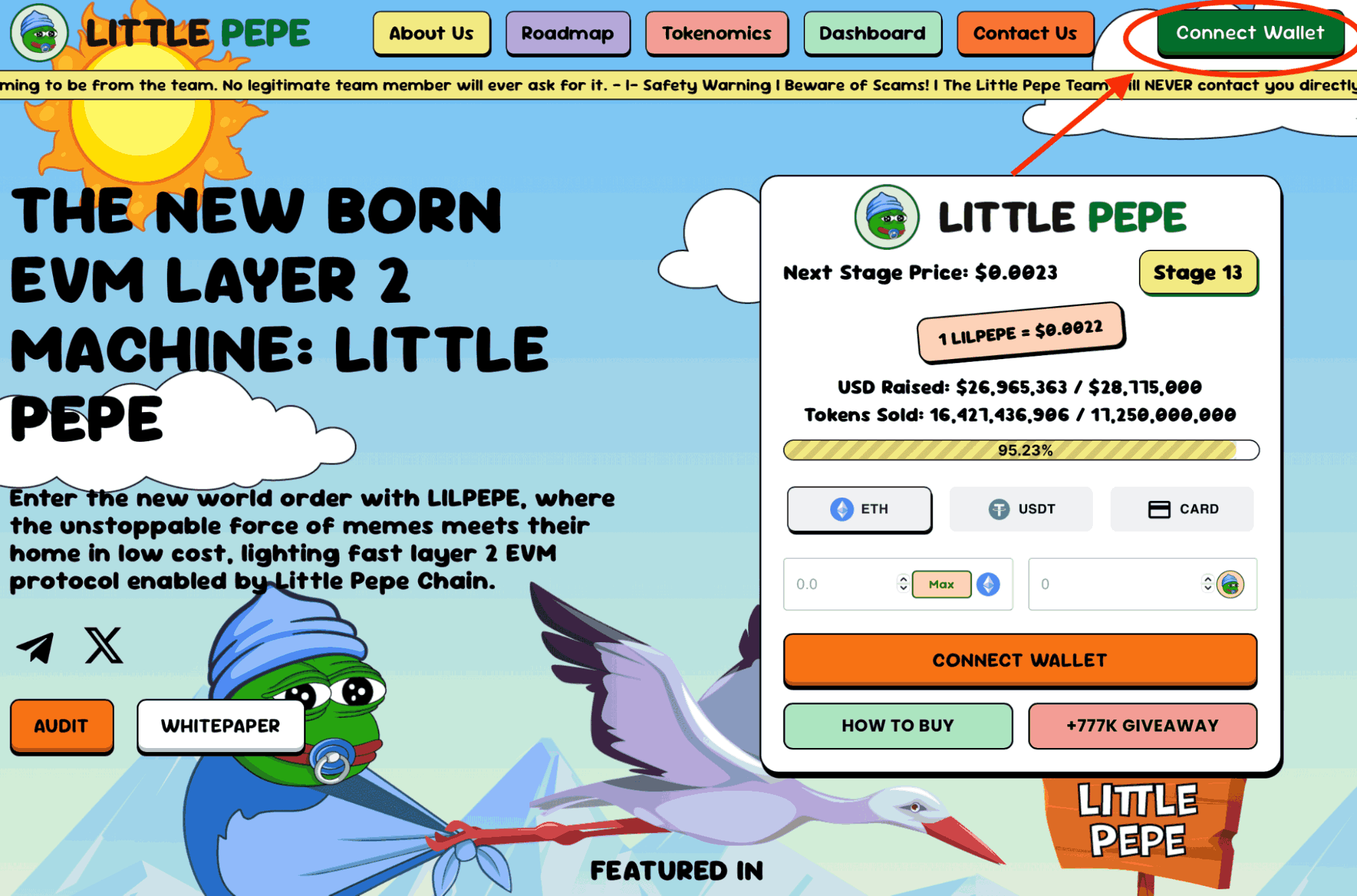
Little Pepe official website showing presale information and project details. Source: Little Pepe
Your wallet will ask you to approve the connection. This approval doesn’t cost gas and doesn’t give the website control over your funds. It just lets the website see your wallet address and initiate transactions.
Once connected, your wallet address will appear in the presale widget.
Step 4 – Buy LILPEPE Tokens
Select your payment method: ETH, USDT, or Card. Enter the amount you want to spend in the input field. The widget will show you how many LILPEPE tokens you’ll receive based on the current price.
The presale is in Stage 13, with tokens priced at $0.0022 each. The next stage will increase the price to $0.0023, so buying earlier locks in a lower price. Review the transaction details and click “Buy Now” or “Connect Wallet” if you haven’t connected yet.
Your wallet will pop up asking you to confirm the transaction. You’ll see the amount of ETH or USDT you’re spending, plus the gas fee. Confirm the transaction and wait for it to process. This usually takes 1 to 3 minutes, depending on network congestion.
After the transaction confirms, your purchase is complete. The tokens won’t appear in your wallet right away because they’re locked until the presale ends.
Step 5 – Claim Your Tokens
The Little Pepe team will announce when token claims are available. This typically happens after the presale closes and the project completes its initial exchange listings.
When claims open, return to littlepepe.com and connect your wallet. You’ll see a “Claim” button if you have tokens available.
Click “Claim” and approve the transaction in your wallet. The LILPEPE tokens will transfer to your wallet address.
A Look into Little Pepe’s Tokenomics
Little Pepe has a fixed supply of 100 billion tokens. Here’s how the supply is allocated:
| Category | Percentage | Token Amount (LILPEPE) |
| Chain Reserves | 30% | 30,000,000,000 |
| Presale | 26.5% | 26,500,000,000 |
| Staking & Rewards | 13.5% | 13,500,000,000 |
| Liquidity | 10% | 10,000,000,000 |
| Marketing | 10% | 10,000,000,000 |
| CEX Reserves | 10% | 10,000,000,000 |
Presale – 26.5%
The presale receives 26.5 billion tokens (26.5% of total supply). This is the largest single allocation and gives early supporters a significant share of the total supply.
The presale is structured in stages, with each stage offering a higher price than the last. This rewards earlier participants and creates urgency for later buyers. The presale has raised over $26.9 million so far and is approaching its hard cap of $28.1 million.
Chain Reserves – 30%
The biggest allocation goes to chain reserves at 30 billion tokens (30% of total supply). These tokens support the Layer 2 network’s operations.
Chain reserves might be used to pay validators, fund liquidity pools on the native chain, or incentivize developers building on the platform. The whitepaper doesn’t provide detailed information on how these reserves will be released or managed.
Staking & Rewards – 13.5%
13.5 billion tokens (13.5% of total supply) are set aside for staking rewards. This allocation incentivizes holders to stake their tokens and support network security.
The rewards pool is designed to last several years, providing ongoing incentives for long-term stakers.
Liquidity – 10%
10 billion tokens (10% of total supply) are allocated to liquidity. This ensures smooth trading on decentralized and centralized exchanges once the token launches.
Strong liquidity prevents large price swings and makes it easier for traders to buy and sell without slippage.
Marketing – 10%
Another 10 billion tokens (10% of total supply) go toward marketing efforts. The project plans to run social media campaigns, influencer partnerships, and community contests to build awareness.
Meme coins rely heavily on viral marketing and community engagement. The 10% allocation gives the team resources to fund these initiatives.
CEX Reserves – 10%
10 billion tokens (10% of total supply) are reserved for centralized exchange listings. When Little Pepe lists on exchanges like Binance, KuCoin, or Gate.io, it needs to provide liquidity for trading pairs.
This allocation ensures the project can meet exchange requirements and provide good trading conditions on multiple platforms.
What Could Drive LILPEPE’s Price Higher?
There are several factors that might contribute to LILPEPE’s growth once the presale comes to an end. Let’s take a look at some of them:
Layer 2 Chain Launch
The biggest thing to watch is whether Little Pepe launches its Layer 2 network and delivers what it’s promising. Fast transactions and low fees sound great on paper, but execution is what matters.
If the chain works as advertised, it could pull in developers who want to build on a cheaper alternative to the Ethereum mainnet.
More developers building on the platform could bring more users, and more users need LILPEPE to pay for gas fees. This would create self-sufficient demand tied directly to network activity.
Exchange Listings
Getting listed on major exchanges usually pushes token prices higher, and LILPEPE has set aside 10% of the supply for CEX reserves, which signals they’re planning to push for tier-1 exchange listings.
When a token hits Binance, KuCoin, or Gate.io, it gets in front of millions of traders who had no idea the project existed during presale. That exposure alone can drive serious volume in the first few days of trading.
The CEX allocation also shows the team understands they need liquidity on multiple platforms. Projects that only list on small exchanges tend to have low volume and high volatility, while major listings help stabilize price action and attract institutional interest.
Meme Coin Cycles
Meme coins don’t move in straight lines and tend to run in cycles based on whatever’s trending on crypto Twitter and broader market sentiment. When the market goes bullish, meme coins tend to pump harder than most other tokens because retail traders pile in looking for quick gains.
Little Pepe is built around Pepe the Frog, one of the most recognized memes in crypto, and that branding gives it built-in visibility. If meme coins start trending again like they did a couple of months ago, LILPEPE could benefit from that renewed attention.
Staking Incentives
Most meme coins see heavy selling right after launch when presale buyers take profits. Little Pepe is trying to counter that pattern with its 13.5% staking allocation.
The staking rewards give holders an alternative to selling. Lock up your tokens, earn passive income, and wait for the price to appreciate. This approach has worked for other projects that wanted to avoid the typical post-launch dump.
If enough holders stake their tokens, the circulating supply stays tight. That makes it easier for prices to move up when new buyers come in.
Community Growth
Meme coins live or die by their communities. Little Pepe has already raised over $26 million, which shows there’s real interest and a growing base of early supporters.
The question is whether that community stays active after the presale ends. Projects that keep their communities engaged through social media, contests, memes, and regular updates tend to maintain momentum.
Little Pepe’s 10% marketing allocation gives them resources to fund ongoing campaigns. If they use that budget well and keep people engaged, the community could keep growing organically. More community engagement brings more attention, which brings more buyers.
The project’s success will depend heavily on how well the team nurtures and expands this community post-launch.
Little Pepe’s Social Channels
Stay updated on Little Pepe through these official channels:
Telegram
Twitter/X
Also, make sure to check out LILPEPE’s official website at littlepepe.com.
Final Words
Little Pepe has done what most meme coins don’t bother with. The project raised over $26 million without venture capital backing or influencer pump schemes. The presale is in Stage 13 at $0.0022 per token, moving to $0.0023 next.
The Layer 2 blockchain angle is interesting if they pull it off. Most meme coins launch a token and call it a day. Little Pepe wants to build infrastructure with staking, zero taxes, and EVM compatibility.
Presale numbers are a good indicator that people are on board with the idea behind it.
However, if you’re thinking of investing in this project, understand that you’re gambling on execution as much as hype. The team has resources and a roadmap. Now they need to ship a working product.
FAQ
What is Little Pepe?
Little Pepe is a meme coin project building a Layer 2 blockchain on Ethereum. The platform combines fast transactions, low fees, and EVM compatibility with meme culture and community engagement.
Is LILPEPE a good investment?
LILPEPE is a high-risk, high-reward meme coin. The project has raised over $26 million in its presale and plans to launch a Layer 2 network. However, meme coins are extremely volatile, and many fail to maintain value after launch. Only invest money you can afford to lose.
Where can I buy LILPEPE tokens?
During the presale, you can buy LILPEPE at littlepepe.com using ETH, USDT, or a credit/debit card. After the presale ends and the token launches, it will be available on decentralized exchanges and potentially on centralized exchanges.
When can I claim my LILPEPE tokens?
You can claim your tokens after the presale ends. The team will announce when claims open. Return to the website, connect your wallet, and click “Claim” to receive your tokens.


