

Cross-border stablecoin flows have reached new 2025 highs, surpassing those of Bitcoin and Ethereum for the first time. This has prompted a sharp warning from the International Monetary Fund (IMF).
The Fund says the explosive rise of digital dollars could accelerate currency substitution, disrupt capital flows, and pressure emerging-market financial systems.
IMF Sounds Alarm as Stablecoin Flows Hit Record Highs and Outrun Bitcoin, Ether
The IMF’s latest departmental paper on stablecoins shows that the market has grown rapidly, with total issuance exceeding $300 billion and representing about 7% of all crypto assets.
Tether (USDT) and USD Coin (USDC) control more than 90% of this space. According to current blockchain data, USDT has a circulating supply of $185.5 billion, while USDC has a circulating supply of $77.6 billion.
What sets 2025 apart is the rapid rise and shifting nature of these flows. While Bitcoin and Ethereum once dominated cross-border crypto transactions, stablecoins have now moved ahead.
The IMF noted that stablecoin flows are expanding faster than native crypto assets, with the gap widening this year. Trading volumes for USDT and USDC reached $23 trillion in 2024, marking a 90% annual increase.
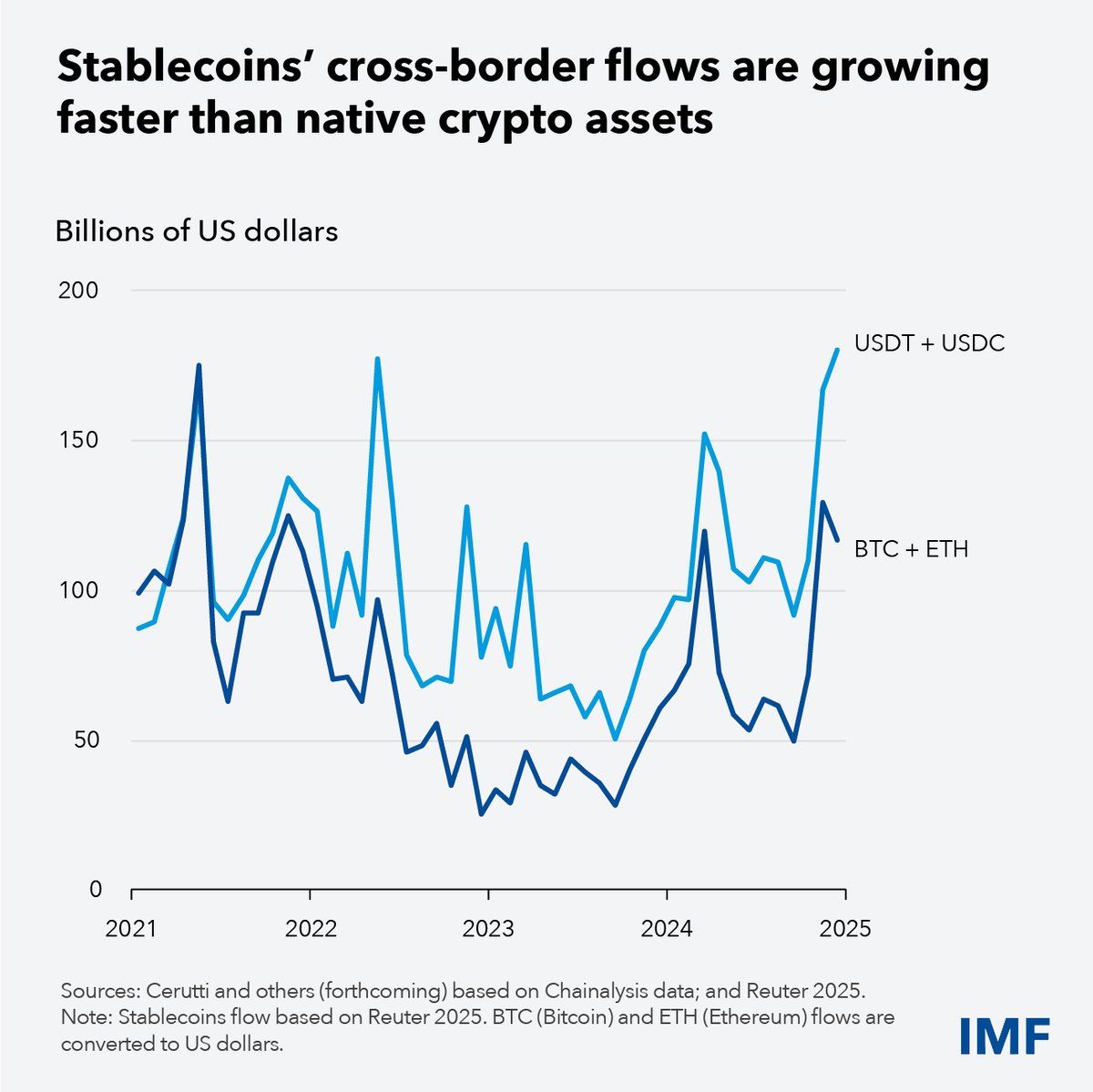
Stablecoin flows (USDT + USDC) have surged past Bitcoin and Ethereum by 2025, according to IMF data (IMF)
The IMF’s latest assessment highlights a structural shift, that stablecoins are no longer a niche settlement tool but a dominant driver of global crypto activity.
Over the past two years, the combined circulation of the two largest stablecoins has more than tripled to approximately $260 billion. They facilitated an estimated $23 trillion in trading volume in 2024.
“The cross-border nature of stablecoins could simplify remittances and payments but also complicate monetary policy and financial stability in emerging markets. A new IMF report explores the challenges and opportunities,” the fund noted.
This highlights both their utility and the challenges they pose to regulators. While the US and Europe remain major trading hubs, Asia now leads in stablecoin usage, with Africa, Latin America, and the Middle East showing the fastest growth in relation to their respective GDPs.
The IMF points to a clear pattern, that consumers and businesses in high-inflation or capital-controlled economies increasingly prefer digital dollars over local currencies.
Researchers at EndGame Macro argue the trend is not crypto hype, but a structural shift in global money flows. Against this backdrop, they label stablecoins “the digital edge of the dollar system.”
A Dollarized Future, But With New Risks
Most major stablecoins are backed by short-term US Treasuries, giving issuers significant exposure to the US financial system. At the same time, they offer yields far higher than traditional bank accounts in emerging markets.
This creates a paradox: stablecoins strengthen the US dollar’s influence globally while weakening monetary autonomy for countries struggling with inflation or capital flight.
IMF economist Eswar Prasad says stablecoins enhance financial inclusion but may also “reinforce dollar dominance” and concentrate economic power among large institutions and tech companies.
The report warns that rapid, unregulated adoption could amplify capital-flow volatility, especially during market stress events when users rush to or from dollar-backed assets.
A central concern of the IMF is regulatory fragmentation. Stablecoins often operate across borders more quickly than national policies can adapt. According to the fund, this creates opportunities for arbitrage and unmonitored liquidity accumulation.
Major economies, including the US, EU, and Japan, are developing clearer frameworks. However, many emerging markets still lack guidelines on reserve quality, redemption rights, or issuer oversight.
This mismatch leaves weaker economies vulnerable to sudden shifts in demand for digital dollars, potentially destabilizing banking systems that are already under strain.
It aligns with a recent Standard Chartered report, which cited stablecoins’ potential to drain $1 trillion from emerging market banks as savers shift deposits into digital dollar assets.
“As stablecoins grow, we think there will be several unexpected outcomes, the first of which is the potential for deposits to leave EM banks,” the bank said in an email shared with BeInCrypto.
South Africa recently confirmed the risk, noting that stablecoins pose a threat to the financial stability of emerging-market banks.
Stablecoins Are Now a Global Macro Force
The IMF’s warning marks a broader acknowledgement: stablecoins are no longer peripheral; they are central to global liquidity, on-chain trading, and digital payments.
Their rising dominance also explains why stablecoin market caps often lead crypto market cycles, including those of Bitcoin and Ethereum, as well as their liquidity conditions.
The IMF is expected to publish a detailed policy roadmap in early 2026, focusing on reserve transparency, cross-border supervision, and minimum capital standards.
With stablecoin flows accelerating and adoption deepening across emerging markets, regulators face a narrowing window to establish global rules before digital dollars become the default means of international value transfer.


