

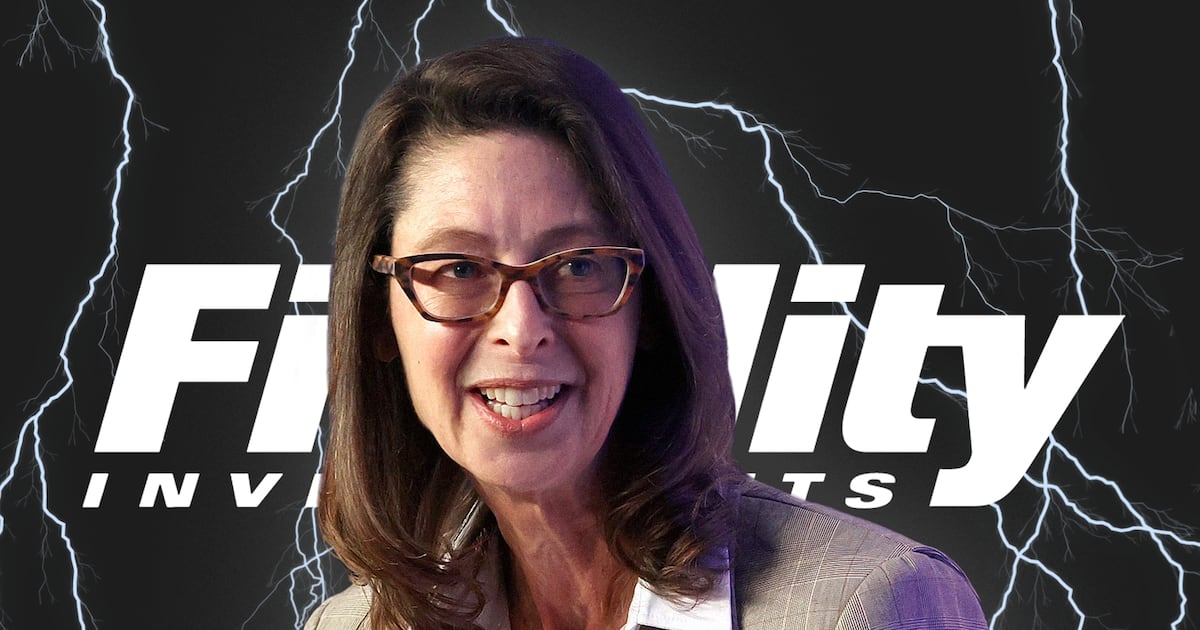
The CEO of a $15 trillion Wall Street giant just called traditional finance “really kind of scary.”
Abigail Johnson, who runs Fidelity, says the current financial system is the most complicated web of basically reconciliation processes built on “primitive technology” — and that blockchain will eventually replace it.
But it won’t be an easy path.
“It’s got to be an evolutionary process and it’ll be some combination of competitive forces and regulatory standards that will kind of push it kicking and screaming along,” Johnson said at an A16Z crypto event on December 4.
Johnson’s critique reveals how even traditional finance leaders see the current system as fundamentally broken. The industry is trapped at the “lowest common denominator” of decades-old technology, with a combination of inertia and the inability of smaller players to upgrade that’s keeping everything intact.
Cue blockchain, a technology that Johnson has been betting on since 2013.
Kicking and screaming
But enthusiastic blockchain adoption alone won’t push the industry, according to Johnson.
Instead, it will be a forced migration.
For one, competitive forces means that institutions who don’t upgrade lose market share to those that do. If one bank offers instant settlement with a blockchain while competitors take three days using legacy systems, customers will move their business. If one brokerage can custody Bitcoin while another can’t, advisors and clients interested in crypto assets will go elsewhere.
Fidelity, with Johnson at the helm, experienced those headwinds firsthand.
The firm faced “surprisingly immature but very loud” anti-crypto sentiment from traditional finance leaders for years, Johnson said. “I just had to be patient and keep going and that the noise would pass.”
Indeed, the noise has passed.
In the past year, some of Wall Street’s biggest banks have begun to experiment with crypto, while digital asset treasuries and exchange-traded funds have deployed billions to buy Bitcoin, Ethereum, and other cryptocurrencies.
Then there’s regulatory standards. These mean governments mandate improvements for the characteristics that blockchain enables — be it transparency, settlement speed, or interoperability.
Across the world, regulation is already coming into effect. In the US, the Genius Act is already operating while the market structure bill, dubbed Clarity Act, awaits approval from the Senate, hopefully by early 2026. And in Europe, MiCA has been active since late 2024.
Existential challenge
At its core, the problem isn’t necessarily that financial institutions don’t want to upgrade. It’s that they can’t.
“There’s a real kind of existential challenge for the industry because at least some of the bigger players would like to upgrade the broader infrastructure a little faster,” Johnson said.
“But the industry is a democratic place and there’s a lot of small players who just don’t have the wherewithal to participate in that kind of an upgrade.”
Since everything is interconnected, the weakest link determines the system’s overall capabilities. And that weakest link is stuck on decades-old technology.
Betting on Bitcoin
Fidelity has been betting on blockchain for over a decade.
In 2013, the firm pioneered Bitcoin custody services for its clients, while setting up mining operations. Fidelity’s Bitcoin mining outlet, in fact, has given the firm “probably the highest single highest ROI business” Johnson said.
The company’s ETF, FBTC, holds the second most Bitcoin after BlackRock, with around $20 billion in assets under management, according to Dune Analytics.
Fidelity recently launched a tokenised money market fund designed to interoperate with stablecoins, allowing clients to earn yield then flip into crypto when needed. And in mid November, the firm saw its new Solana ETF debut.
Still, Johnson admitted she underestimated how long the transition would take.
“I didn’t fully appreciate how slow change really is in our traditional business because there’s just so many forces that keep everybody kind of together and tight doing what they’ve always been doing,” she said.


