

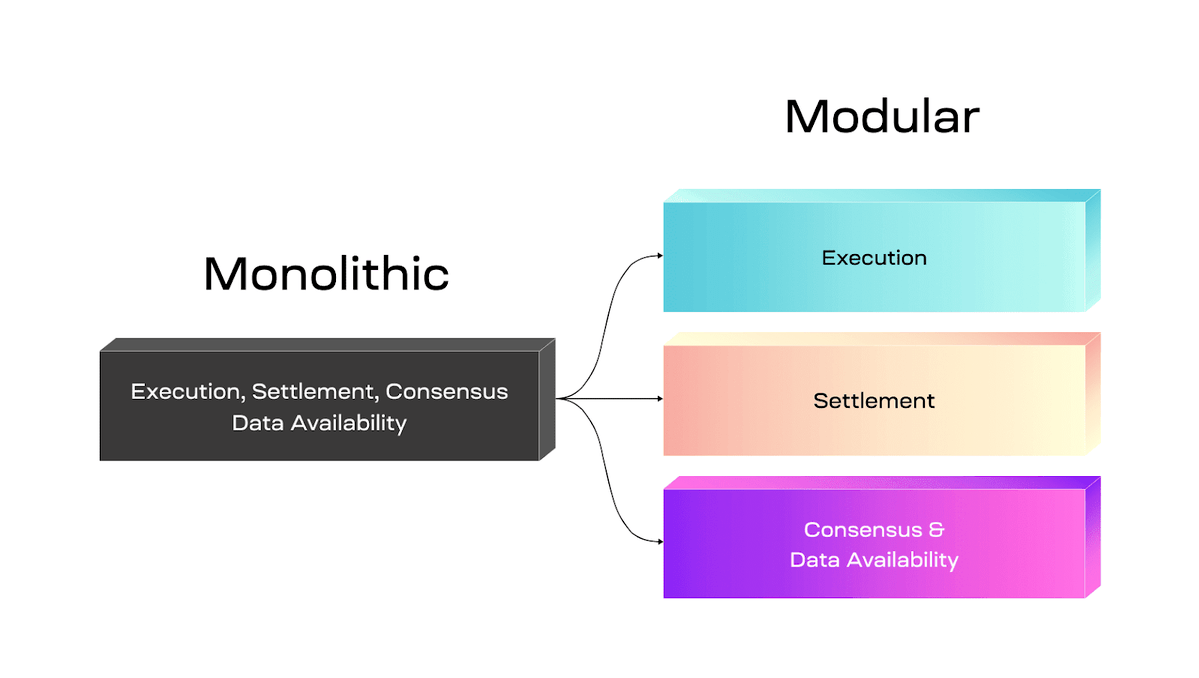
Initially, all blockchains were monolithic. Bitcoin, Ethereum, and the many that followed managed all functions of a blockchain on a single chain, from end to end. However, as blockchains saw users flood in, especially in the bull markets, monolithic blockchains suffered in performance, held back by various bottlenecks that limited throughput and spiked transaction fees on-chain. This was famously seen on Ethereum in the 2021 NFT mania, which saw gas fees reaching more than a thousand dollars during hyped mints.
Source: Celestia docs
This brought the concept of modularity to the forefront, a concept which separated the various functions of a blockchain into various specialized platforms. With each specialized layer executing a function, blockchains were no longer limited by their monolithic architecture and could scale beyond what was originally possible.
This took various forms across numerous projects. Ethereum’s roadmap included rollups to separate execution from the Ethereum base layer, reducing fees and increasing throughput on L2 chains like Arbitrum and Optimism. In a similar fashion, several new virtual machines (VMs) have also sprung up to support abstracting the execution layer away from other blockchains, such as Eclipse which runs the Solana VM and Movement running on Move-based VM. Data availability layers such as Celestia also provided an alternative to blockchains seeking to abstract the data availability layer away.
Alongside the modular blockchain thesis, the concept of highly customized app-chains also began to grow in popularity as new projects wanted custom solutions to tackle their business needs. One such project sought to cater to such specialized chains and unify them in one comprehensive ecosystem.
Enter Dymension.
What Is Dymension?
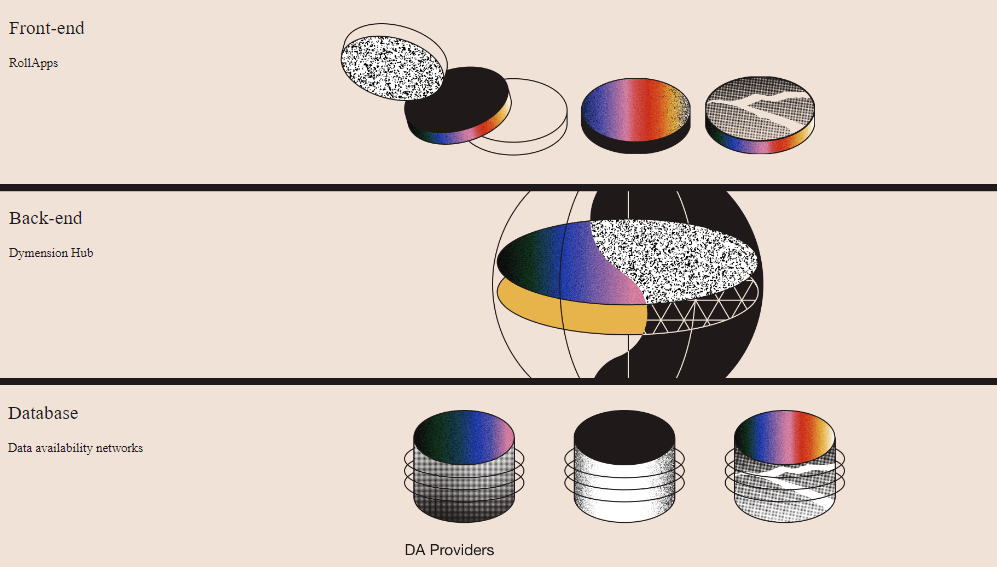
Dymension is a delegated Proof-of-Stake (PoS) L1 blockchain designed to unify, and secure the modular blockchains in their ecosystem known as RollApps. RollApps are modular blockchains built on top of Dymension, using their Dymension RollApp Development Kit (RDK). These RollApps rely on Dymension for security and interoperability between other RollApps.
Source: Dymension docs
Using the traditional Web2 tech stack as an analogy, RollApps can be thought of as the front-end of web applications we use, while Dymension itself is the server on which these applications run, connecting applications to each other and supporting their backend functions. At the very base, data availability layers are utilized for the data availability needs of the respective RollApps. These data availability layers play a similar function to traditional databases which web applications rely on.
The Dymension RollApp Deployment Kit (RDK)
Dymension’s RollApps all begin with the template provided by the Dymension RDK, which allows RollApps to be spun up and deployed quickly with additional customizations required by each specific RollApp. This is similar to the Cosmos SDK, which enables the quick deployment of Cosmos chains.
Dymension’s RollApp RDK comes pre-built with several modules to expedite the deployment process. It also inherits various modules from:
Cosmos SDK - Governance, token transfer and upgrade modules
Inter-Blockchain Communication (IBC) Protocol - Facilitate IBC transfers between other IBC enabled chains
Ethermint - Support Ethereum Virtual Machine (EVM) smart contracts
CosmWasm - Support CosmWasm smart contracts, which are popularly used in the Cosmos ecosystem
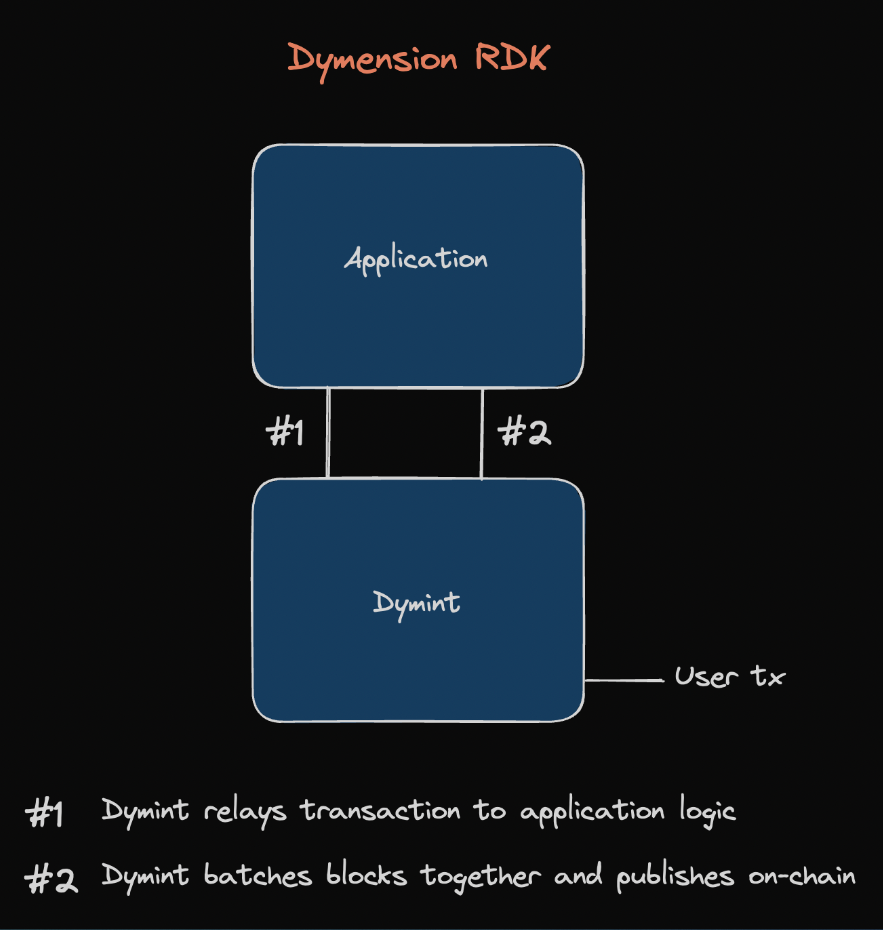
RollApp deployers can select from the modules they wish to incorporate into their RollApp to meet their business needs. This forms the application side of the RollApp, which is the first of the two core services that make up each RollApp.
Source: Dymension docs
Dymint - Dymension’s Tendermint
Dymint is Dymension’s version of Cosmos’ Tendermint consensus mechanism. Dymint is responsible for block production for RollApps through batching blocks and publishing them on-chain. RollApps function similarly to Cosmos app-chains, but with the consensus function abstracted out to the Dymension Hub.
A typical transaction on a RollApp will play out as follows:
User submits the transaction on the RollApp.
RollApp sequencer places the transaction in a block and batches multiple blocks together before publishing this data to the data availability layer chosen by the RollApp.
Once the sequencer receives confirmation that the data has been published to the data availability layer, it submits the state root update to the Dymension Hub. Since all data is published on-chain to the data availability layer, the Dymension Hub can verify the accuracy of the state root update themselves when necessary.
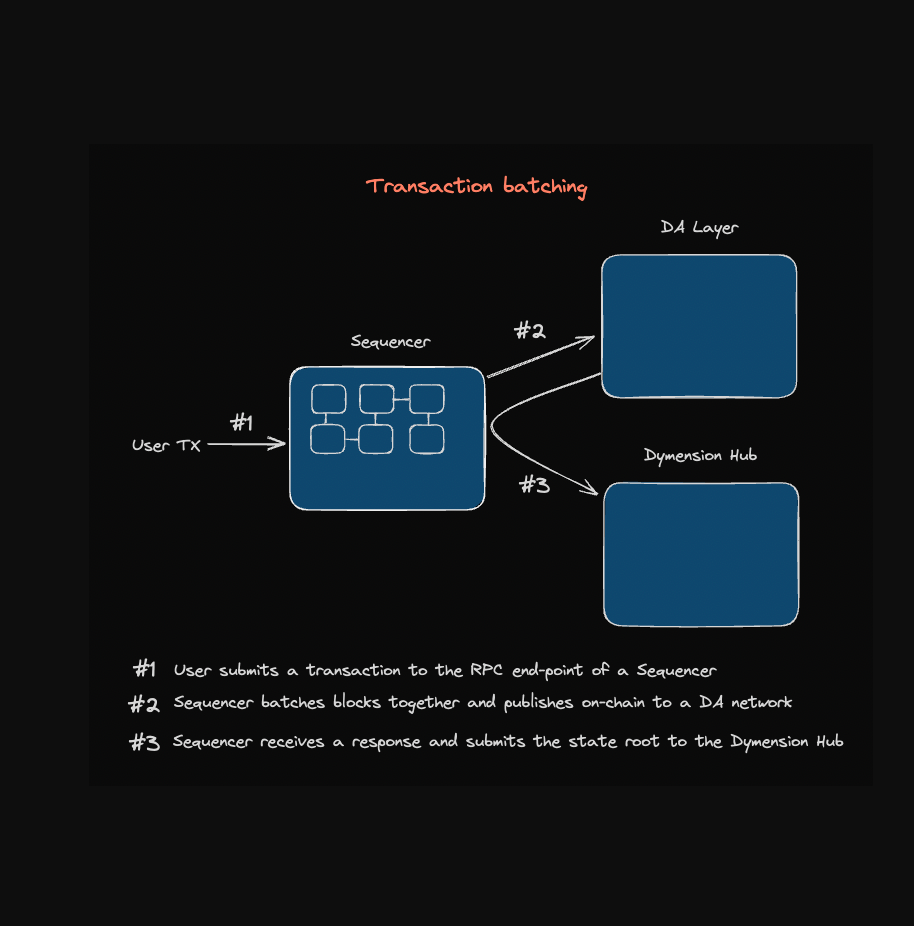
Source: Dymension docs
The Dymension Hub accepts state root updates from the sequencers on RollApps in an optimistic manner. This means that state root updates are assumed to be accurate unless challenged and proven incorrect via fraud proofs. This would then cause the state to revert to the state prior to the fraudulent transactions. Due to its optimistic nature, this reduces the need for active network validation and enables RollApps to achieve high throughput with low latency.
A unique feature of Dymint is Elastic Block Production (EBP), which means that blocks are only produced on-demand, as opposed to continuously producing blocks even when there are no transactions on the chain. As such, this approach to block production greatly reduces the operating cost of running a RollApp sequencer and improves its capital efficiency.
Beyond its function as the consensus layer, the Dymension Hub also supports native bridging between RollApps and even supports its own Automated Market Maker (AMM) to easily swap between tokens when transacting across RollApps.
Dymension Airdrop and Tokenomics
Dymension went live on mainnet on Feb. 6, 2024, launching their native token, DYM, alongside their token airdrop to eligible users across the EVM, Cosmos and Solana ecosystems.
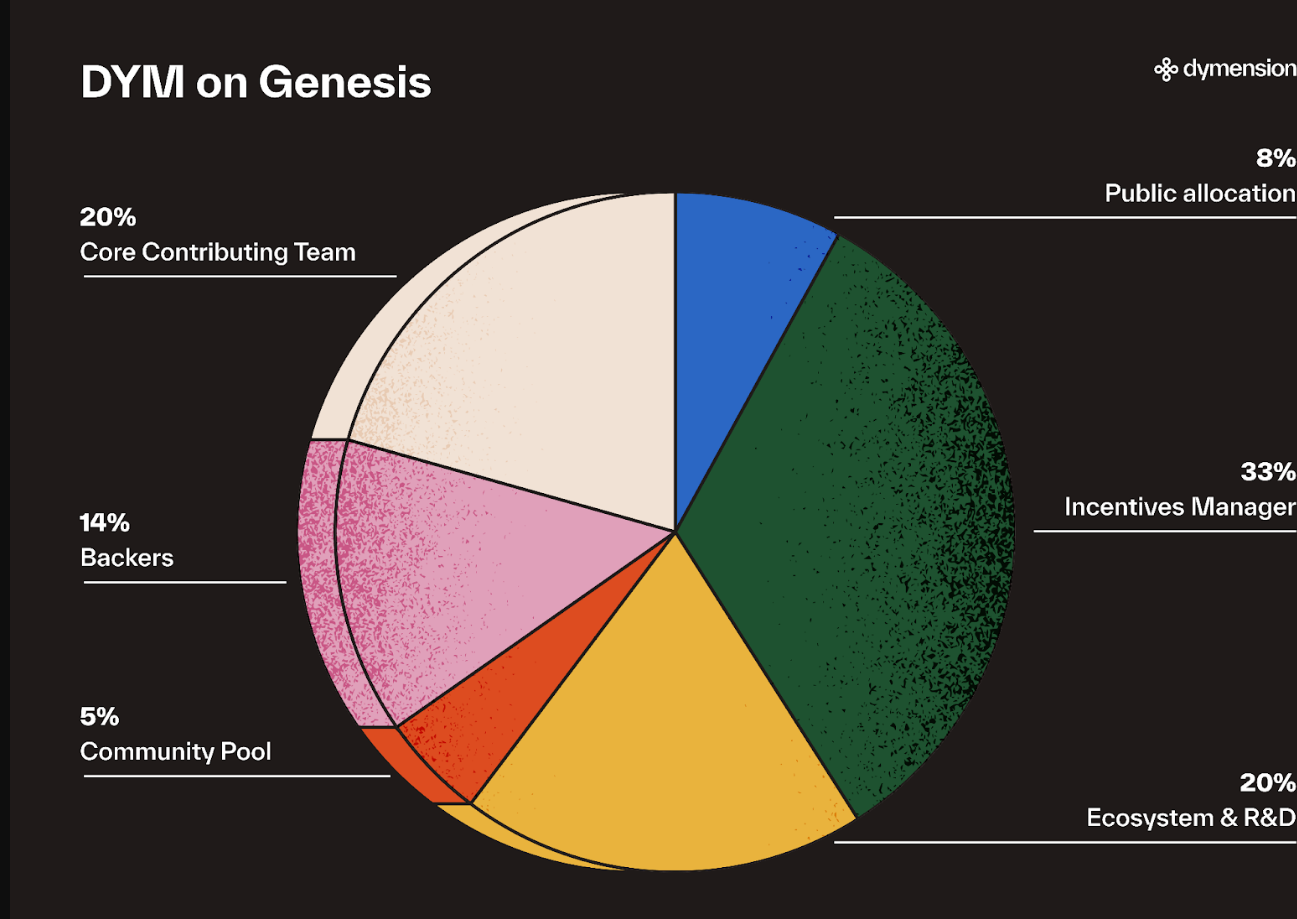
Source: Dymension docs
The total supply sits at 1 billion tokens with 146.67 million tokens circulating at genesis. The initial circulating supply consists of the public rolldrop and 33% of the Ecosystem and R&D fund which is immediately available on launch. Allocations to the Incentive Manager and Community Pool are also unlocked but will be subject to governance for distribution.
Allocations to backers and the core contributing team are subject to a 12-month lockup, following which tokens will vest linearly over 24 months.
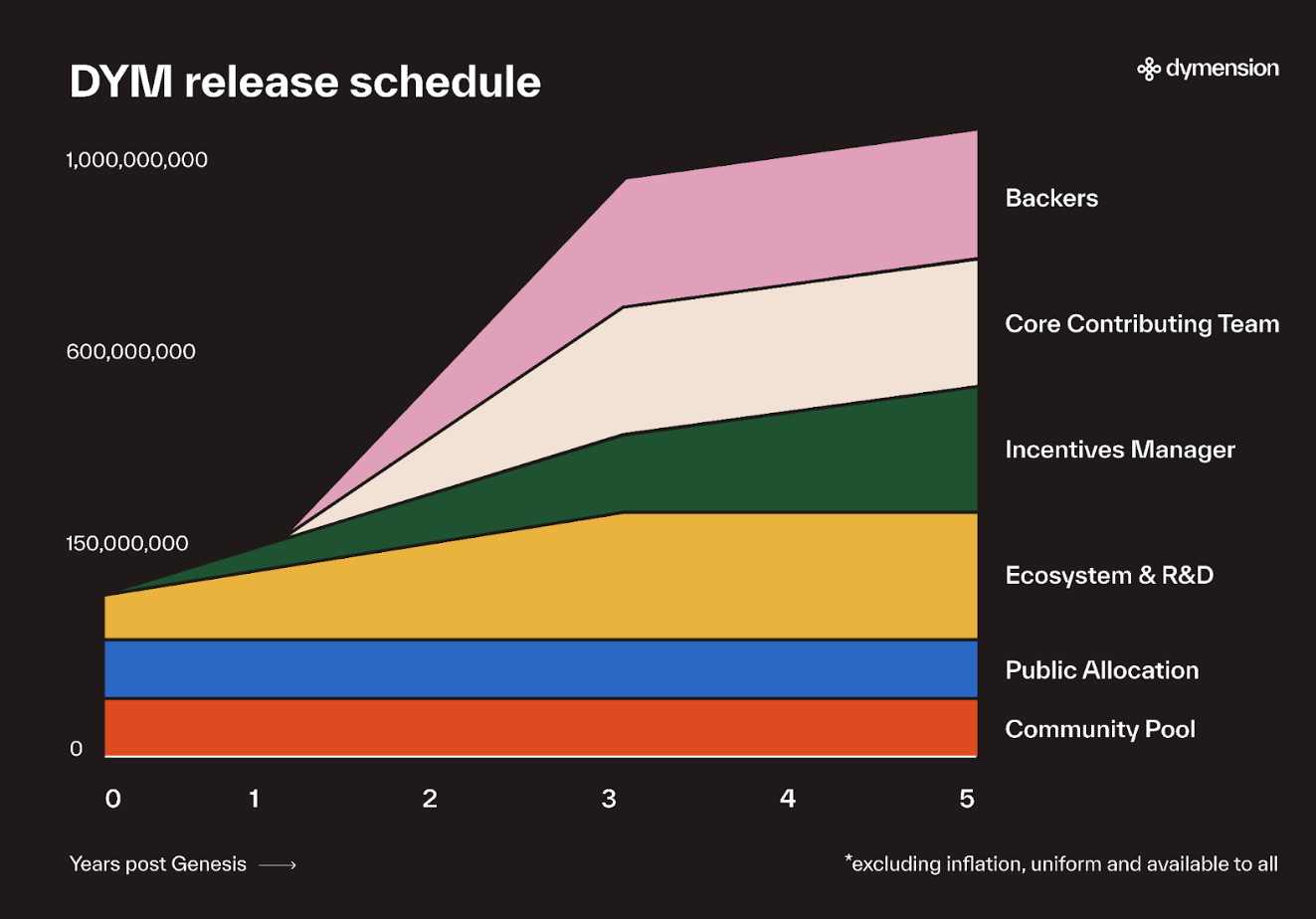
Source: Dymension docs
What’s Next?
With the mainnet now live, the Dymension mainnet has seen more than 450K active addresses on the network and almost 100 million DYM staked with validators.
As RollApps go live, the crypto space will continue to watch as the modular vision of scaling blockchains develops.


