

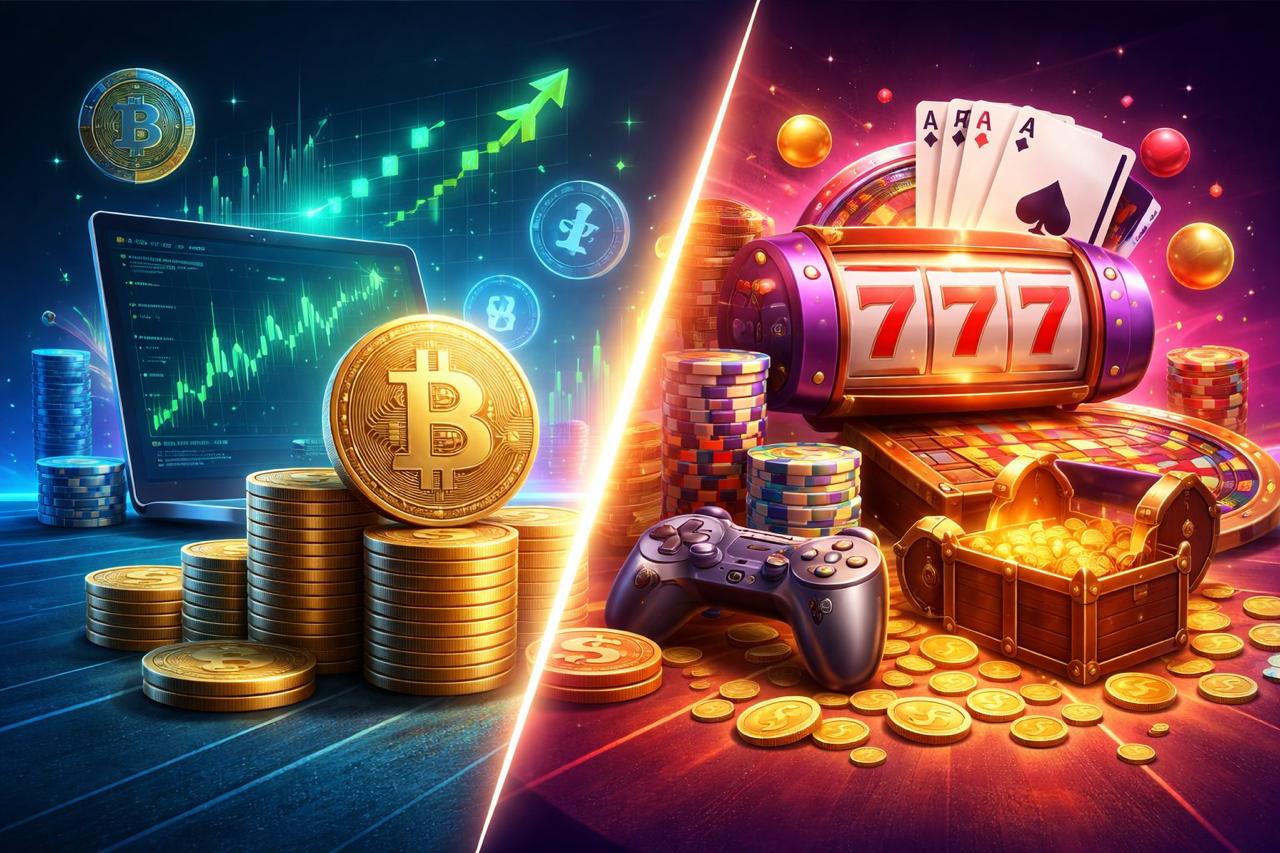
Learn the vital difference between building real wealth with crypto assets and funding digital entertainment like video games or online casinos.
The investment world has changed forever. There was once a time when the only serious options were stocks, bonds, and property. Today, Millennials and Gen Z are pouring billions into cryptocurrency, especially Bitcoin and Ethereum. These digital assets are no longer fringe experiments; they are recognised by governments, banks, and the FTSE 100 as legitimate parts of the global economy.
Yet as crypto goes mainstream, its uses have expanded far beyond “buy and HODL”. Today, Bitcoin and Ethereum are used for real-world payments, DeFi lending, NFTs, and even entertainment, including deposits and withdrawals at licensed online casinos. Understanding the difference between using crypto as an investment and using it for entertainment spending has never been more important. This is exactly what you’ll learn in this article, so keep reading to find out more.
Understanding True Investment
A genuine investment is built on research, long-term growth potential, diversification, and an asset that produces value over time. Leading cryptocurrencies like Bitcoin and Ethereum have graduated from “internet money” to established asset classes because they solve real problems. Bitcoin now serves as censorship-resistant digital gold, while Ethereum serves as programmable money that enables smart contracts and Web3.
Crypto is indeed far more volatile than a savings account or blue-chip shares, but its price is driven by genuine supply/demand dynamics, institutional adoption, and utility, not marketing hype.
Building a Healthy Financial Strategy
The foundation of lasting wealth is diversification. And, a balanced portfolio might hold:
Stable assets (index funds, savings bonds, property)
Growth assets (individual stocks, Ethereum staking)
High-volatility, high-conviction positions (Bitcoin, selected altcoins)
Mixing ultra-safe savings bonds with calculated crypto exposure is one of the smartest moves younger investors are making today. Feel free to check out this guide on how to diversify your portfolio with savings bonds and cryptocurrency.
Transactional Utility: The Role of Crypto in the Entertainment Economy
In macro-economic theory, every successful asset class follows the same lifecycle. It begins as a store of value (something you hold for future appreciation), and then matures into a medium of exchange (something you actually spend in everyday life). Bitcoin and Ethereum started their journey as “digital gold”. For years, the dominant strategy for most owners was simply to buy and lock them away in cold wallets, while the price appreciated. True maturity, however, requires the second stage: real-world spending.
That spending has not arrived at Tesco, Costa, or the local petrol station. Instead, it is being pioneered in purely digital-first economies, where the product, the consumption, and the community all exist entirely online. The video-game industry was the original proving ground. For well over a decade, millions of gamers have comfortably spent real money on intangible items (skins in CS2, V-Bucks in Fortnite, battle passes, DLC). This created an entire generation that sees nothing strange about transferring value for something that never leaves the screen.
The online casino (iGaming) sector is the natural and inevitable successor.
Online casinos operate 24/7, across borders, with players in dozens of countries. Traditional banking simply cannot keep up because it’s very slow and expensive. Cryptocurrency removes every one of those pain points in a single stroke by offering instant deposits and withdrawals, near-zero fees, no chargebacks, and genuine privacy.
Most importantly, casinos are adopting crypto to solve logistical problems, rather than turning gambling into an investment. They are simply upgrading the payment infrastructure to deliver a dramatically better user experience.
Think of it like this: the payment rail (technology) has been swapped from a rusty old freight train to a Ferrari, but the destination (the slot reels or roulette wheel) is still exactly what it always was. It still has pure entertainment with a built-in house edge. The technology is revolutionary; the mathematics of the gameplay remain completely unchanged.
Why the Odds Are Against Slots as an Asset
One of the most dangerous mistakes people make today is confusing entertainment with investment. When you start treating a slot machine like a stock you’re watching for profit, you’re heading for serious financial trouble.
True investing is about positive expected value. This way, your money should grow over time through compounding, dividends, or genuine increases in underlying value. Casino games, by design, work the exact opposite way. Every spin carries a built-in house edge that guarantees the casino wins in the long run.
You can hunt for the best paying slot games in the UK with higher RTP percentages (96–98 %), but even those still prove that they cannot be considered a long-term investment. There is no compounding interest, no dividend payout, and no intrinsic growth in value, only the cost of entertainment.
That’s why chasing “hot streaks” or believing you’re “due” for a big win is a fallacy that has ruined far more players than any market crash ever did. In a nutshell, slots are meant for fun, but the moment you view them as an asset class, you’ve already lost the game.
Protecting Your Capital: Awareness and Discipline
Market crashes often grab headlines, but the biggest threats to wealth are typically emotional decisions and fraud. Whether your capital is tied up in Bitcoin, Ethereum, or simply set aside as a gaming bankroll, true protection comes from mastering two things: awareness to recognise scams, fake promises, and predatory operators before they strike, and the calmness to keep fear, greed, or frustration from hijacking your decisions. If you can get these two right, you will safeguard your money far more effectively than any price chart or hot tip ever could.
The Psychology of Risk: FOMO vs Chasing Losses
Fear of Missing Out (FOMO) hits the crypto trader who sees a green candle soaring and piles in at the top because “everyone else is getting rich”. This is simply pure emotion disguised as strategy. In exactly the same way, a slots player who has just lost five spins in a row suddenly doubles the stake, because they are convinced that they are “due” for a win and are determined to recoup the losses.
Both behaviours spring from the identical psychological flaw known as loss aversion. The brain hates losing more than it loves winning, so it pushes us into reckless moves to escape the pain. Whether you are holding Bitcoin through a dip or sitting at a slot machine, a healthy financial strategy demands emotional detachment. The second emotion takes over, you stop investing or playing responsibly, and that’s where gambling kicks in without you even knowing it.
Avoiding Scams & Unregulated Sites
Blockchain is one of the most secure technologies ever built, yet cryptocurrency scams still thrive because they exploit gaps in knowledge rather than flaws in the code. The same unfair reputation clings to online casinos: the entire industry gets judged because a handful of scam artists lure players with impossible 2000 % bonuses and “guaranteed win” promises that disappear the moment you try to cash out. Too many TikTok and YouTube influencers happily promote these shady sites for commission, and this feeds the dangerous internet get-rich-quick myth that slots are a reliable income stream.
The truth is simple. If you ever decide to play for entertainment, stick exclusively to safe online gambling on UKGC-licensed platforms where your money and data are genuinely protected and the games are provably fair. Anything else is handing your capital to criminals.
Conclusion: Invest for the Future, Play for the Fun
Bitcoin and Ethereum belong in a serious long-term portfolio because they offer scarcity, utility, and adoption-driven growth.
Slots and casino games belong in your entertainment budget because they offer excitement and the occasional thrill of a win.
Never risk tomorrow’s wealth on tonight’s spin. Invest to build a legacy. If you must play at all, then do it for the sheer joy of the moment.


