

A 62-page report from Cantor Fitzgerald models Hyperliquid’s HYPE token reaching a $200 billion market cap in 10 years, based on $5 billion in projected annual revenue and a 50x earnings multiple.
The investment bank began overweight coverage on two digital asset treasuries linked to the protocol, marking a shift in how Wall Street values decentralized exchange infrastructure.
Cantor Fitzgerald Projects $200 Billion Valuation for Hyperliquid HYPE Token
Cantor Fitzgerald has released a rare, 62-page research report initiating coverage on Hyperliquid and its surrounding ecosystem. The financial services company projects a long-term path toward a market capitalization of over $200 billion for the HYPE token.
The analysis marks one of the most detailed examinations yet by a major Wall Street firm into decentralized perpetual futures infrastructure.
The report models Hyperliquid generating $5 billion in annual revenue over the next decade, applying a 50x multiple to arrive at a $200 billion valuation.
Analysts frame the protocol not as speculative DeFi, but as trading infrastructure comparable to global exchanges. This approach sets the research apart from more aggressive crypto bull cases.
Hyperliquid operates a decentralized perpetual futures exchange built on a custom layer-1 blockchain. Year-to-date 2025, the platform has processed nearly $3 trillion in trading volume, generating approximately $874 million in fees.
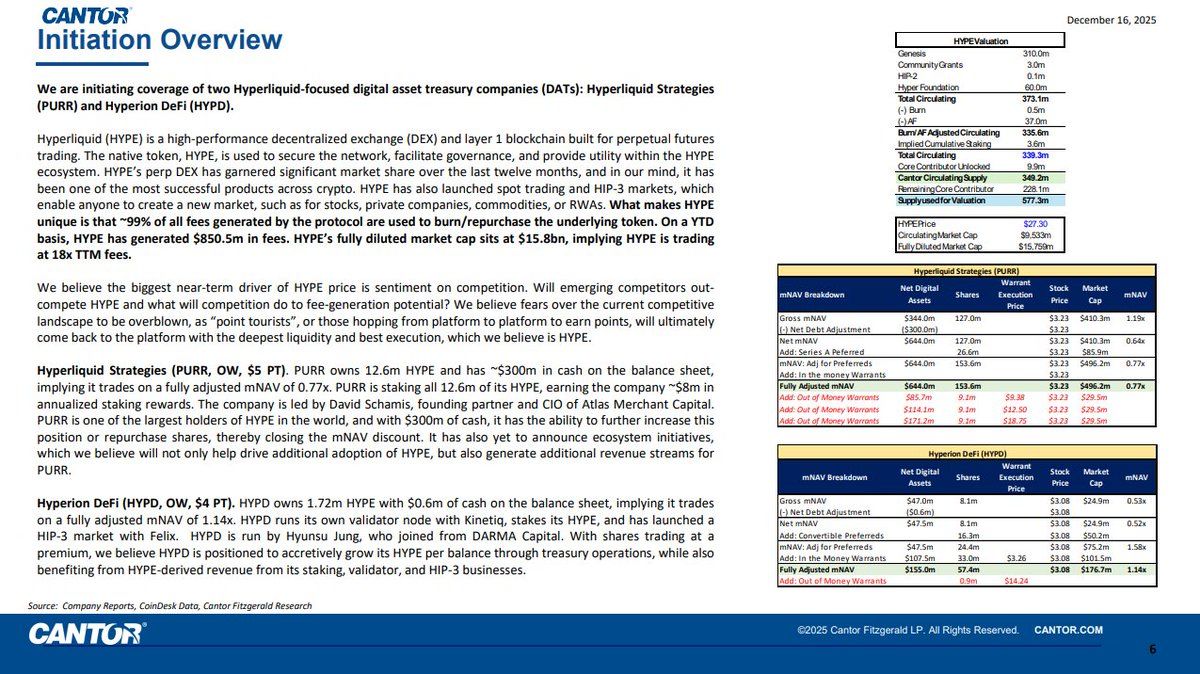
Cantor Fitzgerald’s initiation overview for HYPE, PURR, and HYPD. Source: Luke Cannon on X
Around 99% of protocol fees are returned to the ecosystem via token buybacks and burns, directly linking platform activity to token value.
Cantor Fitzgerald Sees Liquidity as Hyperliquid’s Durable Advantage
Cantor describes Hyperliquid as a potential “exchange of all exchanges.” The firm argues there is a realistic path for annual fees to scale toward $5 billion. This is as the protocol expands across perpetuals, spot trading, and HIP-3 markets.
The report assumes a 15% annual volume growth rate, reaching roughly $12 trillion in annual trading volume within ten years.
The analysis emphasizes that competition remains the primary variable influencing HYPE’s price trajectory.
However, Cantor argues that concerns over rival platforms may be overstated. The firm notes that traders seeking incentives, referred to as “point tourists,” tend to migrate back toward venues offering the deepest liquidity and best execution.
Even a 1% market share gain from centralized exchanges could add approximately $600 billion in volume. It could also lead to more than $270 million in annual fees, according to the report’s estimates.
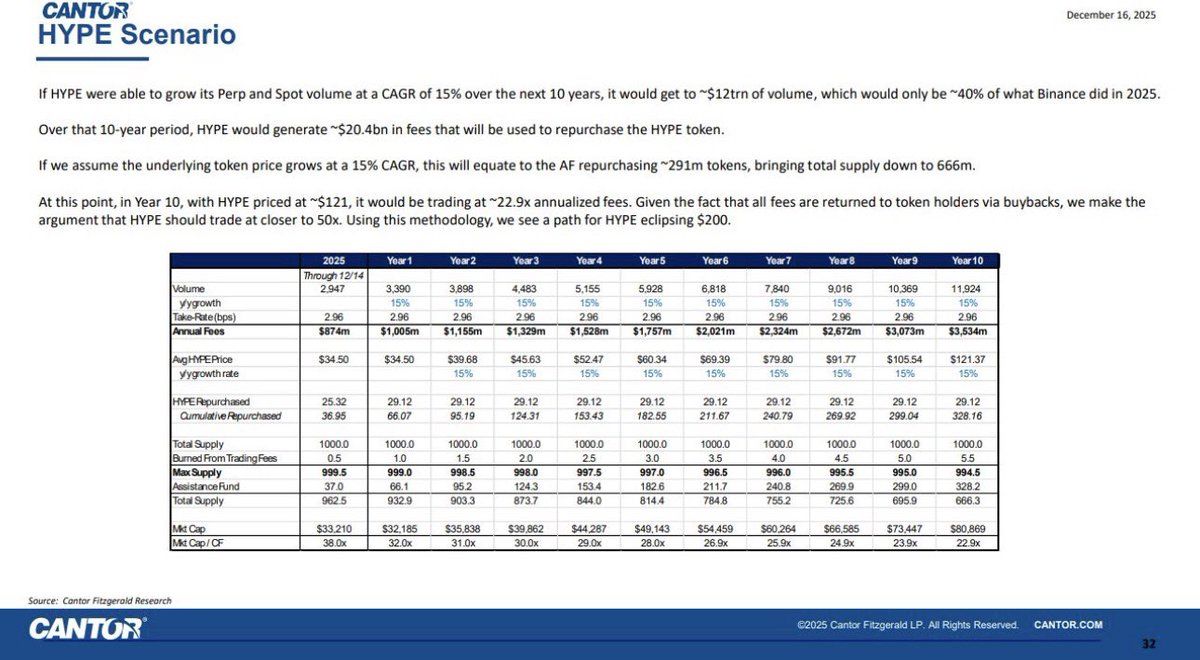
Cantor’s 10-year scenario modeling for HYPE with volume and fee projections. Source: Wock Jones on X
Overweight DATs, Conservative Models, and a Market Missing the Setup
Alongside HYPE, Cantor initiated coverage on Hyperliquid-focused digital asset treasury companies Hyperliquid Strategies (PURR) and Hyperion DeFi (HYPD). It assigns Overweight ratings with price targets of $5 and $4, respectively.
These entities hold HYPE tokens to generate staking yields while offering regulated equity exposure to the protocol’s economics. Both currently trade at discounts to net asset value, which Cantor views as an opportunity for traditional investors.
“…Wall Street doesn’t waste 62 pages on protocols they think will die. $26.84 with Cantor’s reputation behind it is the setup,” one user quipped.
Nonetheless, market reaction highlights the disconnect between price and positioning. HYPE remains roughly 53% below its highs.

Hyperliquid (HYPE) Price Performance. Source: BeInCrypto
Beyond valuation, the report reflects a broader shift in how traditional finance approaches crypto. By applying equity-style revenue modeling, cash-flow multiples, and infrastructure comparisons, Cantor Fitzgerald is treating Hyperliquid less as an experimental DeFi product and more as a foundational trading venue.
Cantor’s deep dive suggests decentralized perpetual exchanges may be moving from the periphery of crypto markets toward their core. This is as regulatory clarity improves and institutions seek compliant exposure to on-chain markets.


