

Digital asset investment products recorded their first weekly outflows in four weeks, shedding $952 million last week.
The negative crypto fund flows come as delays to the US Clarity Act reignited regulatory uncertainty and weighed on institutional sentiment.
US Regulatory Delays Reignite Institutional Caution as Crypto Funds Bleed $952 Million
According to weekly crypto fund flow data, the outflows were driven by a combination of stalled legislation and renewed concerns over selling pressure from large holders.
“We believe this reflected a negative market reaction to delays in passing the US Clarity Act, which has prolonged regulatory uncertainty for the asset class, alongside concerns over continued selling by whale investors,” wrote James Butterfill, head of research at CoinShares.
With momentum fading, analysts now say it is increasingly unlikely that digital asset ETP inflows in 2025 will surpass those of last year. Total assets under management currently stand at $46.7 billion, compared to the $48.7 billion recorded at the end of 2024.
The negative sentiment was overwhelmingly concentrated in the US, which accounted for $990 million of total crypto outflows. In contrast, investors in other regions appeared more constructive.
Canada recorded $46.2 million in inflows
Germany attracted $15.6 million, partially offsetting US losses, but this was not enough to reverse the broader trend.
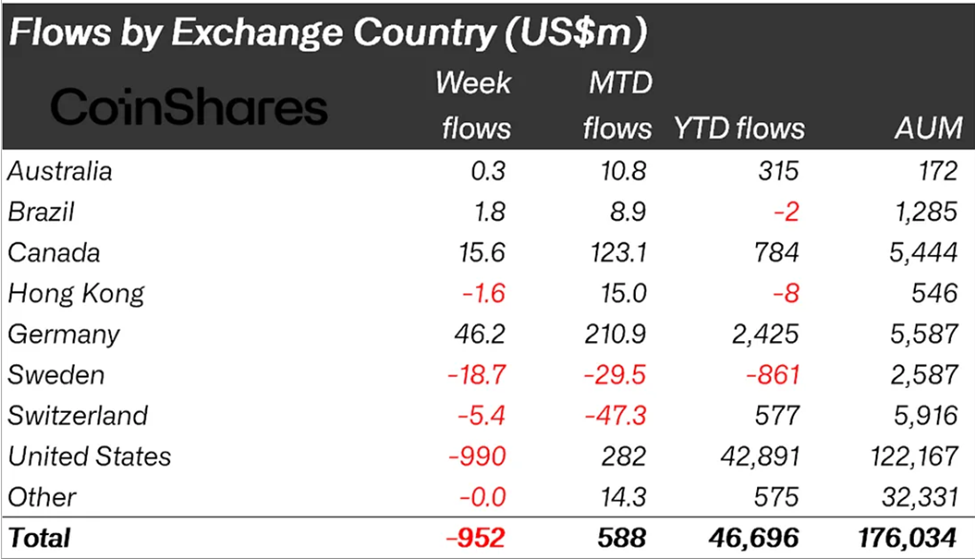
Crypto Fund Flows by Region Last Week. Source: CoinShares Report
This divergence highlights how regulatory uncertainty is impacting US-based institutional products more severely than those listed elsewhere.
While the Clarity Act is intended to establish a clearer federal framework for digital assets, its delayed progress has prolonged ambiguity around oversight, registration requirements, and the division of authority between US regulators.
For institutions operating under strict compliance mandates, that uncertainty has translated directly into reduced exposure.
Ethereum is Most Exposed to Regulatory Risk As Data Shows Selective Altcoin Support
Ethereum led weekly outflows with $555 million, reflecting its heightened sensitivity to the outcome of US crypto legislation. Market participants widely view Ethereum as having the most to gain, or lose, from clearer definitions around what constitutes a digital commodity versus a security.
Despite the sharp weekly outflows, Ethereum’s longer-term inflows remain strong. Year-to-date inflows now total $12.7 billion, significantly higher than the $5.3 billion recorded for the entire year in 2024.
This contrast suggests that while institutional interest in Ethereum remains intact, confidence is fragile in the absence of near-term regulatory clarity.
Bitcoin followed with $460 million in outflows. Although it continues to attract the largest share of institutional capital overall, its year-to-date inflows stand at $27.2 billion, well below the $41.6 billion seen in 2024.
The data suggests Bitcoin’s role as a regulatory safe haven is being tested as broader uncertainty persists across the US market.
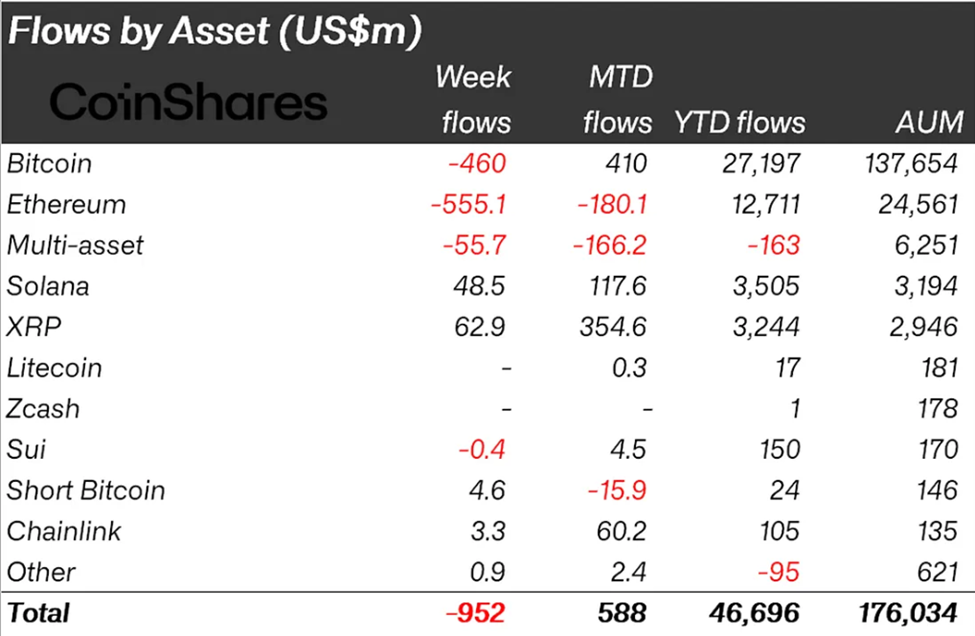
Crypto Fund Flows By Asset Last Week. Source: CoinShares
Not all assets were caught in the sell-off. Solana recorded $48.5 million in inflows, while XRP attracted $62.9 million. This signals selective investor support rather than a broad exit from digital assets.
These inflows indicate growing differentiation within the market. Capital shifts toward assets perceived to have clearer regulatory positioning or stronger network-specific narratives.
Until US lawmakers provide clearer direction through legislation such as the Clarity Act, fund flows are likely to remain volatile.


