

Bitcoin is struggling to reclaim the $90,000 level, and market confidence continues to deteriorate as an increasing number of analysts begin to call for a prolonged bear market. Sentiment has turned decisively cautious, with investors reassessing risk exposure and preparing for a potentially challenging period ahead. Despite multiple attempts to stabilize, price action remains compressed, offering little confirmation that bullish momentum is ready to return.
According to an analysis by XWIN Research Japan, the current market phase is best described as a range-bound consolidation following a high-level correction, with momentum conditionally tilted to the downside. While Bitcoin has remained largely sideways over the past three months, traditional safe-haven assets have followed a very different trajectory.
Gold and silver have continued to push higher, reflecting rising demand for defensive assets amid persistent geopolitical tensions, policy uncertainty, and expectations of lower real interest rates.
This divergence highlights a structural challenge for Bitcoin in the current macro environment. Institutional capital can allocate to precious metals with relative ease, benefiting from deep liquidity, established market infrastructure, and clear regulatory frameworks. Silver, in particular, has amplified gold’s move, supported by tighter supply dynamics and greater sensitivity to speculative flows.
Bitcoin’s Role as a Risk Asset Limits Its Upside
The analysis explains that Bitcoin has not followed gold and silver higher because it is still treated primarily as a high-beta risk asset, rather than a pure safe haven. In risk-off environments, capital typically flows first into gold and government bonds, where investors seek stability and capital preservation. Bitcoin, by contrast, is often a secondary consideration, attracting flows only after confidence improves.
Unlike gold’s long-term and relatively price-insensitive buyer base, Bitcoin remains more exposed to short-term positioning and marginal demand, making broad macro tailwinds insufficient on their own to sustain a durable uptrend.
CryptoQuant data reinforces this interpretation. Bitcoin’s apparent demand has recently turned negative, signaling that fresh demand is not expanding even as prices hold at relatively elevated levels.
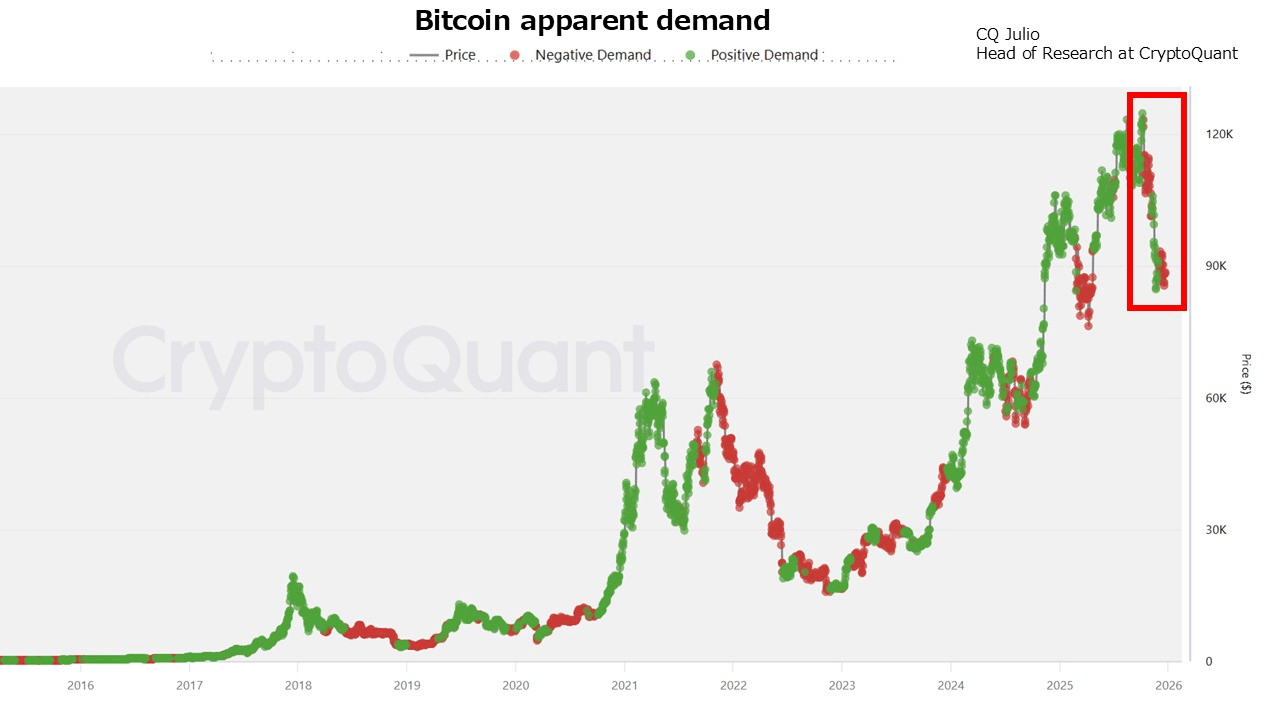
At the same time, Short-Term Holder SOPR has spent extended periods below 1, indicating that short-term participants are selling at a loss or near breakeven. This behavior typically adds selling pressure on rebounds, as underwater holders use price strength to exit positions.
As long as capital continues to favor gold and silver, Bitcoin’s internal demand structure remains a key constraint. The base case points to continued support for precious metals, while Bitcoin’s upside stays capped by weak demand and short-term holder pressure. That view would only change if apparent demand turns sustainably positive and STH SOPR reclaims and holds above 1.
Price Holds Critical Support as Trend Weakens
Bitcoin is currently trading near the $87,000–$88,000 area after a sharp corrective move from recent highs above $110,000. The chart shows that price has lost the short-term bullish structure, with BTC now firmly below the 50-day moving average (blue), which has started to slope downward. This confirms that short-term momentum has turned negative and rallies are facing increasing overhead supply.
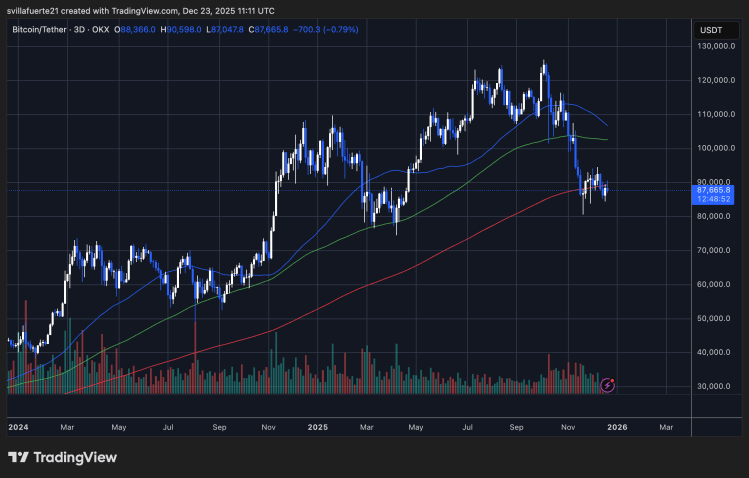
More importantly, price is now testing the 100-day moving average (green), which sits just above the current level and has acted as dynamic support throughout much of this cycle. The market’s reaction around this zone is critical. A sustained hold above the 100-day MA could allow Bitcoin to stabilize and form a base, while a decisive breakdown would likely expose the 200-day moving average (red), currently rising near the low $80,000s.
Volume dynamics reinforce the cautious outlook. The sell-off from the October peak was accompanied by elevated volume, signaling distribution rather than a shallow pullback. Since then, volume has tapered off, suggesting a lack of aggressive dip-buying interest at current levels.
Structurally, Bitcoin remains in a broader uptrend as long as it holds above the 200-day MA, but the loss of the 50-day and weakening momentum indicate consolidation or further downside risk in the near term. Bulls need a recovery back above $90,000 to regain control and shift sentiment meaningfully.
Featured image from ChatGPT, chart from TradingView.com


