

Crypto service providers in 48 jurisdictions have begun collecting transaction data from users, as required by the effort to enforce tax compliance under the Crypto-Asset Reporting Framework (CARF).
The crypto tax transparency regulation developed by the Organization for Economic Co-operation and Development (OECD) officially takes effect in 2027. However, according to several sources from the involved countries, the groundwork is already underway as 2026 commences.
Starting January 1, exchanges, brokers, crypto ATMs, and certain decentralized platforms in participating countries are required to record user transactions, wallet activity, and trading history. The OECD brought together regulators in June 2023 to address the tax discrepancies from the crypto industry, arguing that the sector “limits the visibility of tax authorities.”
“With respect to transparency for tax purposes, the OECD, working with G20 countries, completed and published the Crypto-Asset Reporting framework for the reporting and automatic exchange of information (AEOI) in relation to Crypto-Assets between tax authorities for tax compliance purposes,” the economic organization wrote in its report published last October.
EU, Asia, the US, and UK prepare for global crypto tax transparency
The CARF initiative mandates the involved jurisdictions to implement the framework by translating its requirements into domestic law, including due diligence obligations and reporting standards. According to the OECD, this will help Reporting Crypto-Asset Service Providers (RCASPs) know which user information to collect and how to submit it to tax authorities.
Moreover, the participating countries also need legal frameworks for the automatic exchange of information. Some jurisdictions will use the Convention on Mutual Administrative Assistance in Tax Matters (MAAC), which supports the sharing of data under the Common Reporting Standard.
Others may take up the bilateral double tax treaties, Tax Information Exchange Agreements, or regional arrangements like the EU’s coordinated system.
The OECD reported that several jurisdictions have already passed legislation requiring crypto platforms to collect CARF-related data or are finalizing enforcement measures, and believe more than 50 countries will be ready when CARF exchanges begin in 2027.
G20 officials have welcomed the CARF framework and invited the Global Forum on Transparency and Exchange of Information for Tax Purposes to support its implementation. As of now, 59 countries have joined a joint statement committing to CARF compliance and are actively showing their political support for the program.
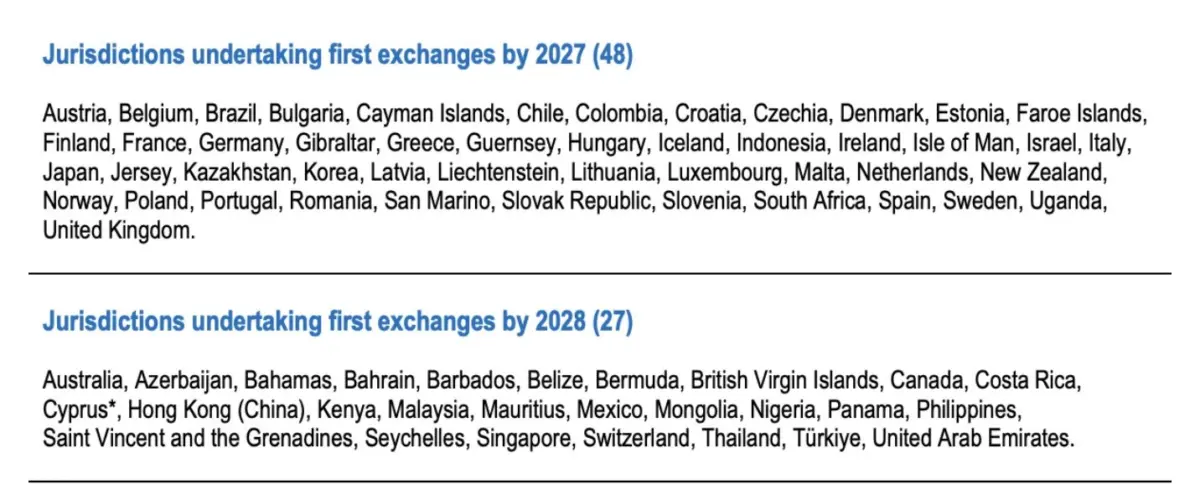
The first batch of 48 jurisdictions will begin collecting data in 2026 for exchanges starting in 2027. However, another 27 countries, including Australia, Canada, Mexico, Switzerland, and Hong Kong, are expected to start reporting in 2028.
Per a press statement released by the special Chinese jurisdiction Hong Kong’s government, the city opened a forum in early December to receive feedback on CARF and updates to tax reporting standards.
Immediate changes commences in the United Kingdom
As reported by the BBC, the UK government issued a statement requiring all crypto buyers to provide account details to HM Revenue & Customs (HMRC) starting Thursday. The updated reporting requirements now give authorities detailed insights into user holdings, transactions, and profits.
Crypto exchanges in the UK now must provide accurate, up-to-date information on all users. Platforms failing to comply may face fines, while investors can no longer rely on limited disclosure to evade taxes.
HMRC will automatically collect data from all users of crypto exchanges, and is expected to uncover tens of millions of pounds in previously unpaid taxes. Proponents believe the CARF rules will make it significantly harder for wealthy crypto investors to hide gains from the revenue collector.
“HMRC has been concerned for some time about high levels of non-compliance among crypto investors. HMRC is running a disclosure facility where taxpayers can come clean on undeclared gains and unpaid tax prior to April 2024,” Dawn Register, a tax dispute resolution partner at BDO, told the news publication.
In 2025, the largest crypto by market cap and purported benchmark for the industry, Bitcoin, surged from approximately $93,500 at the start of 2025 to nearly $124,500 before falling below $90,000 by year-end. The investors who bought during price dips and sold during peaks are now liable for taxes on their gains.
Get up to $30,050 in trading rewards when you join Bybit today


