

Prediction markets platform Kalshi is trying to dress up gambling as serious economic analysis. And not only is this ludicrously misleading, it’s also plain dangerous.
The company is pushing an inflation prediction market that lets users gamble on monthly CPI data, and they’re claiming their platform is better than Wall Street at forecasting inflation. The same Wall Street that has been doing this for well over two centuries.
But then you also read Kalshi’s so-called research report on the matter and realize they haven’t shown their study anywhere at all. So no one knows what “Wall Street consensus” they beat or how exactly they’re pulling forecasts from betting slips.
This is ECONS 101.
Kalshi turns CPI data into a betting board
To quote my professor at Massachusetts Institute of Technology (MIT) Jonathan Gruber, “If you want people to take you seriously as an economist, you show your work, as detailed as humanly possible.” You don’t just toss out a headline that you’re smarter than professional forecasters and expect applause.
Right now, Kalshi looks like it’s trying to turn serious macroeconomic analysis into a game of coin tosses with the world’s largest economy on the line. It’s silly.
Anyway, on the surface, Kalshi offers ten binary bets on where the Consumer Price Index will land for December. You can bet that inflation from November to December is above 0.25%, which means a CPI above 325.844. That’ll cost you $0.53 to win $1.00. You can also go the other way, bet under, and pay $0.47.
Other bets target year-over-year inflation between 2.6% and 3.0%, with different prices depending on the range. It’s all wrapped in decimal points, implied levels, and payout charts that make absolutely no sense to this aspiring economist.
When you combine all ten bets, you get what’s called an implied probability distribution. But instead of a normal curve, it’s bimodal. Two peaks. No confidence around the center, just gaps. Hilarious, right?
The two dominant guesses land around 2.55% and 2.65%, with barely anything near 2.59%, which is odd. If you go by the average or the median of the curve, you’d be picking a number the market itself says is unlikely.
That’s the whole problem. A market forecast that bets against its own math isn’t much of a forecast, now is it Mr. Tarek Mansour?
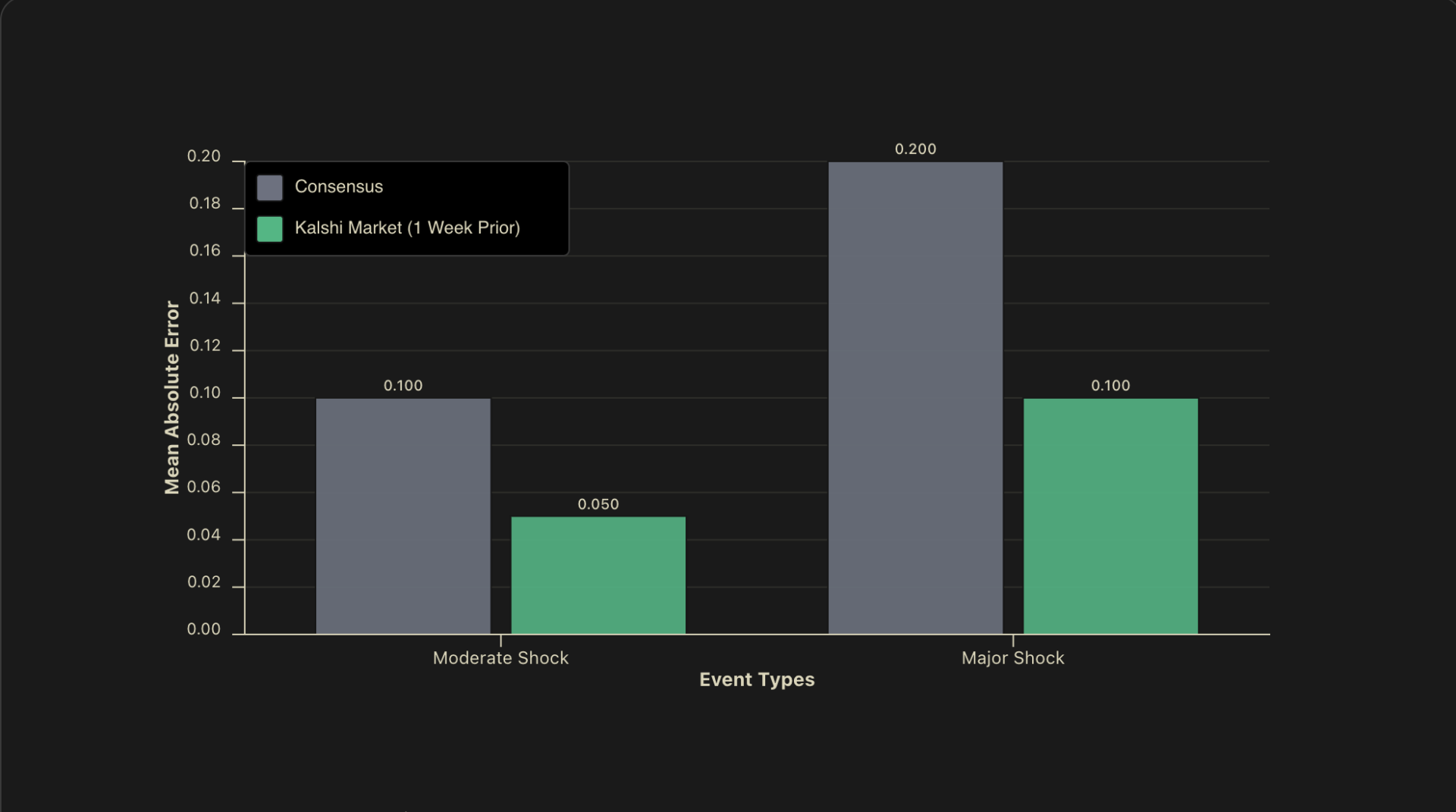
Thankfully, Kalshi kind of admits it. They group inflation surprises into three buckets: normal (below 0.1 percentage points off), moderate shocks (0.1–0.2), and major shocks (above 0.2). But without knowing the baseline they used or how those shocks were measured, this feels like branding and literally nothing else.
Kalshi compares betting signals with traditional markets
The full study, which Kalshi hasn’t released, might explain what’s going on with this strange setup. Maybe it’s just a matter of needing more players to even out prices.
More arbitragers, people who don’t care about politics or news drama and just want to make a buck, could help flatten out the betting curve and close that weird gap around 2.59%.
Or maybe, as Kalshi hopes, the pricing reflects something deeper, like some hidden binary outcome no one else in history has ever seen. That’d be quite a bold theory for a site that still hasn’t shown how it’s winning the inflation prediction game.
But hey, that’s a different story.
A company could make a billion-dollar hedge knowing they might lose, just to protect themselves. That pulls prices away from real expectations. Kalshi thinks it’s cutting through that noise. I call that “delulu.”
But again, Kalshi did admit that its sample size is weak. “Given that our overall sample spans ~30 months, major shock events are definitionally rare,” they said. “Statistical power for larger tail events remains limited.”
Translation? The test period is short, rare events didn’t really show up, and the current data isn’t deep enough. But they still believe the results “are highly suggestive of outperformance.” Make it make sense.
No matter how slick the presentation is, gambling doesn’t belong in economics. Anyone who tries to fit it in clearly did not pass ECONS 101.
Kalshi also said, “In environments where consensus forecasts reflect correlated model assumptions and shared information sets, prediction markets offer an alternative aggregation mechanism that may detect regime changes earlier and process heterogeneous information more efficiently.”
Whatever that means.


