

The massive amount of energy necessary to create the biggest cryptocurrency in the world, Bitcoin (BTC), is one of the biggest limitations of standard blockchain technology. Bitcoin consumes more energy per year than economies as large as the UAE and Argentina. The energy requirements serve as a key impediment to the further adoption of blockchain in the wider market.
The brightest minds in the industry are currently working hard to make blockchain a greener proposition. One of the green blockchain initiatives is Energy Web Token (EWT), a cryptocurrency designed to decarbonize the energy sector of the economy.
How Energy Web Stack Makes the World Greener
The EWT coin is based on the Energy Web Chain (EW Chain) blockchain network, which itself is part of the Energy Web stack of green technologies. The Energy Web was launched in 2017 to bring eco-friendly blockchain solutions to a variety of energy sector participants — upstream energy companies, grid operators, households and business consumers. The platform is developed and supported by the non-profit Energy Web Foundation (EWF).
The Energy Web platform rewards energy-efficient behavior by market participants. Below, we list two innovative projects currently running on the platform.
Green Proofs
This project aims to reduce carbon emissions from Bitcoin mining. Within the scope of this project, the Energy Web is developing a framework that will be used to reward individuals and companies who use renewable energy to mine Bitcoin. Eventually, the project will be expanded to other cryptocurrencies to make blockchain greener across the entire industry.
Project EDGE
Project EDGE enables people who use green energy sources (for example, solar panels) in their dwellings to sell services to utility networks. This allows individuals who go green at their places of residence to monetize any excess energy generated by their local renewable energy devices. Meanwhile, the transparency and traceability of the Energy Web stack enables utility providers to track and communicate with the individuals providing the energy. At the moment, the project is limited to Australia.
Regardless of a specific project, the general idea behind the Energy Web’s functionality is the same — using blockchain and tokenization to incentivize environmentally-friendly practices by individuals and companies. Within the business world, grid operators, utility providers and other key entities in the energy industry are the main users of the platform. Other industries that have adopted Energy Web services include automotive, identity management and decentralized finance (DeFi).
How Energy Web Chain Works
The Energy Web platform is based on a three-layer architecture called the Energy Web Decentralized Operating System (EW-DOS), with the Energy Web Chain at its root. The three layers are applications, infrastructure and the trust layer. The top layer of the EW-DOS stack is made up of the actual applications, built on the platform, that power projects like Green Proofs and Project EDGE.
The second layer, infrastructure, hosts core blockchain services, such as staking, bridging and decentralized identity (DID) repositories.
The bottom, or fundamental, layer is the trust layer. This is where the actual EW Chain resides. The trust layer includes the blockchain, with all of its key components — the block validation processes, validator nodes and the EWT coin.
The Energy Web Chain derives its basic technology from Ethereum’s blockchain, although Energy Web has adjusted the code to create its own unique chain. The main difference is that it uses a block validation method called proof of authority (PoA), which consumes considerably less energy than the power-hungry proof of work (PoW) validation used by chains like Bitcoin, Dogecoin or Monero. In PoA networks, only authorized entities have the right to validate transaction blocks.
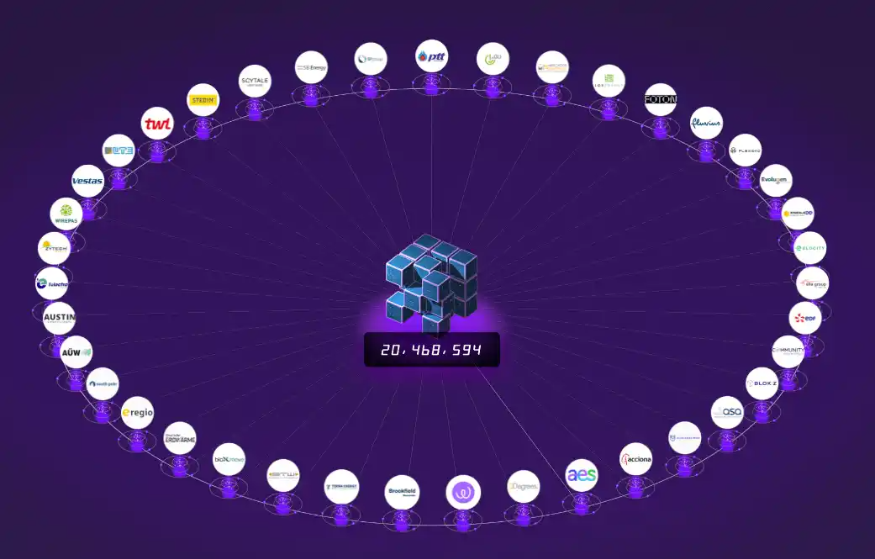
As of October 2022, there are close to 40 validator nodes on the EW Chain, creating blocks of transactions and keeping the network functioning.
While the EW Chain is currently at the core of the platform’s operations, the EWF has partnered with Parity Technologies, a web3 technologies developer, to launch a new chain — the Energy Web Consortia Relay Chain — which will function as a parachain of Polkadot (DOT). The Polkadot framework will allow energy sector enterprises to customize their own blockchains, thereby expanding the reach of the EWF’s carbon-reducing initiative.
What Is the Energy Web Token (EWT)?
The Energy Web Token functions as the native cryptocurrency of the Energy Web Chain. Despite its name, EWT is a crypto coin rather than a token, since it’s a native crypto asset for a full-fledged blockchain network, the EW Chain.
EWT is a supply-capped coin, with a maximum supply of 100 million. The coin’s total supply stands at 69 million, and its circulating supply is 43.3 million.
EWT’s current market price is $3.78, giving it a market cap value of $161.4 million (as of October 9, 2022).
Energy Web Token Functions
EWT has three key functions on the Energy Web Chain — transaction fee payments, reward payments to validator nodes, and staking.
All transactions conducted on the network involve the payment of gas fees, which are payable in EWT. There is no fixed gas fee set for the network. The sender of a transaction chooses their preferred amount to attach as a gas fee.
EWT is also used for the payment of block rewards to validators. Blocks on the EW Chain are produced relatively often, approximately every five seconds. With nearly 40 validators on the network, each validator gets the right to produce a block every two minutes. The current standard reward per block is 0.8547 EWT ($3.20).
This is a very modest amount, compared to Bitcoin’s 6.25 BTC ($121,276) reward. However, it should be noted that EW Chain’s validators are medium or large companies involved in the project for environmental causes and use cases, rather than to earn income from block processing activity.
Energy Web Token Staking
The third function of the EWT coin is staking. While gas fees and block reward payments are established functionalities of EWT, the staking option is still largely at the trial stage. The EWF plans to implement EWT staking in phases. Currently, it’s available on the Energy Web Consortia Relay Chain, and for one of the DeFi apps functioning on the Energy Web Chain — ENGIE Energy Access. Both offer an estimated 10% annual percentage yield (APY).
Bridging Energy Web Tokens
The EWT coin is native to the Energy Web Chain and doesn’t conform to the popular token standard used in the industry, Ethereum’s ERC-20. The EWF has developed an ERC-20–compatible token, EWTB, on the Ethereum blockchain. EWT holders who need to access Ethereum’s rich ecosystem may want to transfer their assets from EWT to EWTB.
Until recently, the Energy Web platform provided a bridging solution to easily transfer your EWT funds to EWTB/Ethereum. However, the bridge is currently being decommissioned by the Energy Web, and the company recommends using other bridging solutions for the transfer. The bridging platform explicitly recommended by Energy Web is the AllianceBlock Bridge.
Energy Web Token Price Prediction
The EWT coin has been on the market since March 2020, initially trading at $0.60. For the first several months after its launch, EWT’s price experienced significant growth, a testament to the market’s appreciation for the project’s innovative business concept.
In August 2020, EWT reached its first local peak at nearly $13. After a correction down to about $6, it set out on another multi-month uptrend, from December 2020 through April 2021, when EWT reached its all-time high price of $22.67.
The 2021 and 2022 market turbulence had a negative impact on EWT, just as it did on the vast majority of other cryptocurrencies. Between April 2021 and August 2022, the coin experienced some ups and downs, but in general, it was on an extended downtrend. After stabilizing at $2.50 in early August, EWT has so far seen a modest uptick to its current price of $3.78.
In our view, despite the turbulent past 1.5 years, the Energy Web Token is a crypto with modest to good growth potential. It’s unlikely to experience record-setting growth rates, but decent to good increases are on the radar. The key reasons for our positive outlook on EWT include the following:
EWT is among the very rare environmentally-focused blockchain projects. As environmental and climate change awareness grows in the wider industry, EWT stands to benefit from this focus.
EWT is backed by leading organizations in the energy and sustainability sectors.
Expansion to the Polkadot environment via the Consortia Relay Chain is among EWF’s current working initiatives. This expansion will create more opportunities for the Energy Web to access new markets, users and partners, and is yet one more factor that should benefit the EWT coin.
Final Thoughts
The Energy Web Token is a coin with great potential to improve the environmental image of the entire blockchain industry. As concepts such as green proofs and tokenized trade of sustainable energy become more popular, the coin’s profile in the market will also rise.
For environmentally aware individuals and businesses, the EWT coin will likely act as a key investment target. If you believe in all things green, EWT might be a great choice for you.


