

Last week, Binance introduced a new Launchpad project, Scroll, but the insufficient airdrop rewards left many users dissatisfied. The market had initially expected Binance to list the token of Puffer Finance, a staking platform. Although this did not happen, I firmly believe that we will see Puffer Finance featured in Binance’s future activities. This is due to the immense potential of Puffer Finance’s team and technical prowess, which aligns with the core narratives of the upcoming bull market. In this article, I will explore the technology, team, and market potential of Puffer Finance, offering an early opportunity to consider deploying capital in this project.
Press enter or click to view image in full size

Project Background
Puffer Finance is a decentralized native Liquid Restake Protocol built on the EigenLayer architecture. It offers Ethereum PoS rewards and additional rewards through restaking, using a native liquid restaking token called pufETH. The project employs anti-slashing technology to reduce risk and improve capital efficiency, allowing stakers to earn extra rewards through local restaking.
Puffer Finance also introduced the concept of UniFi Based Rollup, aiming to address liquidity fragmentation and high costs of cross-L2 transfers in Ethereum’s Layer 2 ecosystem. This innovation not only enhances Ethereum’s economic security but also makes transactions more secure and efficient.
Press enter or click to view image in full size

Team and Investors
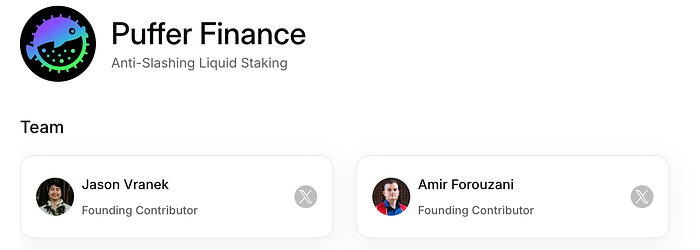
Puffer Finance was co-founded by Amir Forouzani and Jason Vranek, both alumni of the University of California. Jason Vranek, who previously worked at Chainlink, brings significant expertise in the crypto space, adding to the technical credibility of the team.
Press enter or click to view image in full size
The project has raised $18 million in funding, with a valuation of $200 million. The investor lineup includes major centralized exchanges such as Binance, Coinbase, and Kraken, as well as renowned venture capital firms like Franklin Templeton, Mechanism Capital, Jump, and SNZ. Additionally, Puffer Finance boasts an impressive list of angel investors and advisors, including Justin Drake from the Ethereum Foundation, Andrew Kang, Jason Chen, and DiscusFish (Shenyu). These strong industry connections and backing help explain the project’s high valuation and its appeal to the market.
Press enter or click to view image in full size

Problems Solved by Puffer Finance
Puffer Finance aims to lower the high entry barrier for Ethereum validators. Currently, becoming a validator on Ethereum’s mainnet requires staking 32 ETH, which deters many potential participants. Puffer Finance lowers this threshold to 1–2 ETH, allowing more users to participate in staking and earn rewards.
Compared to Lido, which offers an annual staking yield of around 3%, Puffer Finance provides a higher yield, which includes both PoS rewards and additional restaking rewards. By leveraging the EigenLayer’s native liquid restaking protocol, Puffer Finance maximizes the use of staked funds to generate extra returns. Moreover, users have the opportunity to earn airdrop rewards from Puffer Finance and other AVS projects. This “multi-layered” earning mechanism increases the appeal of the platform, making it highly attractive to investors.
Press enter or click to view image in full size
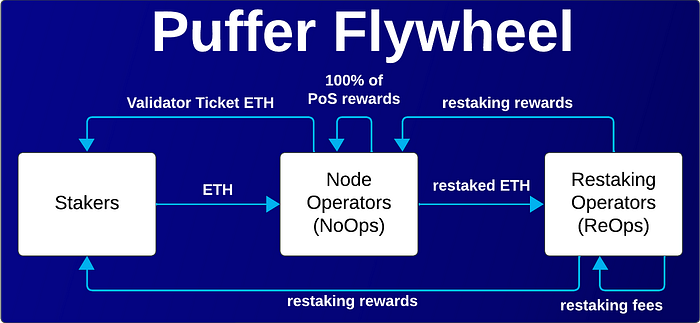
Even after the token launch, I believe Puffer Finance will maintain momentum due to its higher annual yields compared to Lido, attracting users to stake on the platform. While TVL might experience short-term fluctuations post-launch, I expect Puffer Finance to perform well in the long term. This is because the project addresses key Ethereum challenges, including the staking threshold, liquidity fragmentation, and capital efficiency in staking.
Puffer Staking Protocol
One of Puffer Finance’s core innovations is its unique staking model. The Puffer Protocol manages the entire staking process through its PufferModules, which include Restaking Operators, Restaking AVS, and smart contracts. When users stake ETH on Puffer Finance, the platform mints pufETH, an ERC-20 token representing native liquid restaking. The system then uses the PoS rewards to further restake and generate additional earnings.
Press enter or click to view image in full size
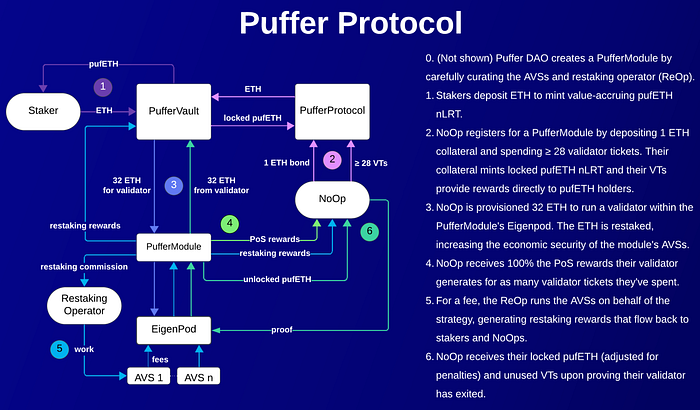
For those interested in becoming validators without 32 ETH, Puffer Finance offers Validator Tickets ($VT). These tickets represent the user’s long-term commitment to running a validator within the protocol’s module. When the pooled funds in Puffer Vault reach 32 ETH, they are used to activate a validator on Ethereum’s mainnet, and PoS rewards are distributed to $VT holders. This system allows stakers to pool resources and share the benefits of both PoS and restaking rewards.
Press enter or click to view image in full size

UniFi Based Rollup
Puffer UniFi is an Ethereum-based rollup solution designed to address the liquidity fragmentation within current Ethereum scaling solutions. While Layer 2s increase transaction speed and lower costs, they often silo liquidity and make cross-L2 interactions difficult and expensive.
Press enter or click to view image in full size

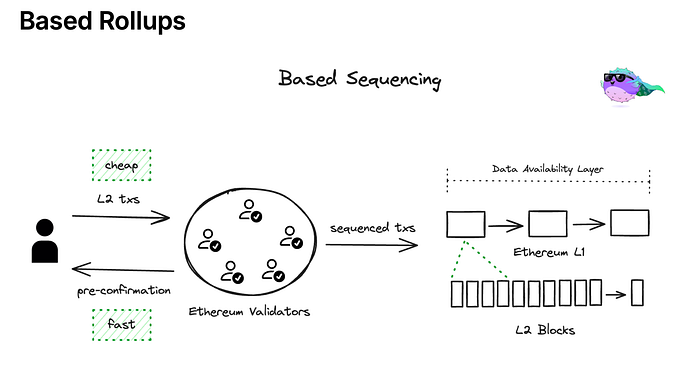
Puffer UniFi addresses this issue by using based sequencing, a technology that relies on decentralized Ethereum validators to sequence transactions instead of centralized systems. This approach enhances security and reduces potential fee exploitation by centralized sequencers. Additionally, Puffer UniFi introduces a pre-confirmation mechanism, allowing transactions to be confirmed within 100 milliseconds and enabling fee-free transactions, greatly improving the user experience.
Press enter or click to view image in full size
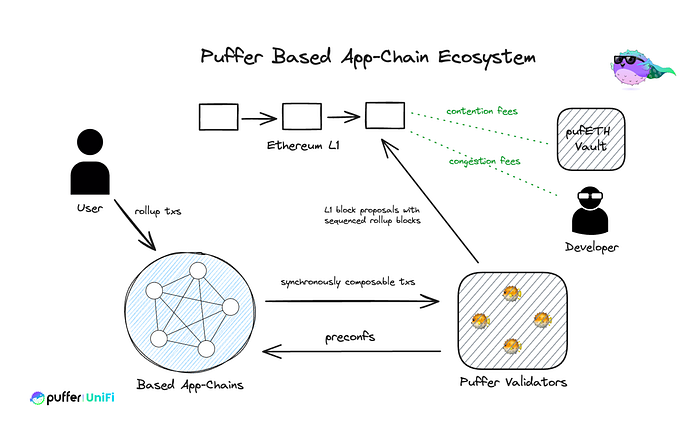
The UniFi rollup also fosters an application chain ecosystem, where developers can build their own app chains that seamlessly interact with each other, sharing liquidity and users. This reduces the risks and costs associated with cross-chain operations and provides a flexible framework for developers. It also promotes a “positive-sum” ecosystem where applications can benefit from shared resources without the negative effects of competition.
Press enter or click to view image in full size
Personal View
Puffer Finance demonstrates strong potential with its innovative technology, robust resources, and market opportunities. The project not only lowers the barriers to Ethereum staking but also offers higher yields through novel restaking techniques. Despite some controversy around restaking, Puffer Finance has taken steps to ensure the safety of funds, such as multiple smart contract audits and partnerships with security firms.
Additionally, Puffer Finance has addressed issues that arose during the EIGEN token airdrop, where inaccurate data from zkLink Nova caused some users to miss out on rewards. The team quickly purchased $EIGEN from the market to ensure all users received their full airdrop allocation, showcasing their commitment to user satisfaction.
Moreover, the team has committed in their whitepaper to capping their validator market share at 22%, ensuring that Puffer Finance never surpasses the critical 33% threshold, which could pose risks to Ethereum’s consensus mechanism.
Considering the strength of the team, technical innovations, and its solutions to key Ethereum ecosystem challenges, I believe Puffer Finance will become a highly talked-about project in the coming bull market. The project has already launched its mainnet, with the UniFi mainnet set to launch soon. As we move deeper into the bull market, Puffer Finance could very well be a project that delivers 10x or even 50x token growth, making it a must-watch.


