

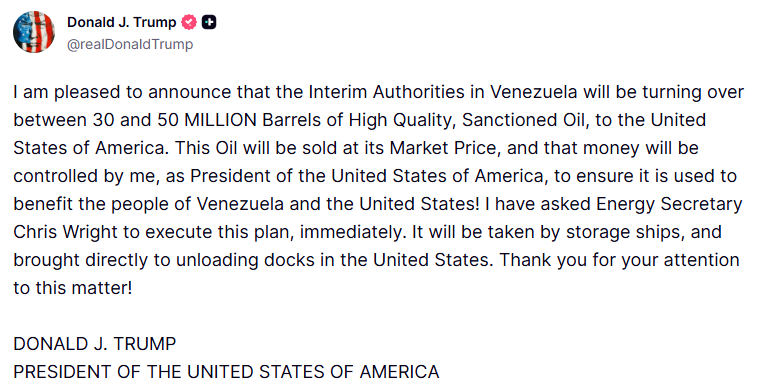
President Donald Trump announced Tuesday that Venezuela’s “interim authorities” would transfer 30 to 50 million barrels of oil to the United States, days after US forces captured Nicolás Maduro in a military raid.
The announcement has fueled speculation about what other Venezuelan assets might be next—including the country’s rumored Bitcoin holdings.
Oil Seizure Sets the Tone
Trump posted on Truth Social that the oil would be “sold at its market price,” with proceeds “controlled by me, as President of the United States.” At roughly $56 per barrel, the transaction could be worth up to $2.8 billion.
The White House has scheduled an Oval Office meeting on Friday with executives from Exxon, Chevron, and ConocoPhillips to discuss Venezuela’s oil sector, signaling that Washington’s interest extends beyond a one-time transfer. Venezuela holds the world’s largest proven crude reserves.
Trump ordered Energy Secretary Chris Wright to execute the plan “immediately,” with storage ships to transport the oil directly to US ports.
Bitcoin Speculation Intensifies
With physical assets now flowing to Washington, attention has turned to Venezuela’s alleged cryptocurrency holdings. Some reports claim the Maduro regime accumulated a “shadow reserve” of Bitcoin to circumvent international sanctions.
Estimates vary wildly. Project Brazen reported Venezuela could hold roughly $60 billion in Bitcoin, citing unnamed sources. Bitcointreasuries.net puts the figure at just 240 BTC, worth approximately $22 million.
Neither estimate has been verified through on-chain analysis. No wallets have been publicly identified, and no custodians have been named.
Experts say it is reasonable to assume Venezuela sought Bitcoin exposure given its exclusion from global financial markets. The country has a documented history of experimenting with cryptocurrencies, including the failed petro token launched in 2018.
Why Bitcoin Is Different
Unlike oil tankers that can be redirected to US ports, Bitcoin cannot be physically seized. Confiscating cryptocurrency requires either private keys or cooperation from custodians within the US jurisdiction.
Venezuela would not have used American or allied custody services given its sanctions status. Maduro’s inner circle is likely to have spread any holdings across numerous wallets, making them extremely difficult to track.
However, the same properties that make Bitcoin hard to seize also make it remarkably easy to move—for anyone who obtains the correct information. Unlike gold bars or oil barrels that require physical logistics, anyone with the private keys can move Bitcoin anywhere in the world within minutes. If US authorities extract private keys from Maduro or his associates, they could confiscate billions in cryptocurrency instantly.
This creates a high-stakes dynamic. The assets are either completely inaccessible or trivially easy to seize, with nothing in between.
Strategic Reserve Implications
The speculation carries added weight given Trump’s executive order to create a strategic Bitcoin reserve “at no cost to taxpayers.” Critics have questioned how the government could accumulate such a reserve without making purchases.
Seizing Venezuelan Bitcoin—if it exists in meaningful quantities—could theoretically address this challenge. However, prosecutors would need to directly link any holdings to criminal charges filed in US courts.
Some crypto market observers see long-term bullish implications regardless of the outcome. The administration would likely hold any Bitcoin it acquires rather than sell, given its stated commitment to building a strategic reserve.
For now, Venezuela’s oil is headed to American ports. Its Bitcoin, if any, remains locked behind unknown keys—beyond the reach of even the most aggressive enforcement actions.


