

The Ethereum staking ecosystem is showing clear signs of tightening as demand for validators continues to rise. Participants now face a multi-week wait to enter the network. This growing staking queue reflects a structural shift in how ETH is being held and deployed less as a liquid supply and more as long-term productive capital. As more ETH becomes locked in validation, the dynamics of supply, yield, and network security are quietly being reshaped.
Why Validator Delays Add Friction To Supply Re-Entry
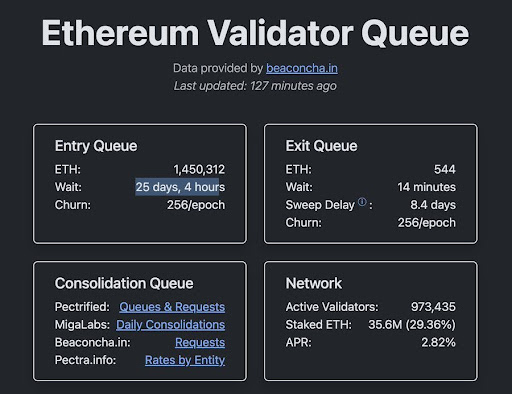
The current state of Ethereum staking highlights a growing problem with predictability. Crypto expert Dave has pointed out on X that the ETH staking entry queue is now showing an estimated wait of 25 days and 4 hours to enter. Previously, the wait time was around 7.55 days, which is a more than threefold increase in wait time over a relatively short period.
At the same time, the exit queue is reporting a wait time of 14 minutes, which previously sat for 44.25 days, representing a reduction of well over 4,000 times, from weeks to minutes. According to Dave, staking on a blockchain with this level of variance between entry and exit requirements is uncertain. Waiting weeks to enter while exit clears almost instantly makes staking behavior highly state-dependent and unpredictable.
This contract is exactly why the expert prefers staking on Cardano, because there is no entry queue. Also, delegation is reflected on-chain immediately, and stake changes are transparent and deterministic. The only delay is a fixed active stake period of two epochs, which is 10 days before delegation changes take effect.
This consistency is the difference because there are no dynamic queues, no sudden shifts, and no surprises driven by changing network states. If demand to stake on Cardano increases rapidly, it will make absolutely no difference, because predictability matters especially with monetary investments.
Why Throughput Without Context Is Meaningless
The headline claim of $8 trillion in stablecoin transfers on Ethereum sounds impressive, but it’s a completely meaningless metric. Crypto analyst DBCrypto noted that a single entity can move $1 billion back and forth between two wallets ten times, creating a sudden $10 billion in volume, but generating zero economic activity.
This is why banks don’t advertise transfer volume as a growth metric, as volume without context tells nothing about utility or growth. However, crypto continues to elevate these numbers as milestones because big figures pump bags. What’s being measured here is motion and activity, not progress or value. DBCrypto concluded that until the industry stops celebrating vanity metrics, it will continue to confuse noise for signal.


