


Circle’s new 2025 year-in-review reads like a status update on where stablecoins are headed next: out of pilot programs and into the real machinery of payments, treasury, settlement, and capital markets.
The company says in their report the biggest change wasn’t just more usage – it was a mindset change. As new rules took shape across key regions, more institutions stopped treating stablecoins as “interesting crypto tech” and started treating them like regulated financial tools that can sit inside normal workflows.
Key Takeaways
Circle says clearer regulation in 2025 pushed stablecoins from pilots into real financial workflows.
The company highlights its IPO and a proposed U.S. trust-bank path as steps toward deeper institutional trust.
Circle’s strategy is expanding beyond USDC, with new apps, FX tools, and Arc as a long-term infrastructure play.
Regulation turns experiments into production
Circle points to 2025 as a turning point for policy. In the U.S., it highlights the GENIUS Act as a major step toward clear standards for fully reserved payment stablecoins. Outside the U.S., it says frameworks and approvals across Europe and parts of the Middle East helped give banks, fintechs, and market operators the confidence to build stablecoin settlement into everyday operations, not just tests.
Circle also uses the report to underscore its own credibility push. It frames its IPO as a milestone meant to reinforce transparency and governance. Separately, it says conditional approval tied to a proposed national trust structure would deepen its integration with the U.S. banking system, with the goal of adding another layer of comfort for institutions using USDC-linked rails.
A wave of partnerships across payments and market infrastructure
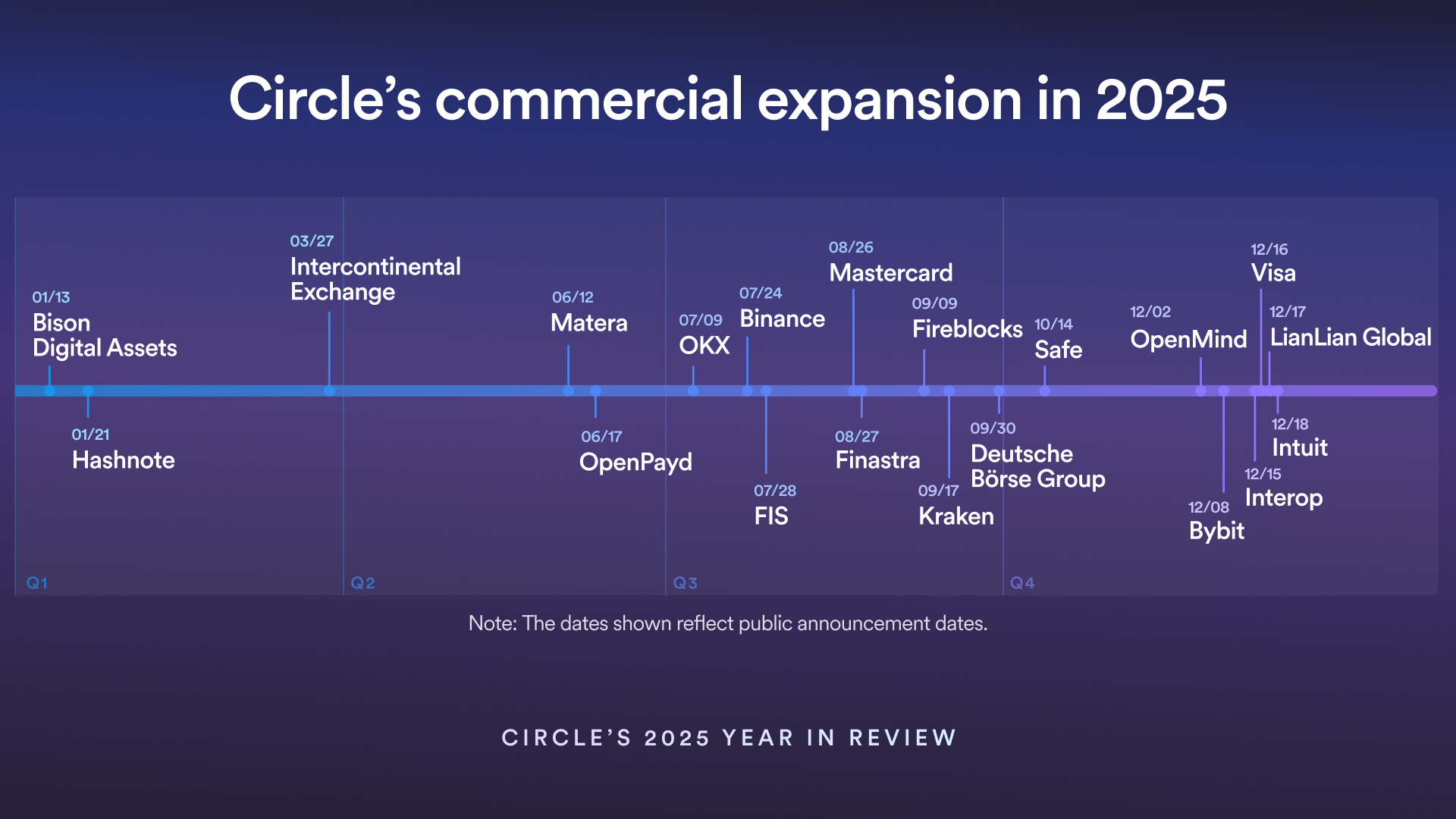
Circle’s commercial timeline for 2025 is packed with recognizable names, and it’s not limited to crypto exchanges. The report highlights discussions and integrations with market infrastructure providers and financial software firms that already sit in the middle of global payments and banking.
In the U.S., Circle points to work with Intercontinental Exchange on exploring how stablecoins and tokenized cash products could fit into mainstream capital-markets workflows. In Europe, it highlights collaboration with Deutsche Börse Group to explore stablecoin use across trading, clearing, settlement, and custody flows.
On the payments side, Circle describes expanded work with Visa and Mastercard around stablecoin settlement, alongside partnerships with infrastructure providers that connect banks and corporates to cross-border payments. It also highlights a wide range of exchange integrations aimed at making USDC easier and cheaper to access for global users, while pushing USYC as a new tool for institutions that want yield-bearing collateral that still moves onchain.
From Circle’s perspective, the overall direction is clear: regulated stablecoins are being tested as operational cash, not just crypto liquidity.
Circle’s bigger play: apps, FX tools, and its own blockchain
Beyond partnerships, Circle’s report tries to show it is building a full “stack” rather than relying on a single product. It positions USDC and EURC as the money layer, and USYC as a tokenized cash-like instrument designed for institutional collateral and cash management.
It then points to new services meant to make stablecoins easier to use in real workflows. The Circle Payments Network is presented as a way for institutions to send money across borders faster using stablecoins, while StableFX is framed as a stablecoin-based approach to FX settlement that runs around the clock.
The biggest strategic signal is Arc, Circle’s purpose-built Layer-1 blockchain. Circle describes it as an “economic OS” designed for real-world finance, with predictable fees, fast settlement, and features meant to appeal to institutional users. The company says Arc’s public testnet attracted a broad set of design partners across finance, payments, and crypto – a sign it wants to own more of the settlement layer long term, not just issue stablecoins that live on other networks.
What it could mean next
If Circle’s view is right, the stablecoin story is shifting from “crypto adoption” to “financial modernization.” In practical terms, that would mean faster settlement windows, fewer delays in cross-border transfers, and more programmable treasury tools for companies that move money globally.
The open question is how quickly this spreads from early adopters to the wider financial system. But Circle’s 2025 review suggests the trend is no longer theoretical: regulated stablecoins are starting to show up where real money moves, and where operational risk matters most.


