

VanEck is projecting Bitcoin’s price to reach $2.9 million by 2050, with the $180 billion asset management firm reaffirming its prediction of an exponential adoption rate uptick over the next quarter-century.
According to the financial firm’s research blog post published Thursday titled “Bitcoin Long-Term Capital Market Assumptions,” the largest coin by market cap could become the go-to global settlement currency and reserve asset in the next 25 years.
The analysis was authored by Matthew Sigel, VanEck’s head of digital assets research, and senior investment analyst for digital assets Patrick Bush.
VancEck base-case valuation estimates 15% annualized return
Discounted cash flow and price-to-earnings models do not exactly capture the characteristics of a non-sovereign monetary asset. The firm mapped Bitcoin’s potential penetration into the global settlement activity and central bank reserve assets.
VanEck’s base case assumes a 25-year horizon beginning in 2026 and ending in 2050, with bitcoin compounding at a 15% annual growth rate through a non-linear path where volatility and periodic market re-ratings are all accounted for.
The asset manager projects the asset could settle between 5% and 10% of global international trade by 2050, while also making up about 5% of domestic trade, taking it to a whopping $2.9 million valuation per coin.
The analysis also identifies global liquidity expansion measured through money supply growth, saying a debasement over time could support the demand for other settlement options and reserve assets, a channel where BTC could benefit.
Crypto market regulatory clarity could affect price growth
VanECk listed regulatory constraints as one of the risks to its thesis, explaining that adoption at the settlement-layer level without clear laws would limit bitcoin’s ability to scale into trade and reserve use.
It outlined bitcoin’s expected volatility profile under its capital market assumptions, predicting annualized volatility between 40% to 70%. Taking the unpredictable price movement into account, VanEck said the king coin has a “very low” correlation to equities, bonds, and gold, and a strong negative correlation to the US dollar.
In the bear market case, bitcoin adoption is usually at its minimum, with near-zero penetration of trade and domestic economic activity. That scenario, per VanEck, would result in a price target of about $130,000 per coin, a 2% annualized return.
A bull market, on the other hand, could envision a hyper-bitcoinization outcome where the crypto would account for 20% of international trade and 10% of domestic gross domestic product.
The implied valuation reaches approximately $53.4 million per coin, corresponding to a 29% compound annual growth rate. VanEck also modeled bitcoin’s share of global financial assets from just 0.07% in the bear case to nearly 30% in the bull case.
On the investment allocations side of the research, VanEck believes the digital asset is a diversifier with convex returns, and a sovereign hedge against several economic slump factors like inflation. The financial institutions suggested allocations will fall between 1% to 3% for strategic portfolios, and as much as 20% for investors with a tolerance for high risk.
Bitcoin unrealized profits hint at peak pricing
Alongside its long-term projections for bitcoin, VanEck discussed near- to medium-term on-chain indicators that inform its view of market cycles. It posted a chart of BTC’s Relative Unrealized Profit, which assesses whether markets are overheating or are bound for a price drop.
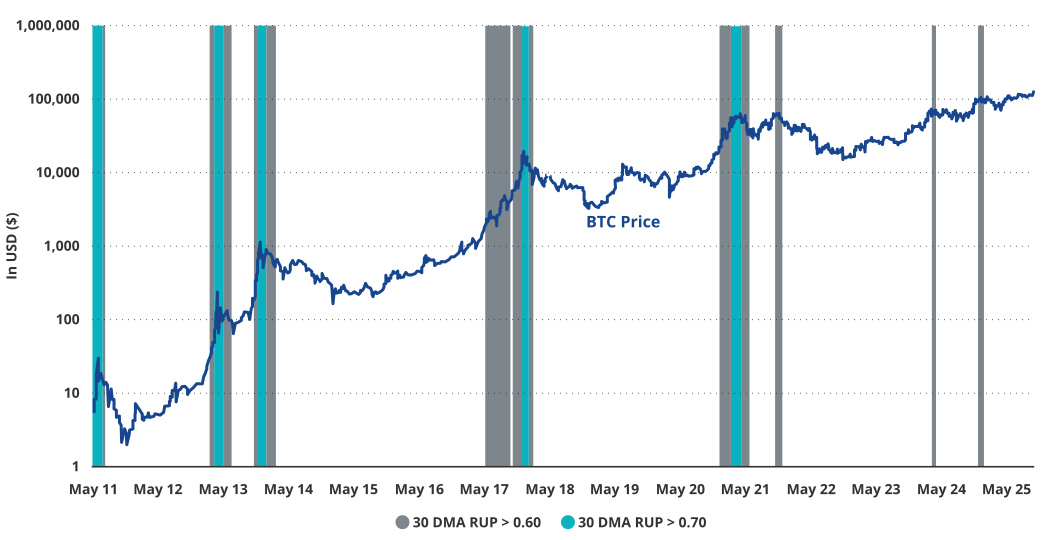
When the 30-day moving average of Relative Unrealized Profit exceeds 0.70, tactical cycle tops usually follow, according to the analysis. The metric stood at 0.43 at the end of 2025, a level VanEck said historically preceded strong returns over the next one to two years.
According to CryptoQuant analyst CryptoZeno, long-term holders have now moved into sustained distribution, with the 30-day net position change flipping into negative territory. The chartist asserted that this pattern is associated with later-stage trends, where older coins re-enter circulation during periods of elevated prices.
This distribution could mean that selling pressure is no longer confined to short-term traders, but is held by conviction holders who are being sold to change the structural balance of supply.
“Bitcoin is likely to experience wider trading ranges and elevated volatility, with price stability hinging more on sustained inflows than on tight supply held by strong hands,” they concluded.
The smartest crypto minds already read our newsletter. Want in? Join them.


