Ethereum Staking Hits Choke Point as Institutions Pile in Despite Low Yields

Markets 2026-01-12 10:54

Ethereum’s staking landscape has shifted sharply over the past month as institutional investors, led by BitMine and new ETFs, have saturated the network.

This influx has created a logistical bottleneck, forcing new participants to wait roughly a month before their staked assets begin earning returns.

Institutions Flock to Ethereum Staking Despite Record-Low Yields

On January 9, blockchain analyst Ember CN reported that BitMine has moved more than 1 million ETH (over $3.2 billion) into Ethereum’s proof-of-stake system over the past 30 days.

This single allocation, comprising roughly a quarter of BitMine’s total corporate treasury, has swollen the entry queue to 1.7 million ETH, its highest level since 2023.

Meanwhile, this surge was also fueled by the arrival of regulated US financial products in the staking ecosystem.

Over the past week, the Grayscale Ethereum Staking ETF and 21Shares’ TETH ETF distributed their first rounds of rewards. The payouts demonstrated that traditional investment vehicles can successfully pass protocol-level earnings to shareholders.

Notably, this institutional momentum comes even as the network’s staking rewards have compressed significantly.

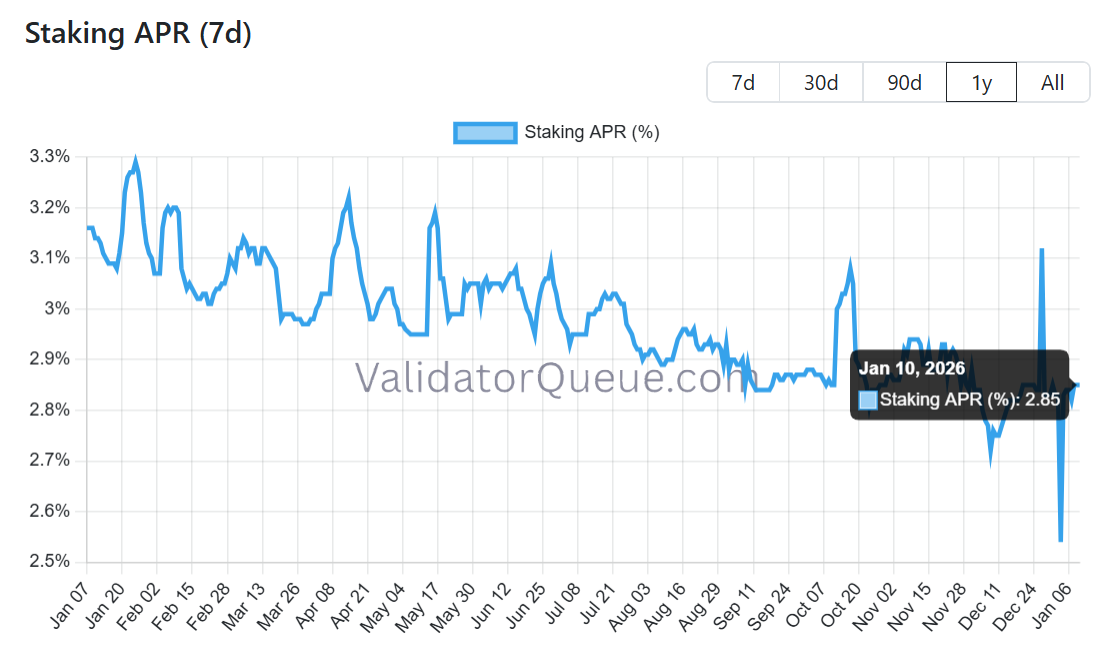
According to validator queue data, ETH’s staking annual percentage rate (APR) dropped to an all-time low of 2.54% earlier this year before recovering slightly to 2.85% as of press time. Over the past year, the APR had averaged over 3.0%.
Ethereum Staking Hits Choke Point as Institutions Pile in Despite Low Yields

Ethereum Staking APR. Source: ValidatorQueue

This data highlights that investors remain willing to stake their assets despite significantly lower returns.

Despite the influx of regulated US entities, ETH’s staking control remains concentrated among a few incumbents.

According to data from Dune Analytics, decentralized autonomous organization Lido DAO retains dominance with 24% of all staked Ether, followed by Binance at 9.15% and Ether.fi at 6.3%. Coinbase, the largest US-based crypto trading platform, controls 5.08%.

Perhaps most significant is the persistence of anonymous actors. The Dune Analytics data also shows that untagged entities control about 27% of the network’s total stake.

This leaves a significant share of Ethereum’s security infrastructure in the hands of unidentified operators who face none of the compliance requirements that bind firms like BitMine.

Share to:

This content is for informational purposes only and does not constitute investment advice.

Curated Series

SuperEx Popular Science Articles Column

SuperEx Popular Science Articles Column

This collection features informative articles about SuperEx, aiming to simplify complex cryptocurrency concepts for a wider audience. It covers the basics of trading, blockchain technology, and the features of the SuperEx platform. Through easy-to-understand content, it helps users navigate the world of digital assets with confidence and clarity.

Unstaked related news and market dynamics research

Unstaked related news and market dynamics research

Unstaked (UNSD) is a blockchain platform integrating AI agents for automated community engagement and social media interactions. Its native token supports governance, staking, and ecosystem features. This special feature explores Unstaked’s market updates, token dynamics, and platform development.

XRP News and Research

XRP News and Research

This series focuses on XRP, covering the latest news, market dynamics, and in-depth research. Featured analysis includes price trends, regulatory developments, and ecosystem growth, providing a clear overview of XRP's position and potential in the cryptocurrency market.

How do beginners trade options?How does option trading work?

How do beginners trade options?How does option trading work?

This special feature introduces the fundamentals of options trading for beginners, explaining how options work, their main types, and the mechanics behind trading them. It also explores key strategies, potential risks, and practical tips, helping readers build a clear foundation to approach the options market with confidence.

What are the risks of investing in cryptocurrency?

What are the risks of investing in cryptocurrency?

This special feature covers the risks of investing in cryptocurrency, explaining common challenges such as market volatility, security vulnerabilities, regulatory uncertainties, and potential scams. It also provides analysis of risk management strategies and mitigation techniques, helping readers gain a clear understanding of how to navigate the crypto market safely.