

The quiet risk facing digital assets today has little to do with volatility or market cycles. It stems from the widening gap between advancing technology and the cryptographic standards still protecting most wallets.
BMIC ($BMIC) addresses this challenge directly through an AI-powered, quantum-resistant wallet built to withstand the next generation of computational threats, positioning the project as a crypto to buy with durability in mind.
This crypto presale enters the market on a clear premise. Quantum computing and artificial intelligence are advancing faster than traditional wallet infrastructure can adapt. Many existing wallets rely on cryptographic systems vulnerable to future attacks. This altcoin to buy focuses on securing assets before those risks become unavoidable.
Crypto Presale Focused on Quantum-Resistant Protection
This crypto presale is centered on a wallet engineered for a post-quantum environment. The BMIC wallet integrates post-quantum cryptography with hybrid signature models to protect assets and transactions. Its foundation relies on signature-hiding smart-account architecture, ensuring public keys are never exposed on-chain.
Built on ERC-4337 account abstraction, the wallet operates through programmable smart accounts rather than traditional externally owned accounts. This structure enables signature privacy, cryptographic agility, and seamless security upgrades. By eliminating on-chain key exposure, the wallet directly mitigates the harvest-now, decrypt-later threat associated with legacy blockchain systems.
By keeping sensitive data off-chain, the architecture reduces long-term exposure to attacks that rely on harvesting transaction signatures today and exploiting them later. Security is implemented as a foundational layer rather than an optional enhancement.
$289,4k raised⚡️
Still early. Still open. Still gaining.
Join now: https://t.co/dUKnc5SZNe pic.twitter.com/YbZP9I7dcA— BMIC_AI (@BMIC_ai) December 18, 2025
AI-Powered Wallet Infrastructure for a Crypto to Buy
Artificial intelligence plays a functional role in how the wallet operates. AI systems optimize cryptographic performance and maintain smooth transaction execution, allowing advanced security measures to operate without introducing friction.
AI also supports continuous monitoring of wallet activity. Potential anomalies and emerging vulnerabilities can be identified early, improving resilience over time. As post-quantum standards evolve, the wallet is designed to adapt without requiring disruptive migrations, which reinforces its long-term relevance as a crypto to buy built for future conditions.
The Best Altcoin to Buy With a Wallet-First Ecosystem
BMIC follows a wallet-first strategy that expands into a broader security ecosystem. The wallet acts as the gateway to additional services that extend protection beyond individual users and into enterprise environments.
Institutional security tools allow organizations to integrate post-quantum custody, encrypted communications, and identity protection alongside existing infrastructure. This approach supports adoption without costly system replacements and aligns with compliance-driven environments across finance, healthcare, and public-sector use cases.
The project’s technical direction is detailed in its official whitepaper, outlining how the wallet, enterprise security services, and future compute access converge into a single ecosystem.
Token Utility Supporting the Crypto Presale Model
The BMIC token underpins access across the ecosystem. Advanced wallet features, enterprise security services, and network participation require token usage. Staking mechanisms contribute to infrastructure reliability while rewarding participants aligned with system stability.
Staking within the ecosystem is designed to avoid classical key exposure. Validator authorization is handled within the smart-account framework, enabling quantum-resistant key rotation and private validation logic. This structure aligns staking rewards with long-term security rather than short-term yield incentives.
A burn-to-compute model further links token usage to network activity. Tokens can be converted into compute credits for future workloads, directly connecting demand to real utility. In addition, a portion of platform revenue is allocated to token buybacks and permanent supply reduction, creating a deflationary mechanism tied to ecosystem growth.
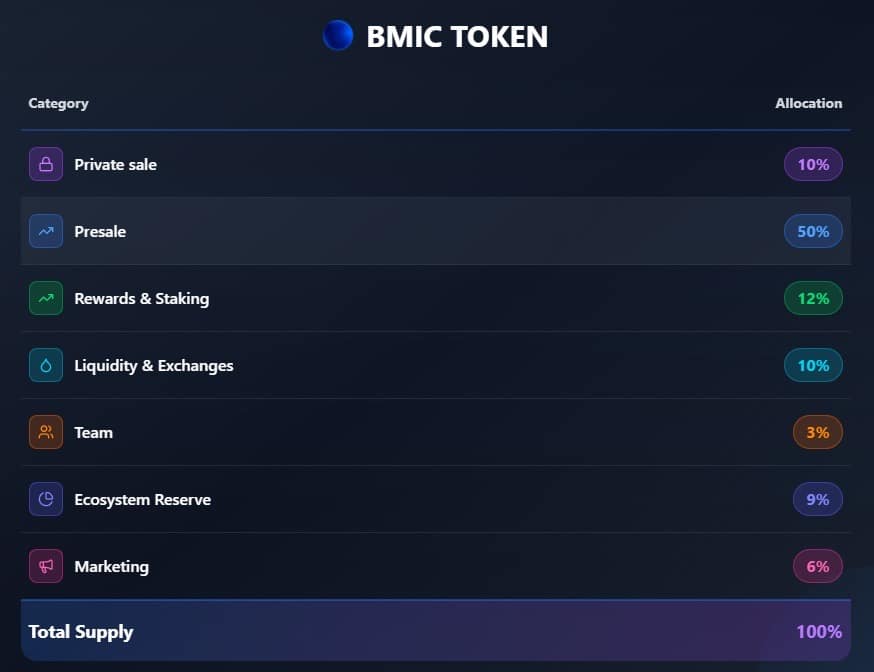
Token distribution balances early access with long-term sustainability. Fifty percent of the total supply is allocated to the crypto presale. Private sale accounts for 10% with gradual release, while rewards and staking incentives represent 12%.
Liquidity and exchange allocation stand at 10%, ecosystem reserves at 9%, marketing at 6%, and the remaining 3% is reserved for the core team under extended vesting conditions.
Decentralized Quantum Compute as a Forward Path
Beyond wallet security, the roadmap outlines a gradual expansion toward decentralized quantum compute access. A unified compute layer is designed to connect multiple hardware providers through a single interface, reducing reliance on centralized platforms.
Blockchain-based incentives encourage infrastructure participation, while AI systems manage workload distribution across classical and quantum resources. The same post-quantum authentication framework is designed to extend into secure transaction and payment rails, supporting a broader vision of quantum-secure digital finance.
How to Buy $BMIC Token in Presale
Participation in the $BMIC crypto presale follows a structured process. Access is provided through the official platform, where compatible wallets can connect to the presale interface. The current presale price of $BMIC is $0.048881.
After connecting a wallet, funds can be allocated according to the published presale terms. This structure provides early exposure to an altcoin to buy and potentially next 100x crypto that prioritizes quantum-resistant security and AI-supported infrastructure from inception.
As digital risks accelerate alongside technological progress, this crypto to buy positions its wallet as a protective layer designed for the next phase of computing. The combination of post-quantum cryptography, adaptive AI systems, and utility-driven token mechanics reflects a security-first approach to emerging challenges.


