

Ethereum traded at $3,150 on Monday (12 Jan) after consolidating within a $3,020–$3,220 range for the past seven days, as renewed discussion around a $4,000 2026 price target gained traction. ETH is up 2.8% over the past 24 hours but remains down 6.4% from its December high near $3,365, reflecting a market still searching for directional conviction. The debate unfolds against a backdrop of accelerating institutional flows, Layer-2 adoption, and a macro environment that continues to reward assets with cash-flow-like utility.
Why Is the $4,000 Ethereum Target Back in Focus?
The renewed focus on $4,000 follows analysis suggesting Ethereum needs incremental, not exponential, demand growth to reclaim higher valuation bands. At the current price, ETH’s market cap sits near $378 billion, roughly 17% below its all-time high, implying that a move to $4,000 would require a market cap expansion to approximately $480 billion. For context, that increase aligns with capital inflows already seen in U.S. Ethereum ETFs, which have recorded $12.5 billion in net inflows as of January 4, 2026, according to PANews.
ETF demand matters because it represents price-insensitive, longer-duration capital. This contrasts with the late-2025 period when persistent outflows pressured ETH below $2,900, as detailed in ICOBench’s ETF flow analysis. The reversal in flows suggests institutional sentiment has shifted from defensive to selectively constructive.
Network Growth and Tokenized Assets Drive Structural Demand
On-chain data reinforces the long-term demand case. Ethereum hosts $170.9 billion in stablecoin market cap and $12.6 billion in tokenized real-world assets, including $4.6 billion in tokenized U.S. Treasuries, the largest such pool in crypto. These assets matter because issuers and users must hold ETH to pay gas fees, creating baseline demand that scales with network usage.
Lower costs have also changed Ethereum’s economics. Daily gas expenditures have fallen to $10–20 million from over $200 million peaks in 2021 following EIP-4844, according to AInvest. Lower fees reduce user friction while preserving fee volume through higher transaction counts—a dynamic that supports sustainable activity rather than speculative spikes.
Layer-2 networks now process over 58.5% of Ethereum transactions, with L2 total value locked at $37.9 billion, up 6.2% week-over-week. Base alone controls 37.5% of that share, underscoring how scaling solutions are absorbing growth while anchoring value back to Ethereum’s base layer. This trend has been a recurring theme in ICOBench’s institutional accumulation coverage.
Technical Structure Suggests Patience, Not Euphoria
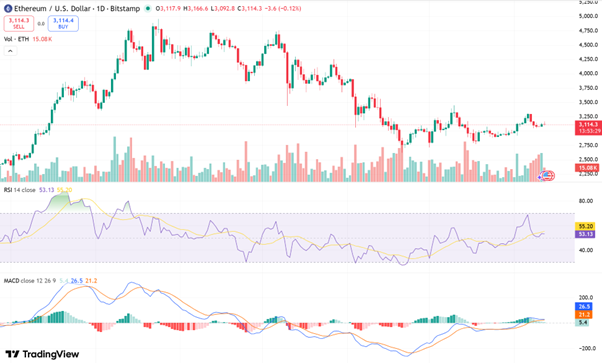
From a trading perspective, ETH’s daily RSI sits at 53, signaling neutral momentum after exiting oversold conditions earlier this month. The MACD histogram has turned slightly positive, but the signal line remains flat, indicating consolidation rather than trend acceleration. Price continues to hold above the 200-day moving average at $2,980, a level that now acts as primary medium-term support.
Source: TradingView
Immediate resistance stands at $3,300, followed by $3,520, where sell-side liquidity capped rallies in November. A sustained break above $3,520 on above-average volume—currently $18.6 billion in 24-hour spot turnover—would materially improve the probability of a 2026 run toward $4,000.
What Could Undermine the Bull Case?
The $4,000 thesis assumes stable risk appetite and continued ETF inflows. A reversal in macro conditions or regulatory pressure on staking-enabled ETFs could reintroduce volatility. Additionally, ETH exchange supply has stabilized rather than declined sharply, suggesting whales are not yet in aggressive accumulation mode.
For now, Ethereum’s fundamentals support cautious optimism rather than exuberance. The data suggests that a $4,000 ETH in 2026 is achievable—but only if network growth continues translating into durable, institution-backed demand.


