

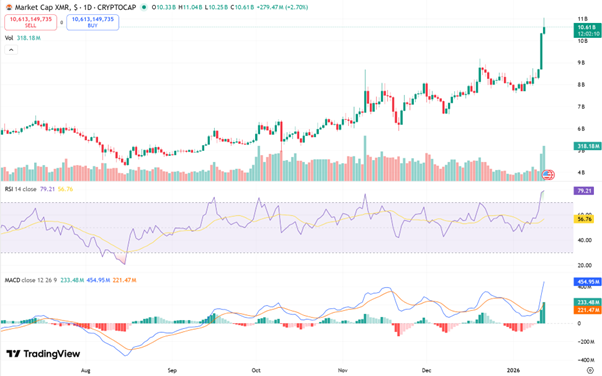
Monero (XMR) climbed to its highest level in more than five years this week, briefly trading above $595 before pulling back, as renewed interest in privacy-focused cryptocurrencies drove increased trading activity. The move marked a decisive shift for the asset after an extended period of consolidation and placed Monero back into focus for both technical traders and longer-term market participants.
The rally unfolded in early January after XMR broke through a resistance range that had constrained price action since late 2021. Once that ceiling was cleared, buying pressure accelerated, pushing the token sharply higher across major spot markets. Although prices retreated from the peak following short-term profit-taking, Monero has continued to trade well above its prior breakout zone, suggesting the market is absorbing gains rather than reversing direction.
Breakout Signals a Structural Change
From a technical perspective, the advance followed months of relatively stable trading that formed a broad base on higher timeframes. Market analysts describe the pattern as consistent with a classic long-term consolidation, where sustained compression can precede sharp directional moves once resistance is resolved. December’s breakout provided confirmation, prompting increased participation from trend-following traders.
Veteran chart analyst Peter Brandt highlighted the structure by comparing Monero’s setup to historical commodity breakouts, noting that similar patterns in traditional markets have often marked transitions from range-bound behavior to sustained trends. While such comparisons are illustrative rather than predictive, they underscore the significance of Monero’s recent move in technical terms.
Hey investors/traders
If you cannot figure out what I am telling you here then I could never be of any value to your thinking pic.twitter.com/dLz1ncK2PX— Peter Brandt (@PeterLBrandt) January 12, 2026
Privacy Narrative and Liquidity Shifts
Beyond chart dynamics, broader market factors appear to have supported the rally. Privacy coins have drawn renewed attention amid ongoing regulatory scrutiny and exchange delistings affecting parts of the sector. Some market participants, such as Simon Dedic, have pointed to disruptions around Zcash-related markets as a potential catalyst for redirected liquidity, benefiting Monero due to its established network, consistent usage, and comparatively deep liquidity.
Privacy mindshare continues to be in up only mode.
The biggest beneficiaries so far have been dino privacy coins like Zcash and Monero, largely driven by cypherpunk ideology and dystopian narratives.
If even simple private store-of-value use cases can perform this well, imagine… pic.twitter.com/TljkZhxFf0
— Simon Dedic (@sjdedic) January 12, 2026
Spot trading volumes rose notably during the breakout phase, reinforcing the view that the move was supported by broad participation rather than isolated trades. This increase in activity has been closely watched as an indicator of underlying conviction.
Momentum Strong but Cooling
Short-term indicators reflect the intensity of the advance. Relative Strength Index (RSI) readings reached overbought levels near the peak, while momentum indicators such as the MACD expanded firmly into positive territory. These signals typically suggest strong trend conditions but also highlight the risk of near-term consolidation as markets rebalance.
Broader Implications for the Crypto Market
Monero’s resurgence has implications beyond a single asset. It highlights a renewed willingness among investors to engage with niche segments of the crypto market, particularly privacy-focused protocols, after a prolonged period of subdued performance. While price volatility remains a feature of the asset class, XMR’s recent behavior suggests it has shifted from a prolonged range into a more active phase, reshaping how privacy coins are viewed within the broader digital asset landscape.


