


JPMorgan Chase & Co. wrapped up 2025 with a fourth-quarter report that underscored its earnings power and balance-sheet strength, beating consensus on most key measures and reinforcing its role as the bellwether of the U.S. banking sector.
While reported net income declined year over year due to higher credit provisioning, underlying performance across revenue, trading, and core banking activity remained robust.
Key Takeaways
JPMorgan beat consensus on most metrics, delivering one of its strongest fourth quarters on record.
Q4 EPS was $5.23 excluding significant items, highlighting stronger underlying profitability than headline figures suggest.
Markets revenue surged, offsetting softer investment banking activity.
Higher credit provisions were largely strategic, not a sign of deteriorating credit quality.
The bank expects 2026 net interest income of about $103 billion, above market estimates.
Revenue growth remains broad-based
Total net revenue rose 7% year over year to $46.8 billion, comfortably ahead of expectations. Adjusted revenue reached $46.77 billion, reflecting solid momentum in both interest-based and fee-driven businesses. Net interest income increased to $25.1 billion, supported by higher deposit balances and stronger revolving credit usage in card services, partially offset by lower interest rates. Excluding Markets, core net interest income still posted growth, highlighting the resilience of JPMorgan’s lending franchise.
Earnings strength masked by one-off items
Reported net income for the quarter came in at $13.0 billion, down 7% from a year earlier. However, excluding significant items, fourth-quarter earnings were materially stronger. JPMorgan reported Q4 earnings per share of $5.23 excluding the significant credit reserve item, pointing to underlying profitability that exceeded market expectations and was not fully reflected in headline figures.
Markets shine as investment banking lags
Markets were a clear standout. Revenue from Fixed Income, Currencies, and Commodities helped lift total Markets revenue by 17% year over year to $8.2 billion, driven by elevated volatility and strong client activity. This performance again demonstrated JPMorgan’s scale advantage during periods of market uncertainty. Investment banking revenue was slightly softer, coming in below estimates, but management said deal pipelines remain healthy and activity was uneven rather than structurally weak.
Credit provisions reflect strategy, not stress
Credit costs rose during the quarter, with provisions totaling $4.7 billion. A significant portion of this was tied to a $2.2 billion reserve build related to the forward purchase commitment of the Apple Card portfolio. Management framed the move as a strategic and precautionary step rather than a response to worsening credit conditions. Consumer credit metrics remained broadly stable, while net charge-offs increased modestly, mainly in wholesale portfolios.
Capital strength and 2026 outlook
JPMorgan closed the quarter with a Basel III CET1 ratio of 14.5% on a standardized basis and total loss-absorbing capacity of $564 billion, maintaining a sizable capital buffer. Shareholder returns remained strong, with dividends and $7.9 billion in net share repurchases during the quarter. Looking ahead, the bank guided for approximately $103 billion in net interest income in 2026, above consensus expectations, signaling confidence in earnings power despite macro and policy risks.
CEO Jamie Dimon said every line of business performed well and highlighted the Apple Card transition as a long-term growth opportunity, while cautioning that markets may be underappreciating potential economic and geopolitical hazards.
Stock price action and technical signals
Following the earnings release, JPMorgan shares climbed around 2%, trading near the $331 level and pushing deeper into recent highs. The post-earnings move confirms that investors focused more on the underlying earnings strength and forward guidance than on the headline decline in reported net income tied to one-off credit items.
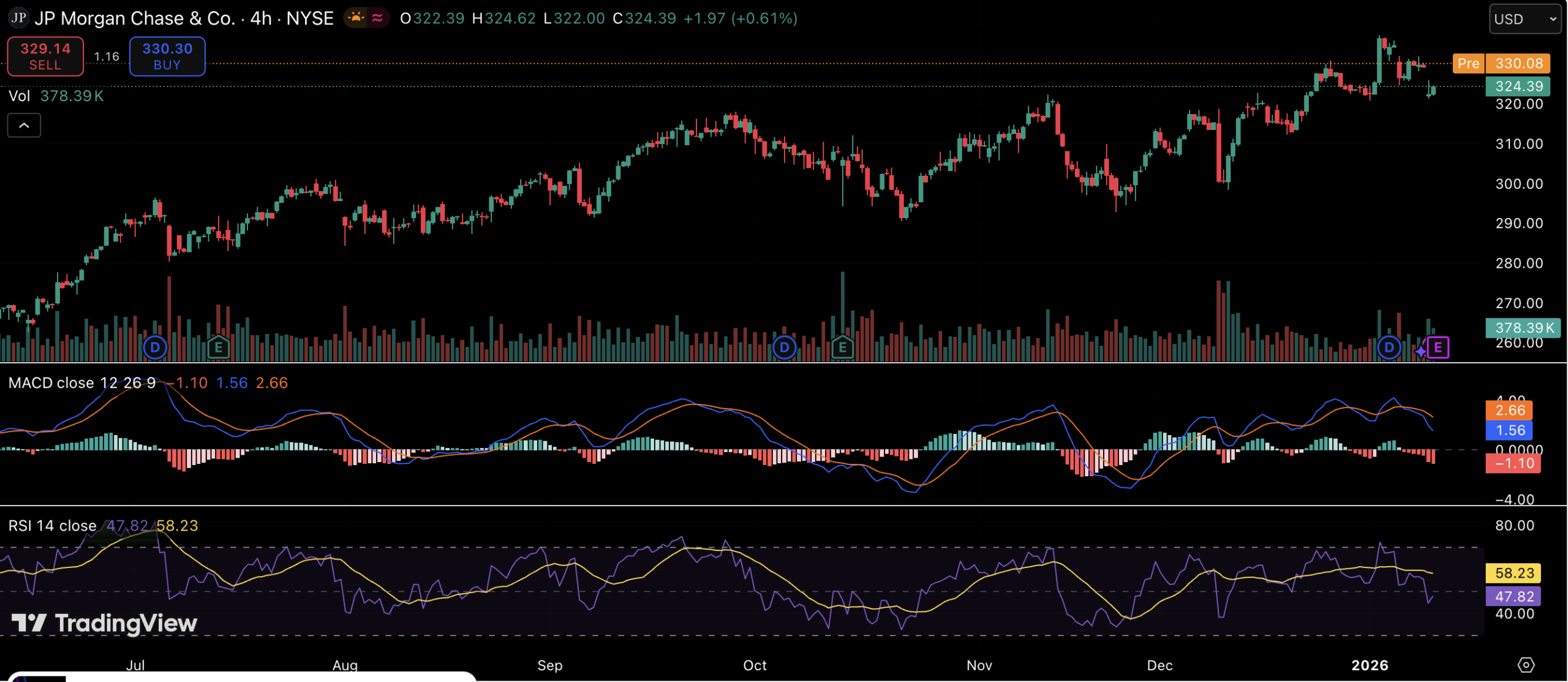
From a technical perspective, momentum is constructive but no longer overheated. The RSI (14) sits just below the 50–60 zone, suggesting neutral-to-slightly bullish conditions rather than an overbought setup. This indicates room for further upside if buying interest remains steady, without the immediate risk of a momentum-driven pullback.
The MACD remains in positive territory, but the histogram has begun to flatten, signaling that upside momentum is slowing rather than reversing. This setup often points to consolidation or a gradual grind higher rather than a sharp breakout. As long as the MACD stays above the signal line, the broader trend remains supportive.
Overall, price action suggests the market is digesting strong fundamentals rather than chasing them aggressively. A sustained hold above recent breakout levels would reinforce the bullish structure, while any near-term pullbacks are likely to be viewed as consolidation within an ongoing uptrend rather than a trend reversal.


