

Advanced Micro Devices (AMD) is heading into 2026 with growing attention on whether its strategic positioning in data centers and AI infrastructure can translate into sustained performance.
While the stock has moved largely sideways in recent months, the underlying drivers behind AMD’s longer-term story are becoming more defined, particularly around CPUs, platform execution, and enterprise procurement dynamics.
Key Takeaways
AMD’s data center CPUs provide stable cash flow and operating leverage.
Helios is a critical proving ground for AMD’s platform strategy.
Becoming a default second source may be enough to lock in long-term demand.
Execution in 2026 will matter more than headline competition.
Data center CPUs remain the cash engine
The most underappreciated part of AMD’s growth story continues to be its data center CPU business. Server CPUs generate strong margins and reliable cash flow, giving AMD a financial base that many AI-focused narratives overlook.
Tight supply conditions, consistent hyperscaler demand, and the potential for pricing improvements are combining with rapid server CPU volume growth to create meaningful operating leverage. This CPU strength allows AMD to support GPU and AI expansion without putting excessive pressure on profitability.
Helios puts AMD’s platform ambitions to the test
Helios represents a major step beyond selling individual chips. The platform is effectively a real-world validation phase for AMD’s ability to deliver rack-level systems at scale. What matters here is not marketing announcements, but actual customer deployments, sustained shipments, and operational reliability.
If Helios gains traction, AMD begins to transition from being viewed primarily as a component supplier to being recognized as a platform vendor, a shift that could materially change how the market values the company.
Second-source adoption could reshape competition
AMD’s path to success does not require overtaking the dominant player in AI accelerators. Instead, its opportunity lies in becoming the default second source for large enterprises. Major technology companies and industrial buyers are increasingly focused on avoiding single-vendor risk in AI infrastructure.
If procurement frameworks start to mandate multi-vendor architectures, AMD can secure recurring demand as part of the baseline system design rather than competing on isolated deals.
Market positioning and the 2026 setup
From a trading perspective, AMD shares have been consolidating, reflecting a market that is waiting for clearer confirmation of execution. Technical indicators suggest neither strong optimism nor deep pessimism, reinforcing the idea that 2026 will be defined by delivery rather than expectations.
Evidence of accelerating CPU growth, Helios platform adoption, and embedded enterprise demand could be the catalyst that turns AMD’s strategic narrative into a sustained market trend.
Technical analysis
Advanced Micro Devices shares are currently trading around the $220 level (down a little over 1% in the past 24 hours), consolidating after a volatile second half of 2025. Price action on the 4-hour chart shows AMD holding a broad range, with buyers repeatedly stepping in near the lower end of recent support while upside momentum remains capped for now.
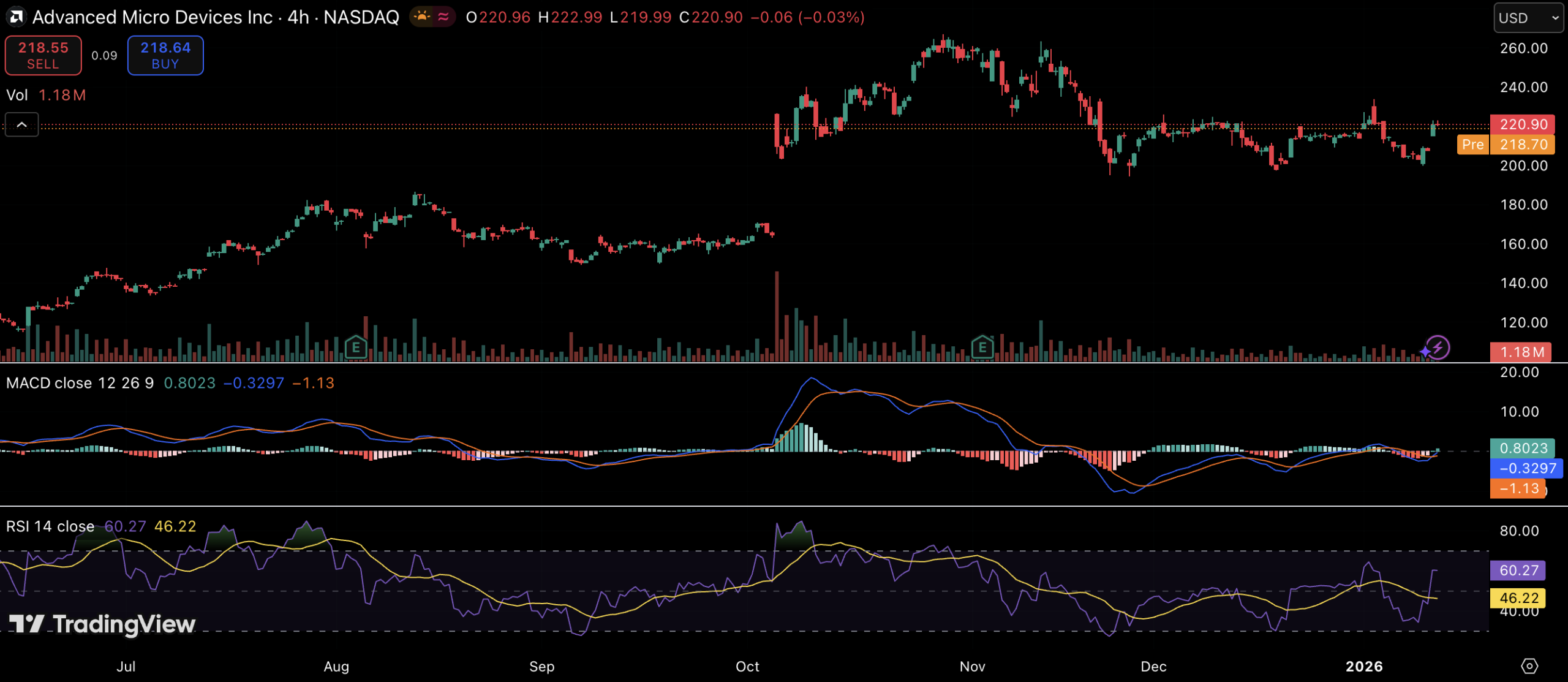
From a momentum standpoint, the RSI is hovering around the low-60s, suggesting moderate bullish pressure without entering overbought territory. This indicates that AMD still has room to move higher if a catalyst emerges, rather than being stretched to the upside.
MACD signals are more neutral but show early signs of stabilization. The histogram has been contracting, and the MACD lines are attempting to flatten after a period of negative momentum. This often reflects consolidation rather than trend reversal, aligning with the sideways price structure seen on the chart.
Overall, the technical setup points to a market waiting for confirmation. A sustained move above recent resistance could shift momentum decisively bullish, while failure to hold current levels would likely keep AMD locked in range-bound trading.


