


A new analysis by Justin Bons, founder and CIO of Cyber Capital, argues that Bitcoin could ‘collapse’ within 7 to 11 years as repeated halvings reduce miner incentives and, in his view, make the network increasingly vulnerable to profitable attacks.
Bons’ argument focuses on the economic foundations of Bitcoin’s proof-of-work system. While Bitcoin’s fixed supply and scheduled halvings are widely viewed as strengths, he contends that the same mechanism steadily reduces the capital available to secure the network. As block subsidies fall, transaction fees are expected to take on a larger role, but Bons questions whether this transition can occur at a scale sufficient to preserve security.
Key Takeaways
Bitcoin’s security budget is shrinking with each halving
Miner revenue, not hashrate, drives security incentives
Profitable attacks could emerge within the next decade
Transaction fees are unlikely to scale sustainably
Network congestion could worsen during stress events
Governance limits reduce flexibility to adapt
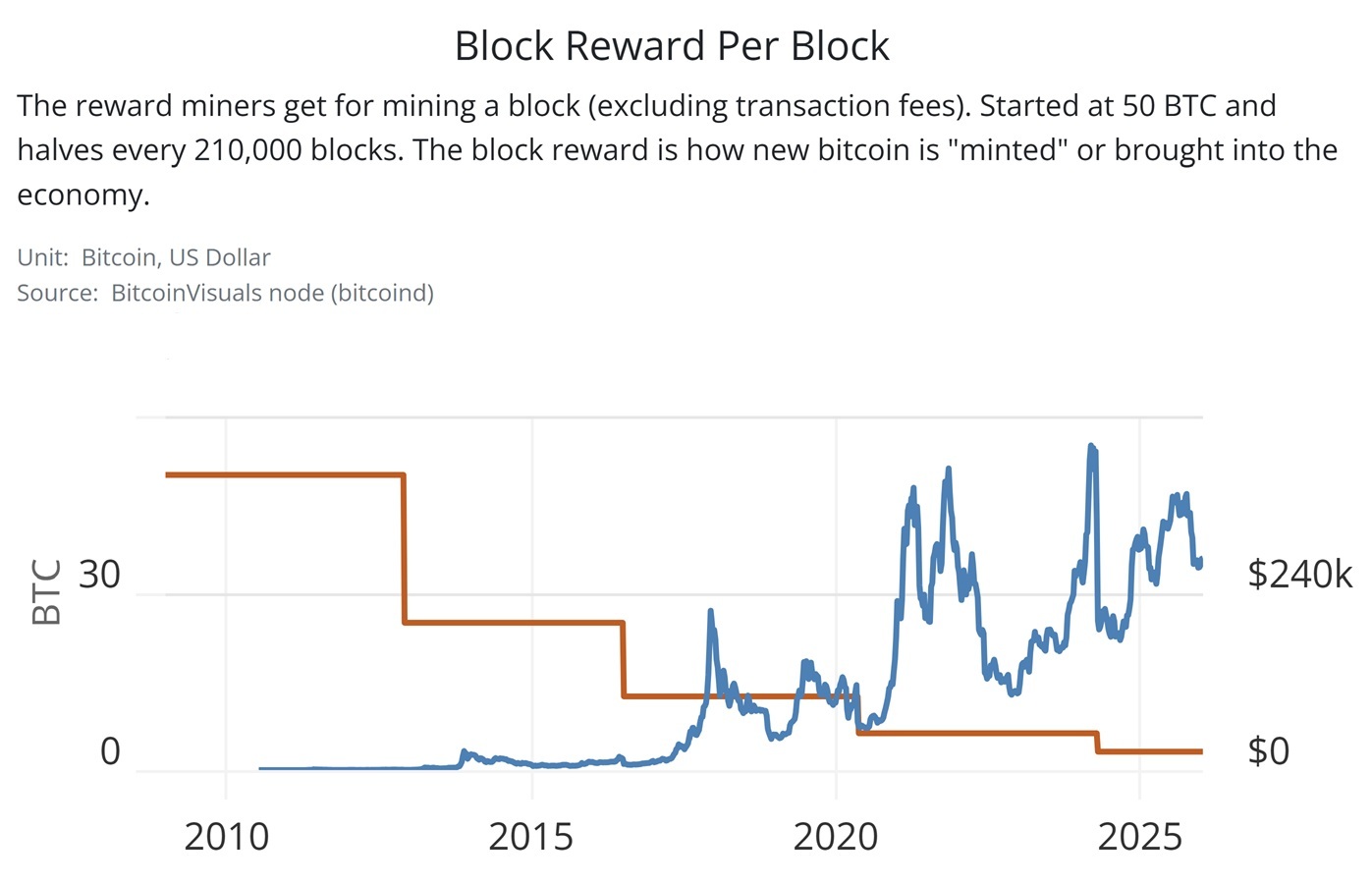
Halvings and declining miner revenue
Bitcoin’s security budget is funded by block rewards and transaction fees. Each halving cuts the inflation-based component in half, reducing miner income unless offset by higher prices or higher fees. Bons argues that relying on perpetual price doubling every four years is mathematically unrealistic over the long term, while sustained high fees would undermine usability.
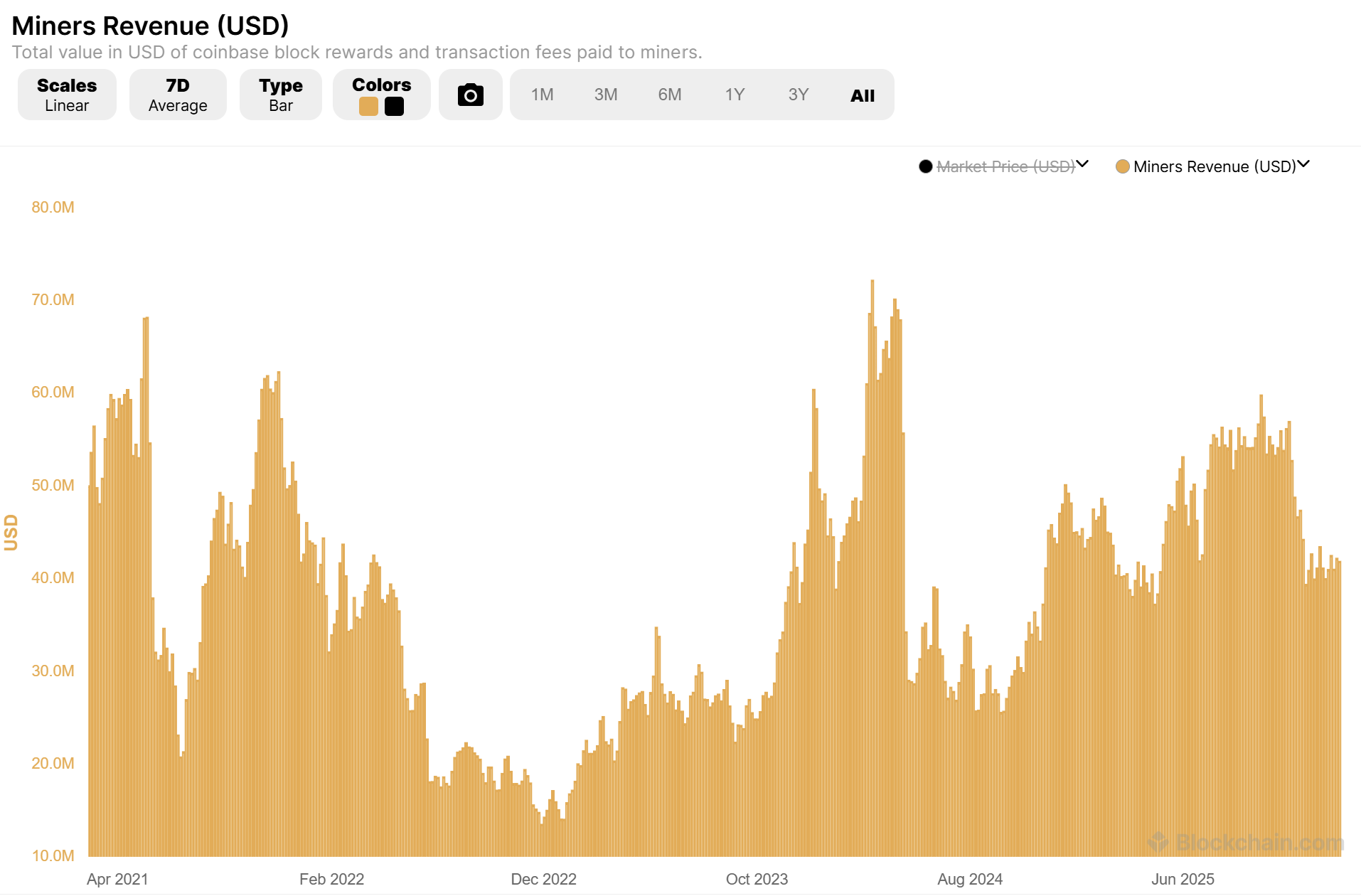
According to miner revenue data cited in the analysis, total payouts to miners, measured in economic terms, are lower today than during earlier cycles, despite higher prices and record hashrate. Bons interprets this as evidence that Bitcoin’s effective security budget is already eroding.
Why hashrate can be misleading
A central point in the report challenges the common assumption that rising hashrate guarantees stronger security. Bons argues that hashrate alone does not reflect the real cost of attacking the network, because improvements in mining hardware efficiency allow more hashes to be produced at lower cost.
From a crypto-economic perspective, he says the relevant metric is miner revenue, which approximates how much capital an attacker would need to overpower honest miners. If revenue declines while hardware becomes cheaper, the cost-benefit equation for an attack can improve even as hashrate rises.
When attacks become economically viable
Using conservative assumptions based on future halvings, Bons estimates that within two to three halving cycles, the cost to sustain a majority-hash attack for a short period could fall into the low millions of dollars per day. At that level, he argues, attacks move from theoretical to economically plausible.
The analysis highlights double-spend attacks targeting centralized exchanges as a realistic vector. In such a scenario, an attacker could deposit bitcoin, trade it for another asset, withdraw the proceeds, and then reorganize the blockchain to reclaim the original coins. Executed across multiple venues, the potential gains could exceed the cost of the attack.
Bons notes that as Bitcoin’s market value grows, the incentives for such attacks increase, while the security budget relative to market capitalization continues to shrink.
Fees and capacity constraints
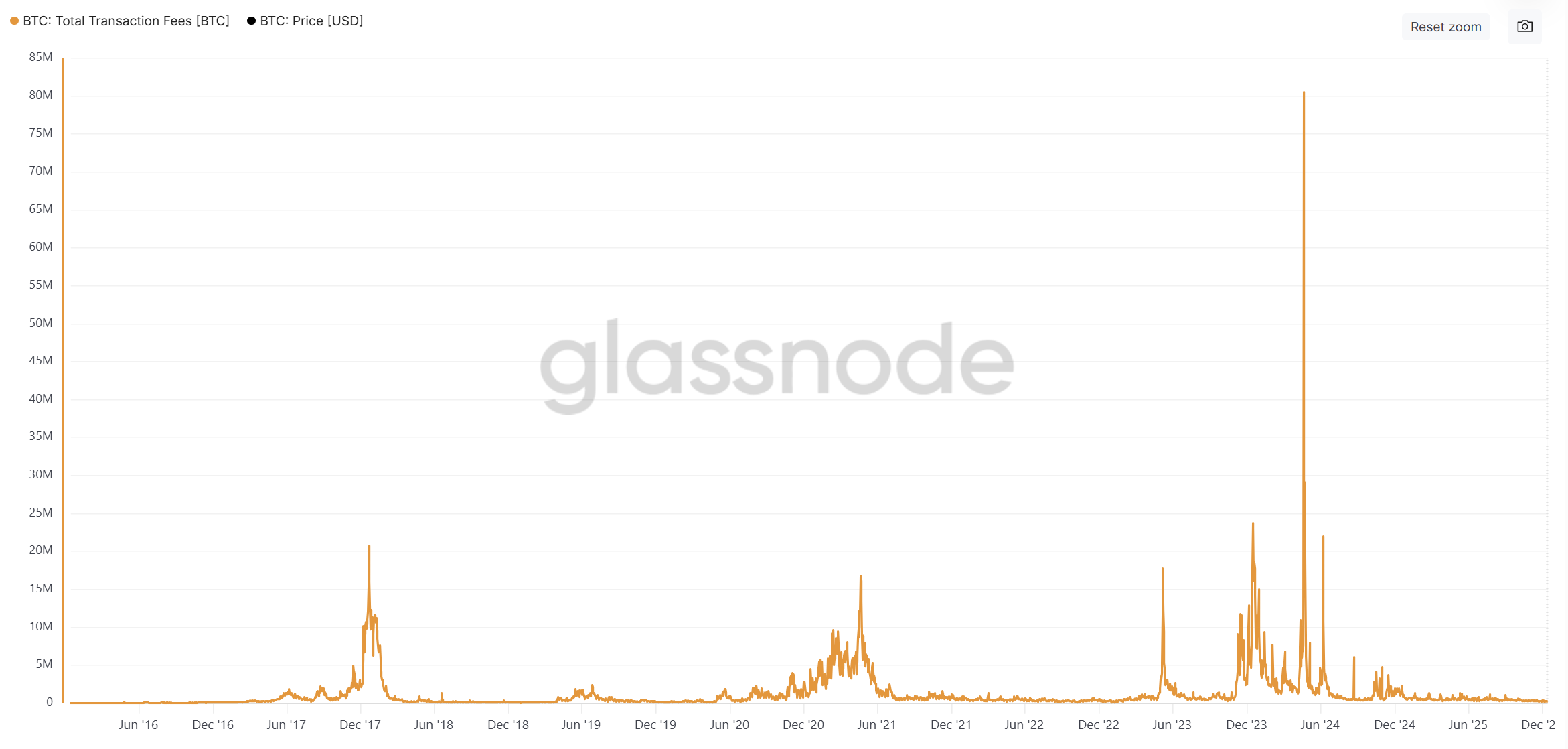
Proponents of Bitcoin’s current design often argue that transaction fees will eventually replace block subsidies as the primary source of miner income. Bons disputes this, pointing to historical fee data showing short-lived spikes rather than sustained growth.
He argues that Bitcoin’s limited base-layer throughput creates a natural ceiling for fee revenue. When fees rise sharply, users reduce activity or seek alternatives, preventing fees from remaining high enough to fund long-term security. In this framework, congestion events do not translate into a stable fee-based security model.
Bitcoin’s capacity limits also feature prominently in the analysis. With base-layer throughput measured in single-digit transactions per second, Bons argues that the network is vulnerable to prolonged congestion during periods of stress.
Congestion and feedback risks
The report outlines a scenario in which a loss of confidence triggers a surge in attempts to move funds on-chain. Given Bitcoin’s fixed throughput, this could result in long transaction backlogs, with many transactions delayed or dropped altogether.
Bons compares this dynamic to a bank-run scenario, where demand to exit overwhelms available capacity. Unlike traditional financial systems, the Bitcoin network has no mechanism to temporarily expand throughput, meaning congestion could reinforce panic rather than resolve it.
He also highlights the interaction between price declines and miner behavior. If falling prices force miners offline, block production slows until the next difficulty adjustment. Slower blocks further reduce capacity, potentially creating a negative feedback loop that compounds congestion, weakens confidence, and pressures prices.
Governance limits and difficult trade-offs
Beyond economics, Bons argues that Bitcoin’s governance structure limits its ability to adapt. He contends that meaningful changes to parameters such as block capacity face strong resistance, leaving few options to address declining security incentives.
In his view, the network ultimately faces a difficult choice: accept declining security as block rewards trend toward zero, or alter Bitcoin’s monetary policy to fund miners. Either outcome, he argues, would undermine a core element of Bitcoin’s current value proposition.
An ongoing and contested debate
Bons’ conclusions remain highly disputed. Many Bitcoin developers and analysts maintain that long-term adoption, fee markets, and second-layer solutions will support security as subsidies decline. They argue that large-scale attacks would be difficult to execute and that incentives will evolve alongside usage.
Still, the analysis highlights a growing concern within the industry: how proof-of-work networks sustain security as issuance falls. As Bitcoin progresses through successive halving cycles, the debate over miner incentives, fees, and long-term resilience is likely to intensify.
Whether or not Bons’ timeline proves accurate, his critique underscores a broader question facing Bitcoin’s future: how to balance scarcity, security, and usability in a system designed to last for decades.


