The Complete Guide to Rocket Pool

Guides 2026-01-17 12:06

What is Rocket Pool?

Rocket Pool is a decentralized liquid staking protocol for the Ethereum ecosystem that allows anyone to stake ETH, earn staking rewards, and contribute to securing the network without needing to run a solo validator. Built on smart contracts and powered by a global network of independent node operators, Rocket Pool lowers the staking requirements for everyday users and technically inclined node operators.

Rocket Pool solves one of the biggest pain points in Ethereum staking: accessibility. Traditionally, native Ethereum staking demands a full 32 ETH, uptime guarantees, and hardware management. Rocket Pool replaces these with a permissionless staking pool and liquid staking tokens. This approach makes it one of the most used and resilient staking platforms in the ecosystem.

How Rocket Pool works under the hood

Rocket Pool operates a two-sided marketplace.

  • Liquid stakers deposit 0.01 or more ETH and instantly mint Rocket Pool ETH (rETH), the protocol’s liquid staking token.

  • Node operators bond 8 or 16 ETH plus RPL tokens, the protocol’s native token, as collateral (minimum 10% of the node operator’s ETH value and capped at a maximum of 150%) to launch a Rocket Pool node called a minipool. The protocol then contributes additional ETH to their bond from pooled deposits until the full 32 ETH minimum is reached to operate a validator.

The table below compares the two primary participants in the Rocket Pool network, ETH holders and node operators, along key requirements and reward dynamics.

Actor Staking requirements Up-front capital Typical reward stream Best for 
ETH holder 0.01 ETH None beyond gas rETH appreciates versus ETH Passive users 
Node operator 8 or 16 ETH + ≥10 % value in RPL Home PC or virtual private server (VPS) Base validator yield + 14 % commission (on the rewards generated from stakers’ ETH, not on their principal or rETH) + RPL inflation Technical users 

The Rocket Pool network relies on a set of trust-minimized smart contracts that handle deposits, validator assignments, reward tracking, and token minting. 

To support off-chain data needs, Rocket Pool uses an Oracle DAO: a decentralized set of elected node operators who submit validator performance data, ensure execution-layer coordination, and monitor for slashing events.

Together, these tools help keep the network secure and ensure that rETH accurately reflects the value of the ETH it represents, including staking rewards.

Liquid staking with rETH

One of Rocket Pool’s most important innovations is the issuance of rETH, a liquid staking token backed by ETH staked through the protocol. rETH makes staking ETH accessible and flexible by removing the traditional lock-up period and enabling decentralized finance (DeFi) utility.

Benefits of rETH include:

  • Liquidity: rETH can be traded, used as collateral, or deployed in DeFi protocols.

  • Appreciation: Unlike rebasing tokens, the exchange rate of rETH to ETH increases in value over time as staking rewards accumulate. While rETH’s underlying value always grows, its market price may fluctuate slightly depending on supply and demand.

  • Direct redemption: Users can swap rETH back to ETH via smart contracts or secondary markets at any time.

  • Minimum staking amount of 0.01 ETH: This low entry point allows nearly anyone to participate in Ethereum staking through Rocket Pool.

    How rETH accrues value

    When ETH is deposited, rETH is minted at a rate based on the current value of staked ETH within the Rocket Pool network. As validators perform duties and earn rewards, they are distributed proportionally to stakers. Instead of increasing token balances, rETH reflects accrued rewards through a rising exchange rate against ETH, allowing holders to passively earn staking rewards without manual claims.

    ‍rETH integrates with major DeFi protocols and infrastructure providers, including major lending platforms like Aave and Compound, decentralized exchanges (DEXs) such as Uniswap and Curve, and oracle providers like Chainlink.

    Node staking and the role of smart nodes

    For users with more capital and technical expertise, Rocket Pool offers the opportunity to become a node operator and run a Rocket Pool node.

    Staking requirements for node operators:

    • Either 16 ETH (legacy model) or 8 ETH (after the Atlas upgrade)

    • Minimum 10 percent of bonded ETH in equivalent RPL tokens‍‍

    • Participation in the Smoothing Pool, Rocket Pool’s system for averaging maximal extractable value (MEV) and priority fee rewards across node operators. is optional but encouraged

    Node operators bond their ETH and are matched with 16 or24 ETH (from the pooled deposits of rETH holders) to create full 32 ETH (8 + 24 = 32 or 16 + 16 = 32) validators. These validators operate on the Beacon Chain, the core of Ethereum’s Proof of Stake (PoS) consensus mechanism, which now manages all validator activity since merging with the execution layer in 2022.

    Node operators earn:

    • Staking rewards on their bonded ETH.

    • A 14 percent commission on the staking rewards generated by the 16 or 24 ETH supplied by regular ETH stakers through the Rocket Pool staking pool.

    • Additional RPL token incentives, distributed regularly as part of Rocket Pool’s inflation-based rewards system. These incentives vary based on how much RPL the operator has staked (up to 150% of their bonded ETH value) and are designed to reward long-term, high-performing node operators.

    Node operators use Rocket Pool’s Smartnode stack, which includes Ethereum clients, monitoring tools, and automation for validator setup. This simplifies the technical workload and helps maintain the network's security.

    Example rewards

    Operator type Bonded ETH rETH matched (to reach 32) Commission RPL rewards Total yield potential 
    8 ETH Node 8 ETH 24 ETH 14% ≈8.20% ~7% to 10% APR*% 
    16 ETH Node 16 ETH 16 ETH 14% ≈8.20% ≈~5% to 8% APR*% 

    * Bonding 16 ETH results in lower yield because you earn commission on a smaller matched pool (16 ETH vs 24 ETH), making 8 ETH nodes more capital-efficient for the same validator rewards.

    The role of RPL tokens

    The RPL token powers governance and insurance within Rocket Pool. Node operators are required to stake (bond) RPL as collateral when launching a validator. This bonded RPL helps protect the protocol against operator misbehavior.

    Key facts about RPL:

    • Collateral requirement: Node operators must stake RPL equal to 10-150% of the value of their ETH bond.

    • RPL tokens are minted at a 5% annual inflation rate: Funds protocol incentives.

    • Distribution of RPL rewards (from inflation):

      • 70% to node operators

      • 15% to the Oracle DAO

      • 15% to the Protocol DAO treasury (Rocket Pool node operators) 

    RPL also grants token holders voting power in Rocket Pool’s governance system, allowing them to vote on upgrades, parameters, and new features.

    Decentralization and security features 

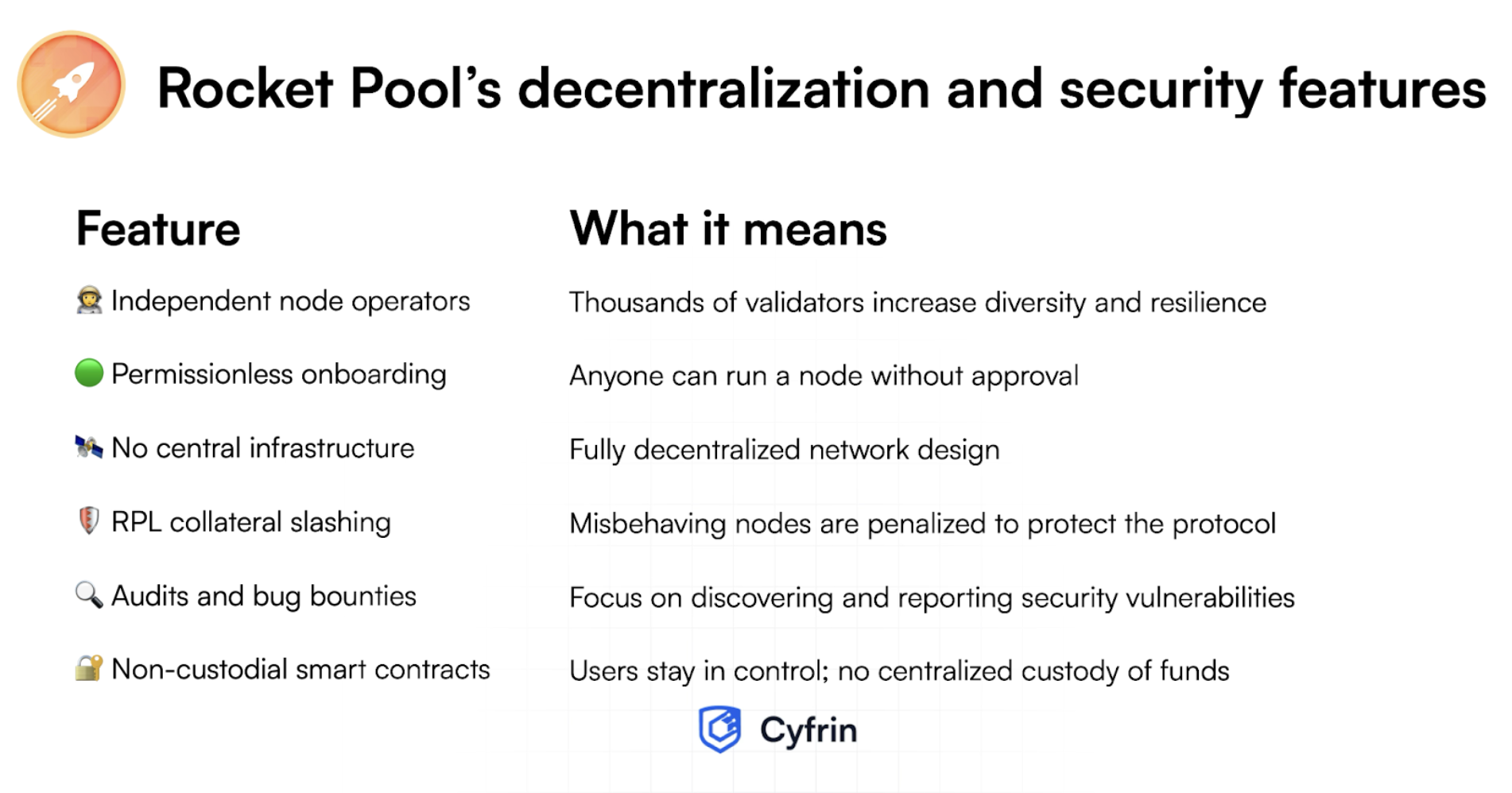
    Rocket Pool’s decentralized design features:

    • Thousands of independent node operators run Rocket Pool validators, enhancing client diversity and resisting censorship.

    • Permissionless node onboarding and validator creation.

    • Minimize reliance on centralized infrastructure as each node operator is a separate entity with their own server infrastructure.

    The protocol’s risk controls include:

    • RPL collateral slashing for malicious or underperforming nodes.

    • Regular audits and bug bounty programs to incentivize vulnerability reporting.

    • Non-custodial smart contracts that eliminate single points of failure.


      The Complete Guide to Rocket Pool

      Rocket Pool features


      These features make Rocket Pool a resilient and trust-minimized staking solution for the Ethereum ecosystem.

      Recent developments and roadmap

      Rocket Pool has made rapid progress in decentralization, efficiency, and usability. Key milestones include:

      • Atlas Upgrade (Apr 2023): Introduced 8 ETH minipools, unified validator queues, and improved rewards distribution.

      • Houston Upgrade (Dec 2023): Brought on-chain governance via the Protocol DAO and improved flexibility for node operators.

      • Saturn Upgrades (Ongoing):

        • Planned support for 4 ETH minipools and Megapools

        • Protocol Revenue Sharing for RPL stakers

        • Tokenomics updates to further align incentives

      • Smartnode v1.16.0 (Jun 2025): Added native MEV-boost relay rotation and auto-update checks.

      • Partnerships and collaborations:

        • Balancer alliance: Deepens rETH liquidity and integrates with advanced DeFi instruments.

        • Ronin integration: Brings Rocket Pool staking to a new audience of GameFi users.

        • Updraft course: A dedicated Rocket Pool rETH Integration course helps DeFi developers learn how to stake, trade, and integrate rETH into protocols like Aave, Balancer, and EigenLayer, accelerating adoption and innovation across the ecosystem

      How to stake ETH with Rocket Pool

      Staking ETH via Rocket Pool is easy and non-custodial. You can use popular wallets like MetaMask or Ledger Live:

      1. Visit Rocket Pool 

      2. Connect your wallet

      3. Enter the amount to stake (minimum 0.01 ETH)

      4. Confirm the transaction to receive rETH

      Your rETH will appear in your wallet and will automatically accrue value over time.

      Conclusion

      Rocket Pool proves that decentralization and convenience can coexist. By splitting the hefty 32 ETH bond required to stake ETH, issuing liquid staking tokens, and letting thousands of independent node operators take part, it makes Ethereum staking accessible while keeping the Rocket Pool network robust against single-point failures. 

      Whether you drop 0.01 ETH for passive income or spin up a smart node to maximize yield, Rocket Pool gives you a decentralized, user-friendly way to participate in Ethereum’s Proof of Stake, with no custodians, no long lockups, and no giant bankroll required.

      Share to:

      This content is for informational purposes only and does not constitute investment advice.

      Curated Series

      SuperEx Popular Science Articles Column

      SuperEx Popular Science Articles Column

      This collection features informative articles about SuperEx, aiming to simplify complex cryptocurrency concepts for a wider audience. It covers the basics of trading, blockchain technology, and the features of the SuperEx platform. Through easy-to-understand content, it helps users navigate the world of digital assets with confidence and clarity.

      Unstaked related news and market dynamics research

      Unstaked related news and market dynamics research

      Unstaked (UNSD) is a blockchain platform integrating AI agents for automated community engagement and social media interactions. Its native token supports governance, staking, and ecosystem features. This special feature explores Unstaked’s market updates, token dynamics, and platform development.

      XRP News and Research

      XRP News and Research

      This series focuses on XRP, covering the latest news, market dynamics, and in-depth research. Featured analysis includes price trends, regulatory developments, and ecosystem growth, providing a clear overview of XRP's position and potential in the cryptocurrency market.

      How do beginners trade options?How does option trading work?

      How do beginners trade options?How does option trading work?

      This special feature introduces the fundamentals of options trading for beginners, explaining how options work, their main types, and the mechanics behind trading them. It also explores key strategies, potential risks, and practical tips, helping readers build a clear foundation to approach the options market with confidence.

      What are the risks of investing in cryptocurrency?

      What are the risks of investing in cryptocurrency?

      This special feature covers the risks of investing in cryptocurrency, explaining common challenges such as market volatility, security vulnerabilities, regulatory uncertainties, and potential scams. It also provides analysis of risk management strategies and mitigation techniques, helping readers gain a clear understanding of how to navigate the crypto market safely.