


Stablecoins have moved from a niche crypto tool into the center of one of the most consequential policy debates in US finance.
As lawmakers race to finalize a sweeping digital asset bill, a single question is dividing regulators, banks, fintechs, and crypto firms alike: should stablecoins be allowed to pay yield?
Key Takeaways
Banks argue yield-paying stablecoins could drain deposits and tighten credit across the economy.
Crypto firms say yield does not equal lending risk and should be regulated through reserve standards, not bans.
Lawmakers are split as they finalize a major crypto bill that could redefine stablecoin economics.
At first glance, the issue sounds technical. In reality, it cuts straight to the future shape of money, banking, and competition in the financial system.
Why banks and regulators are pushing back
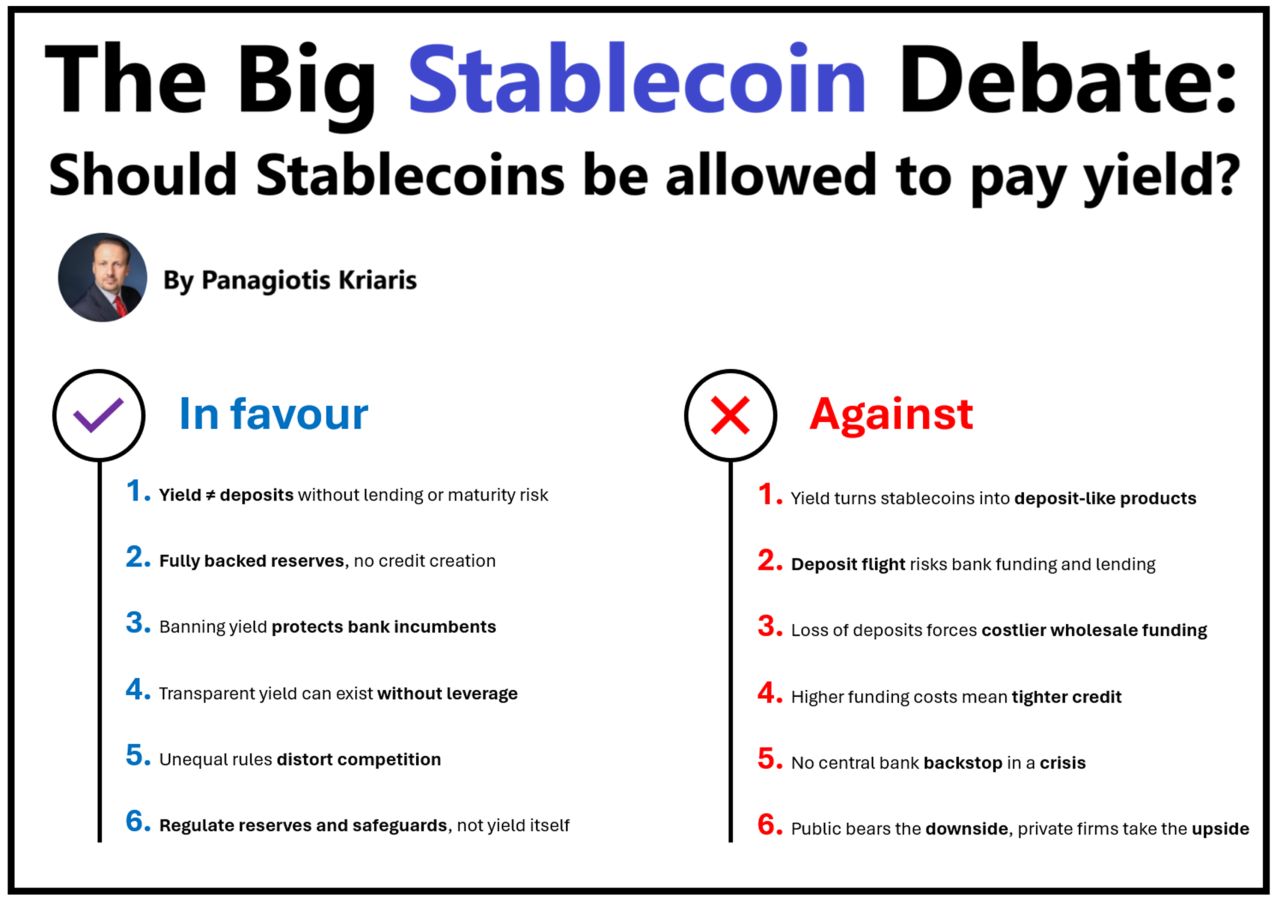
Traditional lenders argue that paying yield fundamentally changes what stablecoins represent. In their view, once a digital dollar starts earning interest, it stops being a payments instrument and starts to resemble a savings product. That shift, they warn, could trigger a large migration of deposits away from the banking system.
The concern is not theoretical. The CEO of Bank of America has publicly cautioned that trillions of dollars could leave commercial banks if interest-bearing stablecoins are widely permitted. Deposits are the backbone of bank funding. When they shrink, banks are forced to rely more heavily on wholesale markets, which are more expensive and more volatile.
Higher funding costs, banks argue, eventually flow through to households and businesses in the form of tighter credit conditions. Loans become harder to obtain, interest rates rise, and lending becomes more sensitive to market stress.
There is also a systemic risk argument. Unlike banks, stablecoin issuers do not have access to central bank liquidity facilities, nor do they operate under established resolution regimes. In a crisis, regulators worry that losses could spill into the broader financial system, leaving taxpayers exposed while private issuers capture the upside during good times.
The crypto industry’s counterargument
Crypto firms and fintech companies see the debate very differently. They reject the idea that yield alone transforms a stablecoin into a bank deposit. From their perspective, the key distinction lies in how the instrument is structured, not whether it earns a return.
Stablecoin issuers emphasize that reserves are fully backed and not used for lending or maturity transformation. Unlike bank deposits, these funds do not sit on a balance sheet supporting credit creation. Supporters argue this makes stablecoins fundamentally different from traditional savings products, even if they generate yield.
They also point to transparency. On-chain yield mechanisms, they say, can be audited in real time and designed without leverage. In contrast, bank risk often remains opaque to depositors despite heavy regulation.
Another flashpoint is competition. Banks are free to pay interest on deposits, while stablecoin issuers face the prospect of an outright ban. Critics argue this protects incumbent funding models rather than consumers and creates an uneven playing field between legacy finance and digital alternatives.
A political fault line in Washington
The dispute is now shaping the final stages of crypto legislation in Congress. Draft language under discussion would prohibit “interest for holding” stablecoins, while still allowing rewards tied to activity such as payments or loyalty programs. Industry participants say that distinction is artificial and could effectively eliminate most yield-bearing designs.
That tension recently spilled into public view when Coinbase withdrew its support for the bill, warning that the restrictions would undermine the economic viability of stablecoin rewards and innovation.
Lawmakers in the United States Senate now face a choice that goes beyond technical regulation. At stake is whether stablecoins remain a narrow payments rail or evolve into a genuine competitor to bank deposits.
The deeper question
Strip away the legal language, and the debate comes down to a structural issue. Are stablecoins simply digital wrappers around existing money, or are they the early form of a parallel monetary system?
How Congress answers that question will shape not only crypto markets, but also the future balance between banks, fintechs, and digital money in the US economy.


