


Ethereum’s staking system has quietly reached a milestone that is reshaping how investors view the network’s long-term supply dynamics.
Data shared by Santiment shows that the official Ethereum Proof-of-Stake deposit contract now holds close to half of all ETH in circulation, underscoring a structural shift toward long-term commitment rather than short-term trading.
Key Takeaways- Nearly half of all ETH is now locked in the Ethereum Staking" >staking deposit contract, signaling strong long-term commitment.
Staking involves actively participating in transaction validation (similar to mining) on a PoS-based blockchain. Users who hold the minimum required balance of a specific cryptocurrency can validate transactions and earn rewards. These rewards are set by the network and are then sent to the user’s wallet.
- The staking Wallet" >wallet cannot freely move funds, making sudden sell-offs structurally impossible.
A device or application that securely holds a user's public and private keys while allowing interaction with a blockchain network.
- Supporters see locked ETH as a sign of confidence, while critics warn about potential future supply pressure if exits accelerate.
The deposit contract, introduced during Ethereum’s transition away from mining, is designed to collect ETH from validators who help secure the network. Over the past year alone, the amount of ETH locked inside this contract has expanded sharply, reflecting growing confidence in staking as both a yield strategy and a vote of trust in the network’s future.
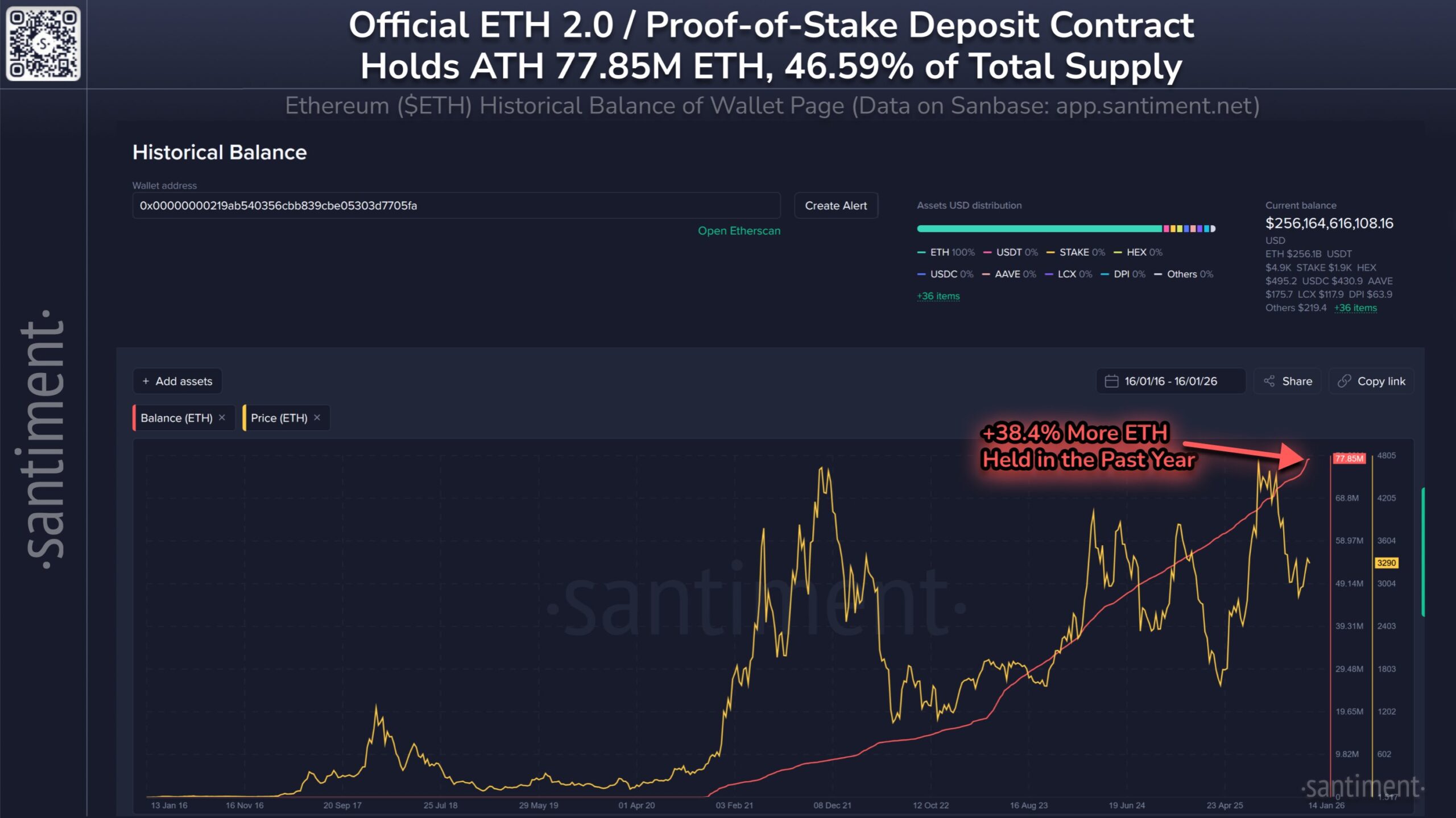
Staking Wallet Grows to Historic Size
The deposit contract currently holds around 77.85 million ETH, valued at just over $256 billion. That represents roughly 46.6% of Ethereum’s total supply, a figure that would normally raise red flags if it belonged to a single investor. In this case, however, the wallet is not a traditional holder but a protocol-level mechanism that aggregates validator deposits.
Importantly, ETH locked in this contract cannot be moved freely. Withdrawals only occur when validators exit staking, and even then, the process is intentionally slow. The protocol enforces exit limits that prevent large amounts of ETH from re-entering circulation all at once, reducing the risk of sudden supply shocks.
Why the “WhaleThese are individuals or entities that own significant quantities of a particular cryptocurrency, often influencing market trends through their holdings.
" >Whale Wallet” Narrative Misses the Point
These are individuals or entities that own significant quantities of a particular cryptocurrency, often influencing market trends through their holdings.
Occasionally, the staking contract is mislabeled as a massive whale wallet capable of influencing markets. In reality, it has no ability to send ETH directly to exchanges or react to price swings. Any reduction in its balance would require thousands of individual validators to exit over time, making rapid liquidation structurally impossible.
That design has helped turn staking into a long-term anchor for Ethereum’s supply. For many participants, locking ETH is less about short-term returns and more about supporting the network while holding through multiple market cycles.
The Debate: Supply Stability or Future Risk?
Supporters argue that nearly half of ETH being locked is a strong signal of conviction. It suggests that a large portion of holders are aligned with Ethereum’s long-term roadmap and are willing to forgo Liquidity The ability to quickly convert a digital currency or token into another asset or cash without affecting its price.
Skeptics, however, point to a different risk. If Ethereum were to face a prolonged price decline, a growing number of validators might eventually choose to exit staking. Even with withdrawal limits, a sustained wave of exits could gradually increase circulating supply and weigh on prices over time. Others also worry that staking concentration could, in theory, give outsized influence to a smaller group of large operators.
What This Means for Ethereum’s Market Structure
Regardless of where one stands in the debate, the scale of ETH locked in Staking Staking involves actively participating in transaction validation (similar to mining) on a PoS-based blockchain. Users who hold the minimum required balance of a specific cryptocurrency can validate transactions and earn rewards. These rewards are set by the network and are then sent to the user’s wallet.
As Ethereum continues to mature, staking behavior is becoming one of the key indicators investors watch alongside price, On-chain Transactions that are recorded and verified on the blockchain.


