

Curve DAO Token (CRV) price predictions attract growing attention as decentralized finance keeps evolving. Many crypto investors now ask a simple question. Is CRV a good investment at current levels?
At the moment, CRV trades around $0.37. This price reflects recent volatility across the DeFi market. In December, CRV dropped to a monthly low of $0.33 on December 19. Earlier, it reached a monthly high of $0.45 on November 28. These moves demonstrate the token’s sensitivity to market sentiment and liquidity trends.
Curve DAO Token plays a key role in decentralized exchanges focused on stablecoins. Because of this, CRV price predictions often depend on DeFi usage, trading volume, and protocol incentives. Beginners often struggle to connect these factors. This guide solves that problem.
In this article, you will learn what Curve DAO Token is and how it works. You will also explore CRV price history, expert forecasts, and long-term Curve DAO price predictions through 2050. By the end, you will understand what drives CRV prices and whether the token fits your risk profile.
| Current CRV Price | CRV Price Prediction 2026 | CRV Price Prediction 2030 |
| $0.37 | $3.5 | $14 |

Curve DAO Token (CRV) Overview
Curve DAO Token (CRV) is the native governance token of the Curve Finance protocol. Curve is a decentralized exchange designed mainly for stablecoins and similar assets. Unlike regular crypto exchanges, Curve focuses on low price volatility and high liquidity efficiency. This design helps users swap assets with minimal slippage.
Michael Egorov created Curve Finance in 2020. His goal was simple. He wanted to build an exchange optimized for stable assets. Because stablecoins move within narrow price ranges, Curve uses special algorithms instead of traditional order books. These algorithms reduce trading costs and improve capital efficiency.
CRV plays a central role inside the Curve ecosystem. Token holders can vote on protocol decisions. These include fee distribution, liquidity incentives, and future upgrades. This system turns Curve into a decentralized autonomous organization, or DAO. Every CRV holder can influence how the protocol evolves.
CRV also supports liquidity incentives. Curve rewards users who provide liquidity with CRV tokens. This mechanism attracts deep liquidity pools. Deep liquidity lowers trading fees and improves price stability. As a result, Curve became one of the most important platforms in decentralized finance.
Another important feature is vote-escrowed CRV, known as veCRV. Users can lock CRV for a fixed period. In return, they receive voting power and higher rewards. Longer lockups bring stronger influence and better yields. This design encourages long-term commitment rather than short-term speculation.
CRV has a fixed maximum supply. However, not all tokens entered circulation at launch. Emissions decrease over time, which may affect long-term price dynamics. Because of this structure, CRV price predictions often consider supply schedules and user participation levels.
CRV Price Statistics
| Current Price | $0.37 |
| Market Cap | $526,548,443 |
| Volume (24h) | $94,451,914 |
| Market Rank | #78 |
| Circulating Supply | 2,334,850,314 CRV |
| Total Supply | 3,030,303,031 CRV |
| 1 Month High / Low | $0.45 / $0.33 |
| All-Time High | $15.37 Aug 14, 2020 |
CRV Price Chart
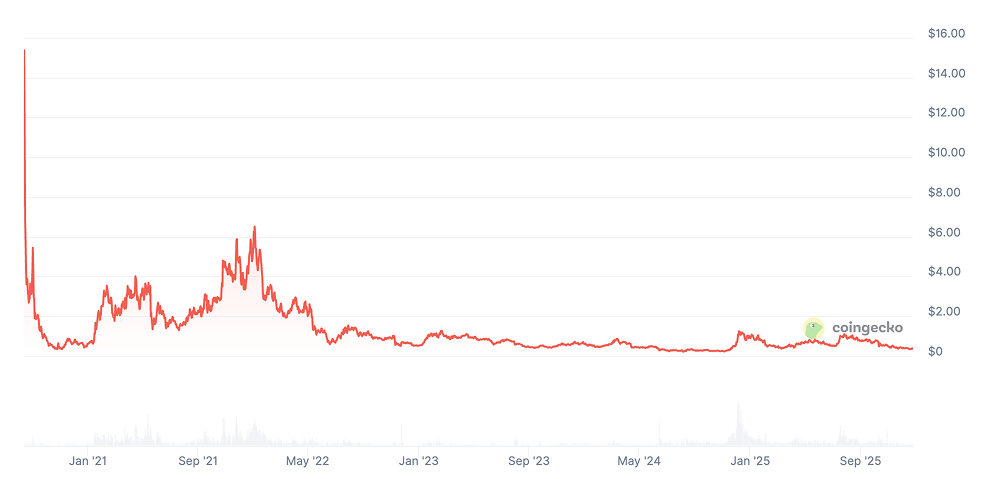
CoinGecko, December 24, 2025
Curve DAO Token (CRV) Price History Highlights
2020: DeFi Summer And A Turbulent Launch
Curve DAO Token launched in August 2020 during the peak of DeFi Summer. Early trading was chaotic. On some exchanges, CRV briefly traded above $50 in the first minutes. Soon after, the price stabilized near $6–$7. This phase reflected pure price discovery.
The main issue was aggressive token emissions. Curve distributed large amounts of CRV to liquidity providers. This constant supply increase created heavy selling pressure. Even though Curve’s TVL kept growing, the token price collapsed. CRV closed the year near $0.6, far below its opening levels.
2021: Curve Wars And The Bull Market Peak
In 2021, Curve entered its strongest growth phase. The protocol introduced the veCRV model. This system rewarded long-term token locking with voting power and higher yields. As a result, major DeFi protocols began competing for CRV control. This period became known as the Curve Wars.
Demand for CRV increased steadily. The price recovered from $0.60 and climbed above $4.00 by spring. Despite a broad crypto crash in May, CRV regained momentum later in the year. It ended 2021 around $5–$5.35, approaching its all-time high near $6.50.
2022: Market Collapse And Systemic Shocks
The year 2022 marked a sharp reversal. CRV opened near $6, but the market environment deteriorated fast. The collapse of Terra’s UST stablecoin in May hit Curve directly. Curve pools became central to the depeg event.
Although Curve functioned as designed, fear dominated the market. Capital exited DeFi rapidly. Later, the FTX collapse intensified losses across crypto. CRV dropped below $1.00 and reached lows near $0.5, reflecting extreme risk aversion.
2023: Exploits And Founder Risk
CRV traded between $0.4 and $1.2 in 2023. Early optimism faded in July after a vulnerability in the Vyper programming language led to pool exploits. Prices fell sharply.
Concerns grew around founder Michael Egorov’s large CRV-backed loans. Liquidation risks threatened further downside. Egorov reduced pressure through OTC token sales, stabilizing the market temporarily.
2024: Forced Liquidations And Market Reset
Mid-2024 brought the final clearing event. Large CRV positions tied to Egorov were liquidated. Prices collapsed to $0.18–$0.2, the lowest levels ever recorded.
This sell-off removed long-standing supply overhangs. Combined with reduced emissions and a recovering market, CRV rebounded strongly. The year ended near $0.9.
2025: Volatility And Return To Fundamentals
In 2025, CRV showed sharp swings. It spiked to $0.94–$1.15 during the summer rally. Later, altcoins weakened against Bitcoin. By December, CRV traded near $0.37, reflecting cautious sentiment.
Curve DAO Token Price Prediction: 2026, 2027, 2030-2050
| Year | Minimum Price | Maximum Price | Average Price | Price Change |
| 2026 | $0.54 | $6.56 | $3.5 | +845% |
| 2027 | $0.76 | $10.81 | $5.5 | +1,385% |
| 2030 | $2.23 | $25.71 | $14 | +3,680% |
| 2040 | $70.56 | $193.31 | $130 | +35,000% |
| 2050 | $142.13 | $267.35 | $200 | +54,000% |
Curve DAO Token Price Prediction 2026
DigitalCoinPrice analysts project that in 2026, Curve DAO Token could trade between $0.69 (+90%) on the lower end and $0.88 (+140%) at peak levels. This outlook reflects gradual recovery in DeFi liquidity and renewed interest in yield-focused protocols.
According to PricePrediction, CRV may see a more conservative range. Their 2026 forecast places the token between $0.54 (+50%) and $0.64 (+75%), suggesting a stabilization phase as Curve adapts to changing DeFi market dynamics.
Telegaon presents a far more bullish scenario. Their 2026 estimates place CRV between $3.63 (+900%) and $6.56 (+1,700%), assuming a strong DeFi resurgence and increased demand for Curve’s liquidity infrastructure.
Curve DAO Token Price Prediction 2027
DigitalCoinPrice expects CRV to continue climbing in 2027, with prices ranging from $0.98 (+170%) to $1.32 (+260%), supported by protocol maturity and improved token economics.
PricePrediction also sees upside momentum. Their models forecast a minimum price of $0.76 (+110%) and a maximum of $0.94 (+160%), pointing to steady but controlled growth.
Telegaon remains aggressively optimistic. Their 2027 outlook places CRV between $6.74 (+1,700%) and $10.81 (+2,85%), driven by expectations of mass DeFi adoption and long-term capital inflows.
Curve DAO Token Price Prediction 2030
By 2030, DigitalCoinPrice analysts believe CRV could trade between $2.25 (+500%) and $2.77 (+650%), reflecting broader DeFi usage and sustained demand for stablecoin liquidity.
PricePrediction aligns closely with this view. Their 2030 forecast suggests a range of $2.23 (+500%) to $2.7 (+630%), assuming Curve maintains its role as a core DeFi protocol.
Telegaon’s long-term model is significantly more bullish. Their projections place CRV between $19.64 (+5,300%) and $25.71 (+7,000%), pricing in a major expansion of decentralized finance.
Curve DAO Token Price Prediction 2040
PricePrediction’s ultra-bullish 2040 scenario places CRV between $159.85 (+44,000%) and $193.31 (+53,000%), based on assumptions of large-scale institutional adoption and deep integration into global finance.
Telegaon offers a more moderate—but still explosive—forecast. Their 2040 price range spans from $70.56 (+19,000%) to $94.82 (+26,000%), accounting for long-term market cycles and competition.
Curve DAO Token Price Prediction 2050
Looking further ahead, PricePrediction estimates that CRV could trade between $227.92 (+61,000%) and $267.35 (+72,000%) by 2050, assuming Curve becomes a foundational pillar of decentralized liquidity.
Telegaon’s 2050 outlook is slightly more conservative. Their model places CRV between $142.13 (+38,000%) and $181.78 (+50,000%), reflecting a slower but sustainable global adoption curve.
CRV Price Prediction: What Do Experts Say?
Expert opinions on Curve DAO Token show a wide range of expectations, but most analysts agree that CRV stands at a critical recovery phase. Recent technical studies focus on momentum signals, key resistance levels, and broader market confirmation rather than long-term narratives alone.
Alvin Lang presents one of the most structured recovery cases. His analysis from late November highlights a potential move toward the $0.55–$0.76 range by the end of 2025. This outlook reflects a possible upside of 20% to 70% from observed entry levels near $0.45. Lang places strong emphasis on momentum divergence. He notes that the MACD histogram turned positive while the MACD line remained slightly negative. Historically, this setup often precedes stronger upside moves. According to Lang, the $0.55 level remains decisive. A clean break above it would confirm medium-term bullish momentum, while $0.37 acts as a key downside support.
Joerg Hiller takes a more cautious stance. His framework focuses on consolidation and controlled breakout potential. Hiller identifies $0.44 as a technical pivot that could define CRV’s short-term direction. With RSI near neutral levels around 49, he argues that the market has room to move without immediate exhaustion. His base case targets the $0.42–$0.55 zone, with $0.5 as a realistic magnet price. A confirmed breakout above $0.55, in his view, could unlock roughly 25% upside before year-end.
Caroline Bishop delivers the most aggressive outlook. She projects a recovery toward $0.75–$0.9 from the $0.38 area, with extended targets reaching $1.15 under favorable conditions. Her thesis centers on CRV rebounding from its 52-week low near $0.37, supported by MACD reversals from oversold territory. However, she assigns only medium confidence, stressing that broader market strength remains essential.
CRV USDT Price Technical Analysis
Based on Investing.com’s monthly technical dashboard, the overall signal for CRV is Strong Sell. Both main groups agree. Technical Indicators show Strong Sell, and Moving Averages also show Strong Sell. In the summary count, the monthly reading shows only 1 Buy signal versus 7 Sells for indicators, and 1 Buy versus 11 Sells for moving averages. That imbalance suggests the higher-timeframe trend still leans bearish.
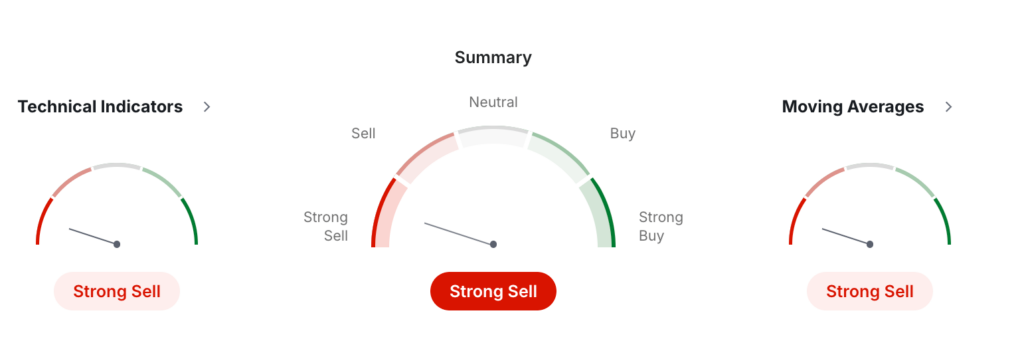
Investing, December 24, 2025
Momentum indicators support that view. RSI (14) at 44.10 prints a Sell signal, which usually means weak demand and limited upside pressure. MACD (12,26) at -0.156 also signals Sell, reinforcing that bearish momentum remains in control. At the same time, a few metrics hint at exhaustion. StochRSI (14) at 0 flags oversold conditions, and Williams %R at -85.17 also sits in oversold territory. In simple terms, CRV looks weak on the monthly chart, but it may already be “stretched” to the downside.
Trend strength looks muted rather than aggressive. ADX (14) at 13.50 reads Neutral, which often means the trend lacks strong conviction. However, volatility remains elevated. ATR (14) at 0.3706 is marked as high volatility, so price swings can stay sharp even without a strong trend.
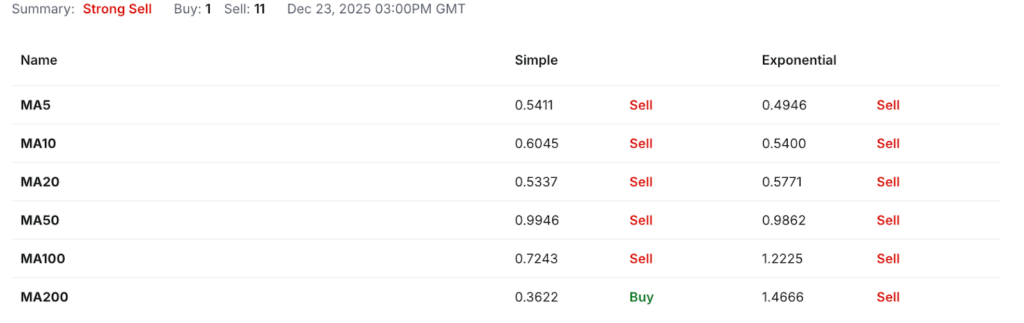
Moving averages confirm the pressure. Short and mid-term averages (MA5, MA10, MA20, MA50, MA100) all show Sell on both simple and exponential settings. The only exception is MA200 (Simple) at 0.3622, which shows Buy, suggesting the current zone sits near a long-term reference level on the simple 200-month line.
For key levels, Investing.com pivot points place the monthly pivot near 0.4412 across methods. Common support zones cluster around 0.34–0.37 (S1/Fib), with deeper supports near 0.26 and 0.16. On the upside, resistance levels appear near 0.52, then 0.62, and higher around 0.7.
What Does the CRV Price Depend On?
The price of CRV depends on several interconnected factors. Most of them come directly from how the Curve protocol functions inside the DeFi ecosystem. For beginners, it is important to understand that CRV is not driven by hype alone. Its valuation reflects real usage, incentives, and market conditions.
The first key factor is Curve protocol activity. Curve specializes in stablecoin and low-volatility asset swaps. When trading volume and total value locked (TVL) increase, demand for CRV usually improves. Higher usage means more fees, stronger governance interest, and greater demand for locked CRV.
Another major driver is token supply and emissions. CRV has a known emission schedule, but inflation still plays a role. When emissions remain high, selling pressure increases. When emissions decline, the market often reacts positively. Long-term price performance depends heavily on how fast new tokens enter circulation.
Governance demand also matters. CRV is required for voting power through veCRV. Protocols, funds, and large liquidity providers often buy and lock CRV to influence reward distribution. This creates structural demand that does not depend on short-term price moves.
Market-wide conditions strongly affect CRV as well. During Bitcoin-led rallies, altcoins like CRV often lag. In contrast, when capital rotates into DeFi, CRV tends to perform better. Liquidity cycles matter more than news headlines.
Several additional factors influence CRV price dynamics:
Growth or decline in DeFi adoption.
Stablecoin market health and regulation.
Yield competitiveness versus other DeFi protocols.
Risk sentiment toward governance tokens.
Security events also play a role. Exploits, smart contract bugs, or liquidation risks can damage confidence quickly. Even if the protocol remains functional, fear can push prices lower.
Finally, the long-term CRV price depends on whether Curve keeps its relevance. If Curve remains a core liquidity layer for stablecoins, CRV maintains utility. If competitors outperform Curve, demand for CRV may weaken.
Curve DAO Token (CRV) Features
From a technical perspective, Curve stands apart from most decentralized exchanges. Unlike generic automated market makers, Curve designs its math for stablecoins and correlated assets, not broad price discovery. This focus allows Curve to deliver very low slippage and deep liquidity where it matters most.
The foundation of the protocol is the StableSwap invariant (v1). This model blends two classic AMM formulas. When a pool stays balanced, it behaves like a constant sum model, which means near-zero slippage. As the pool becomes imbalanced, it gradually shifts toward a constant product model. This hybrid approach creates a flat bonding curve around the peg, such as $1.00 for stablecoins. Large trades can execute with minimal price impact.
Curve v2, also known as CryptoSwap, extends this concept to more volatile pairs like ETH/USDT. Instead of a fixed range, Curve v2 concentrates liquidity around an internal oracle price. The protocol tracks price using an exponential moving average (EMA). As the market moves, Curve automatically shifts its liquidity curve. This reduces impermanent loss and removes the need for manual rebalancing.
Another major innovation is LLAMMA, the engine behind Curve’s native stablecoin, crvUSD. LLAMMA replaces hard liquidations with soft, gradual ones. When collateral prices fall, the system slowly converts collateral into stablecoins across defined price bands. If prices recover, the process reverses. This smooth approach lowers liquidation risk and market shock.
Curve also offers Tricrypto-NG pools, optimized for three-asset combinations like USD, BTC, and ETH. These pools adjust fees dynamically based on volatility, helping protect liquidity providers during unstable markets.
Finally, Curve supports cross-chain and sidechain gauges. This system allows the DAO to direct CRV emissions across multiple networks, unifying liquidity across Layer 2 ecosystems while keeping governance centralized.


