

Dogecoin (DOGE) is consolidating near a critical technical zone as analysts point to a repeating long-term fractal that previously preceded a major cycle expansion. DOGE traded at $0.125 at press time, up 2.4% over 24 hours and down 13.3% on the week, according to aggregated exchange data. The setup emerges as meme coins regain attention amid a broader altcoin rotation tied to expectations for a potential 2026 crypto bull run.
What is the fractal pattern driving Dogecoin’s $1 narrative?
A fractal in technical analysis refers to a recurring price structure that repeats across market cycles, often reflecting similar trader behavior under comparable conditions. In Dogecoin’s case, analyst Tardigrade compare the current 2020–2026 cycle to the 2013–2018 structure, where a prolonged descending channel acted as a corrective phase rather than a trend reversal.
$Doge/Monthly
Macro Structure in #Dogecoin ✍️ pic.twitter.com/qA0paGHaPj— Trader Tardigrade (@TATrader_Alan) January 21, 2026
Importantly, the parallels are structural rather than purely visual. Channel inclination, temporal symmetry, and internal reactions closely match the earlier cycle. During 2013–2018, Dogecoin resolved the descending structure to the upside and reclaimed mid-range resistance, initiating an extended expansion phase.
Momentum and volume data signal a potential shift
On the daily chart, Dogecoin’s 14-day RSI sits near 42, up from sub-35 readings earlier this month, forming a bullish divergence where momentum makes higher lows while price remains range-bound. This matters for traders because RSI divergence often appears near the end of corrective phases, signaling seller exhaustion rather than renewed downside.
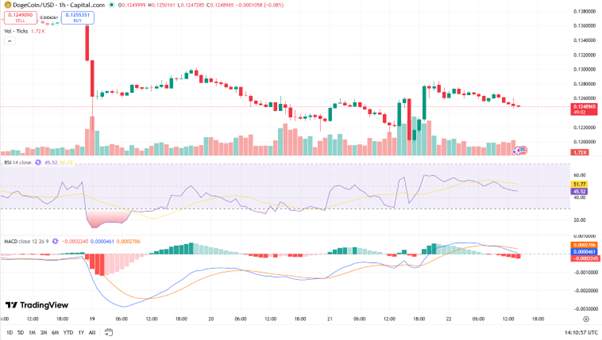
Source: TradingView
Volume trends reinforce that view. DOGE spot trading volume jumped 62% to $2.0 billion during the recent pullback, according to Coinotag. Rising volume during consolidation suggests accumulation, not distribution, particularly when price holds above key support.
Whale flows and ETF exposure add liquidity depth
On-chain data shows mixed but active whale behavior. A single wallet reportedly moved 500 million DOGE—worth roughly $500 million at the time—to Binance on Jan. 14, a transfer that can signal either profit-taking or liquidity provisioning. Historically, similar exchange inflows have coincided with volatility rather than sustained declines.
Dogecoin fell 14% from yearly highs after a whale moved 500 million DOGE to Binance, potentially signaling trouble at the $0.13 support level. pic.twitter.com/v6wniyAEcg
— Byzex (@byzex_official) January 19, 2026
At the same time, earlier accumulation phases saw whales absorb between 1 billion and 4.7 billion DOGE during corrections. That pattern matters because large holders often accumulate before directional moves, using high-liquidity periods to build positions.
Key levels traders are watching now
Technically, trader Vin_Cooper believed that DOGE is struggling at $0.125 after failing to break through $0.126 resistance. The support remains at $0.122 and a break below that support would invalidate the corrective-fractal thesis. For investors comparing opportunities across the sector, DOGE remains one of the best altcoins to buy for liquidity, but not without volatility.
? $DOGE is struggling at $0.125 after failing to break through $0.126 resistance ?
? Support: $0.122
? Resistance: $0.13–$0.135
Recent breakout shows potential, but momentum is still weak#Dogecoin #DOGE #Crypto #MarketTrends https://t.co/TwharQce0K— Vin_Cooper (@CoopVin) January 21, 2026
For now, Dogecoin’s price action reflects compression rather than expansion. Whether the historical fractal ultimately resolves toward $1 depends less on memes and more on sustained volume, support retention, and broader altcoin market conditions.


