


The next existential threat to blockchain security may not come from hackers or regulators, but from physics.
As quantum computing steadily advances, some cryptographers believe the industry is approaching a point where today’s encryption standards will no longer be enough. Among them is Kostas Chalkias, who argues that the crypto sector is underestimating how disruptive that moment could be – and which networks would feel it first.
Key Takeaways
A leading cryptographer warns that quantum computing could threaten major blockchains sooner than expected, with Bitcoin seen as the most exposed
Sui is positioned as more adaptable to post-quantum security due to its cryptographic design, though adoption remains early
SUI price has stabilized after a sharp pullback, with momentum indicators suggesting selling pressure may be easing
Rather than framing quantum risk as a distant, abstract concern, Chalkias sees it as a structural problem baked into the design of early blockchains. In his view, once sufficiently powerful quantum machines arrive, attackers won’t target newer experimental networks. They’ll go after the largest and most exposed systems first.
Why Bitcoin Could Be the First Target
According to Chalkias, Bitcoin sits at the top of that list. The reason is not its popularity alone, but the way its cryptography has been used over time. Many early Bitcoin addresses have already revealed their public keys on-chain, including wallets widely believed to belong to Satoshi Nakamoto.
That exposure matters because Bitcoin relies on ECDSA signatures, a scheme expected to become vulnerable once quantum computers reach a certain threshold. If that happens, attackers wouldn’t need new transactions to exploit old addresses – the cryptographic material is already visible.
From Chalkias’ perspective, this makes Bitcoin uniquely vulnerable compared to chains that can more easily rotate keys or migrate accounts.
The Timeline Is Slipping – and That’s the Risk
For years, the crypto industry treated quantum threats as a problem for the 2030s. Chalkias believes that estimate is still broadly reasonable, but with an important caveat: progress may not be linear.
Advances in artificial intelligence could accelerate quantum research in unpredictable ways, compressing timelines that were once thought to be decades away. That uncertainty, he argues, is more dangerous than a known deadline.
Governments are already reacting. Standards bodies such as NIST are pushing institutions to adopt post-quantum cryptography, signaling that long-lived digital infrastructure must prepare well in advance. Chalkias believes blockchains should be doing the same – now, not later.
Why Sui Thinks It’s Better Positioned
Chalkias contrasts older chains with Sui, which was designed with cryptographic agility in mind. Sui uses EdDSA rather than ECDSA, making it easier to integrate post-quantum upgrades.
More importantly, Mysten Labs has developed a mechanism that allows existing Sui addresses to transition to quantum-resistant security through a single action, using post-quantum zero-knowledge proofs. Chalkias is clear that this approach cannot be retrofitted onto Ethereum or Solana due to architectural constraints.
Despite that, no blockchain marketed as quantum-safe currently ranks among the top 40 by market capitalization. Ethereum has begun funding research in this area, while Solana developers are exploring alternative address formats, but the industry remains in early stages.
SUI Price Analysis: Market Cools as Momentum Tries to Stabilize
From a market perspective, SUI’s price action reflects consolidation rather than fear.
At the time of the chart, SUI is trading near the $1.49 area after a sharp correction from highs above $2.00. The sell-off erased a large portion of January’s gains, but price has since stabilized into a sideways range.
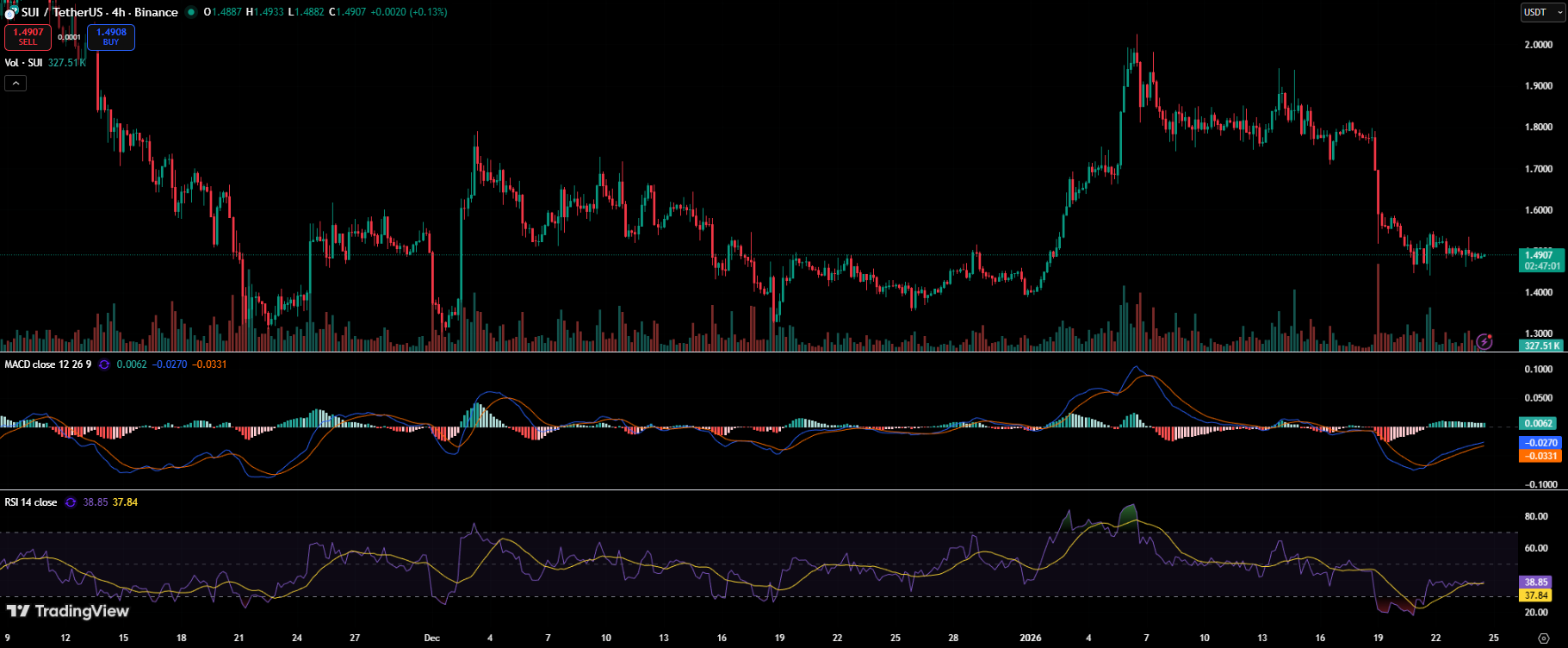
Momentum indicators suggest selling pressure may be easing. The RSI on the 4-hour chart sits near 38, recovering from oversold territory, which often signals that downside momentum is weakening rather than accelerating. Meanwhile, the MACD histogram is turning less negative, hinting at a potential short-term trend stabilization.
On the downside, the $1.45–$1.40 zone stands out as key support. A clean break below that area would open the door to deeper consolidation. On the upside, SUI faces initial resistance near $1.60, with a stronger barrier around $1.75 if bullish momentum returns.
For now, price action suggests a market in pause mode – digesting losses while waiting for a catalyst. Whether long-term narratives around quantum resilience translate into sustained demand remains an open question, but technically, SUI appears to be searching for a base rather than breaking down.


