

The emergence of Spacecoin (SPACE) represents a fundamental shift in how global telecommunications are managed, moving away from centralized satellite giants toward a decentralized physical infrastructure network (DePIN). By leveraging low-Earth orbit (LEO) nanosatellites and blockchain technology, Spacecoin aims to provide permissionless, high-speed 5G connectivity to the billions of individuals currently lacking reliable internet access.
Operating as a specialized layer on the Creditcoin blockchain, the protocol automates the coordination of hardware and data transmission through smart contracts. This allows for a borderless connectivity model that bypasses traditional terrestrial bottlenecks and censorship, positioning Spacecoin as a key player in the 2026 DePIN landscape.
Key Takeaways
Spacecoin utilizes a decentralized network of LEO nanosatellites to provide censorship-resistant 5G internet, specifically targeting underserved regions in Africa and Southeast Asia.
The SPACE token serves as the core economic unit of the network, facilitating micropayments for bandwidth, operator staking, and decentralized governance.
Following the successful launch of the CTC-1 constellation in late 2025, Spacecoin has secured strategic pilot agreements with governments in Kenya, Nigeria, and Indonesia for 2026 deployments.
The Technology Behind the Spacecoin DePIN – SPACE Tokenomics and 2026 Roadmap
Spacecoin's infrastructure is built on the premise that every satellite acts as a decentralized node within a blockchain network. This Spacechain protocol ensures that no single government or corporation can shut down the service, as the ledger is maintained across multiple orbital assets.
In October 2025, the project successfully validated this concept by routing a world-first end-to-end blockchain transaction through space. This technical milestone proved that blockchain networks can verify and settle data without relying on terrestrial internet infrastructure.
The network is fully compatible with 3GPP industry standards, allowing standard 5G NTN-enabled mobile devices to connect directly to the satellite constellation without specialized ground equipment. This direct-to-device capability is central to Spacecoin's mission of providing affordable access.
Target service costs are estimated at just $1–2 per month for users in emerging markets. By eliminating the need for expensive terrestrial fiber-optic trenches, Spacecoin offers a scalable alternative for nations with challenging geographical archipelagos like Indonesia.
In January 2026, Spacecoin expanded its ecosystem through a strategic partnership with World Liberty Financial (WLFI). This collaboration aims to integrate decentralized finance settlements, utilizing the USD1 stablecoin, directly into the satellite network.
This partnership highlights the growing trend of combining physical connectivity with financial inclusion. It allows unbanked populations to access both the global internet and capital markets through a single satellite-linked device.
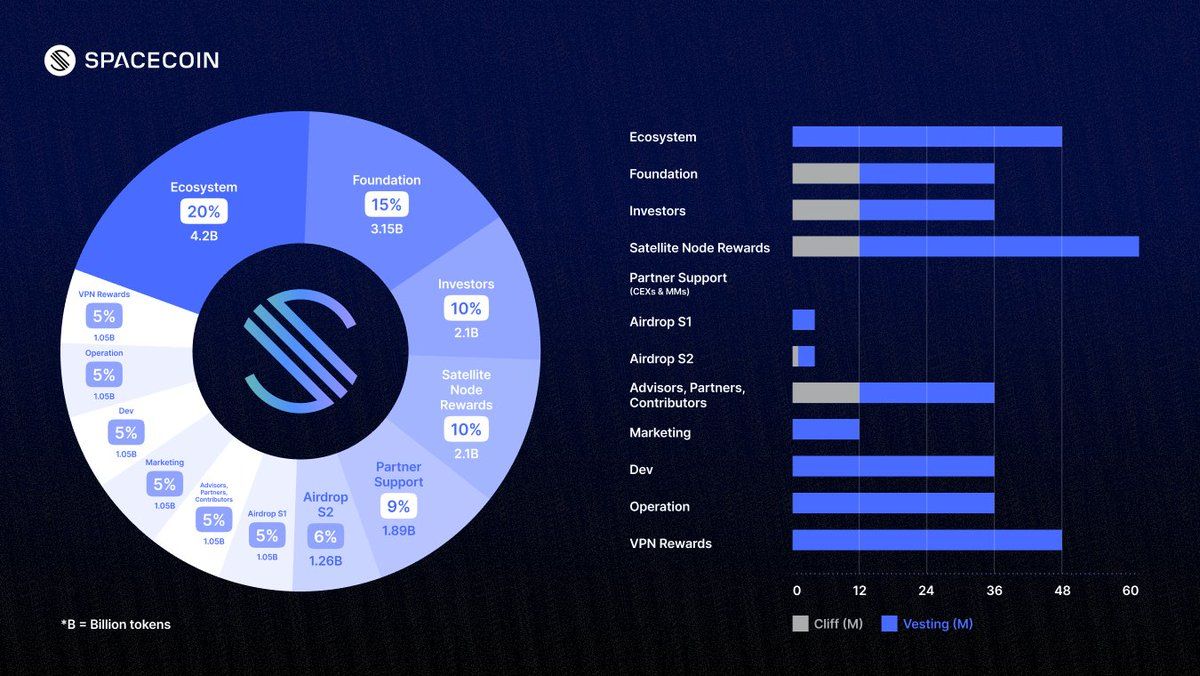
The SPACE token is the utility engine that coordinates the interaction between satellite operators and end-users. Users pay for bandwidth in SPACE tokens, which are then distributed to the operators who provide the hardware and routing services.
To ensure high quality of service, operators must stake SPACE tokens as collateral. This stake can be slashed if the node provides unreliable connectivity or violates protocol standards, creating a self-regulating marketplace without centralized approval.
As of early 2026, the SPACE token has seen significant market activity, including a high-profile launch on the Binance Alpha platform on January 23. The tokenomics are designed to incentivize early network participants while supporting long-term ecosystem growth.
The project’s roadmap for 2026 focuses on the commercial rollout of the CTC-1 constellation, which includes advanced satellites launched via a SpaceX Falcon 9 mission in November 2025. These satellites are currently performing inter-satellite link tests to ensure seamless handovers.
Looking ahead, Spacecoin plans to open-source its entire technology stack, including satellite hardware designs. This move is intended to democratize the space-based ISP industry, allowing third-party entities to launch their own nanosatellites and join the network.
This strategy directly contrasts with the proprietary models of traditional incumbents like Starlink. By positioning itself as an open-source alternative, Spacecoin seeks to build a resilient global 5G network owned by its community.
Conclusion
Spacecoin (SPACE) is effectively bridging the gap between aerospace engineering and decentralized finance to solve the global digital divide. By utilizing a DePIN model on the Creditcoin blockchain, the project provides a resilient and affordable alternative to traditional satellite internet. As the 2026 pilots in Kenya and Nigeria move toward full commercialization, the SPACE token will remain a vital asset for those monitoring the intersection of blockchain and physical global infrastructure.


