

Oracle’s aggressive push into artificial intelligence is running headfirst into rising investor skepticism, with the stock now down roughly 50% from its September high and questions mounting over how much risk the company is taking on to fund its expansion.
Key Takeawys
Oracle stock is down about 50% from its September high.
The company plans to raise up to $50B to fund its AI buildout.
Heavy reliance on OpenAI is worrying investors.
Technicals remain bearish, with momentum still weak.
Oracle Corporation shares have struggled as markets digest both the scale of its AI ambitions and the financial exposure tied to executing them.
Massive capital raise to fuel AI expansion
Oracle announced on Sunday that it plans to raise between $45 billion and $50 billion in gross cash proceeds this year, split roughly evenly between debt and equity issuance. The funding will be used to accelerate the buildout of AI-focused data-center infrastructure, which has become a central pillar of Oracle’s growth strategy.
As part of that plan, Oracle intends to issue investment-grade bonds in a one-time offering early this year. Importantly, the company said it does not expect to return to the bond market in 2026, signaling that management views this as a front-loaded financing move rather than a long-term reliance on debt markets.
Big-name customers, heavy concentration risk
Oracle says the new capital will help it build additional capacity to meet already contracted demand from major AI players, including AMD, Meta, Nvidia, OpenAI, TikTok, xAI and others. The customer list underscores Oracle’s growing role as a core infrastructure provider for large-scale AI workloads.
Still, a significant portion of the AI buildout is closely tied to OpenAI, and that concentration is becoming a focal point for investor concern. Questions are emerging around whether the ChatGPT creator’s financial model can support multiyear commitments for vast amounts of data-center capacity, particularly as competition and costs across the AI sector intensify.
Wall Street flags exposure to OpenAI
Those concerns were highlighted late last month by Mizuho trading-desk analyst Jordan Klein, who warned that Oracle is “way too exposed and levered to OpenAI, but in the worst way.” The comment reflects broader unease that Oracle’s AI strategy, while strategically aligned with industry trends, may hinge too heavily on a single counterparty following through on long-term spending plans.
Any slowdown, renegotiation, or shift in OpenAI’s capacity needs could leave Oracle with expensive infrastructure and weaker-than-expected returns on capital.
Technical analysis: downtrend still intact
From a technical standpoint, Oracle’s chart reinforces the cautious narrative. The stock is trading near $165 after a prolonged decline, with price action continuing to form lower highs since the autumn peak.
The 14-period RSI on the 4-hour chart is sitting in the low 30s, hovering near oversold territory. While this suggests downside momentum has cooled, there is no clear bullish divergence yet, indicating buyers remain tentative.
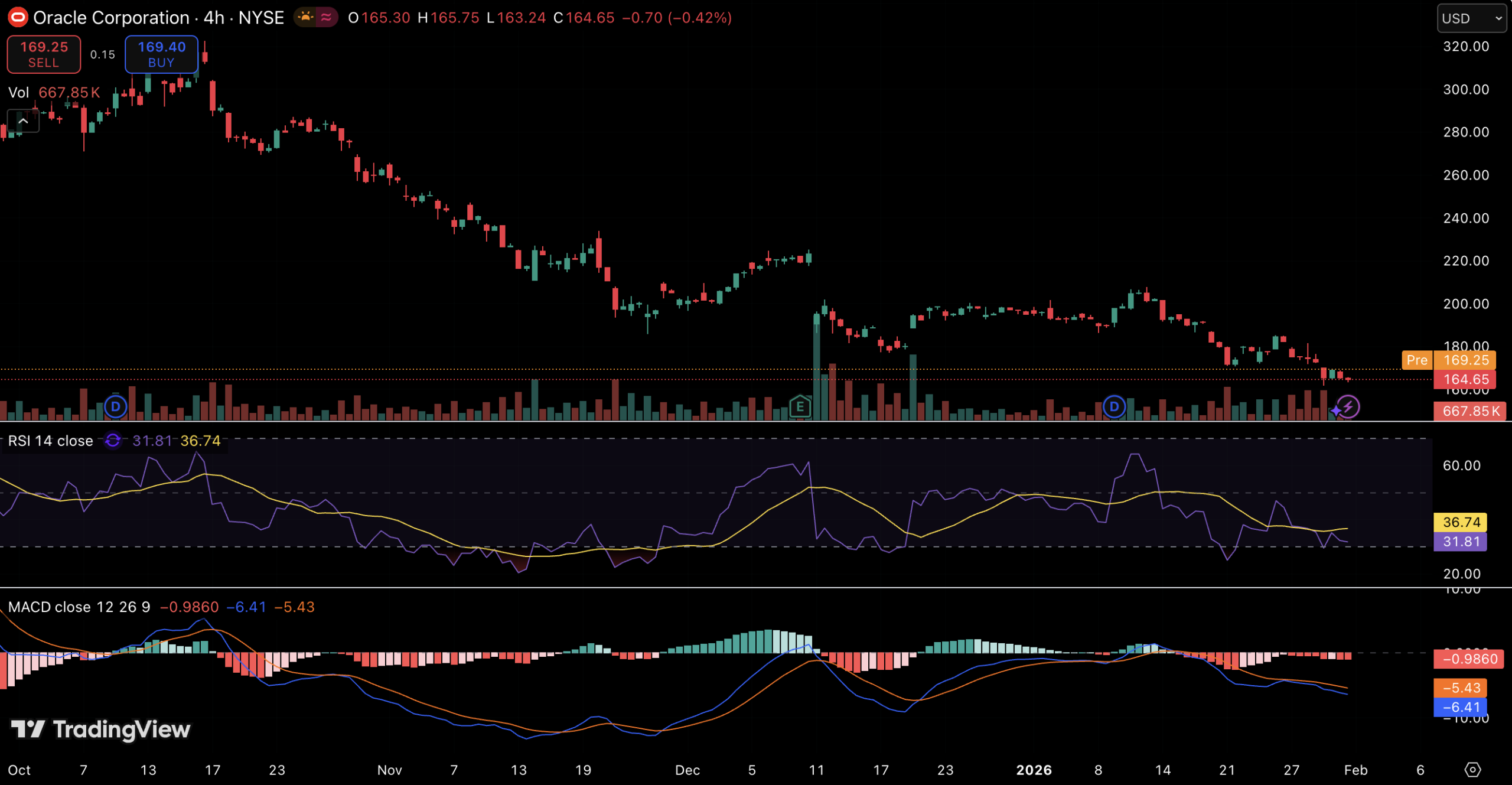
MACD remains firmly negative, with the MACD line below the signal line and the histogram still printing red bars. This setup signals that bearish momentum is still dominant, even if the pace of selling has slowed.
In the near term, Oracle shares may attempt a brief stabilization or relief bounce. However, without a clear momentum shift – such as RSI reclaiming the mid-40s to 50 zone and MACD flattening or turning higher – rallies are likely to face selling pressure.
For now, Oracle’s ambitious AI funding push is colliding with technical weakness and rising concentration concerns, leaving the stock vulnerable as the year unfolds.


