


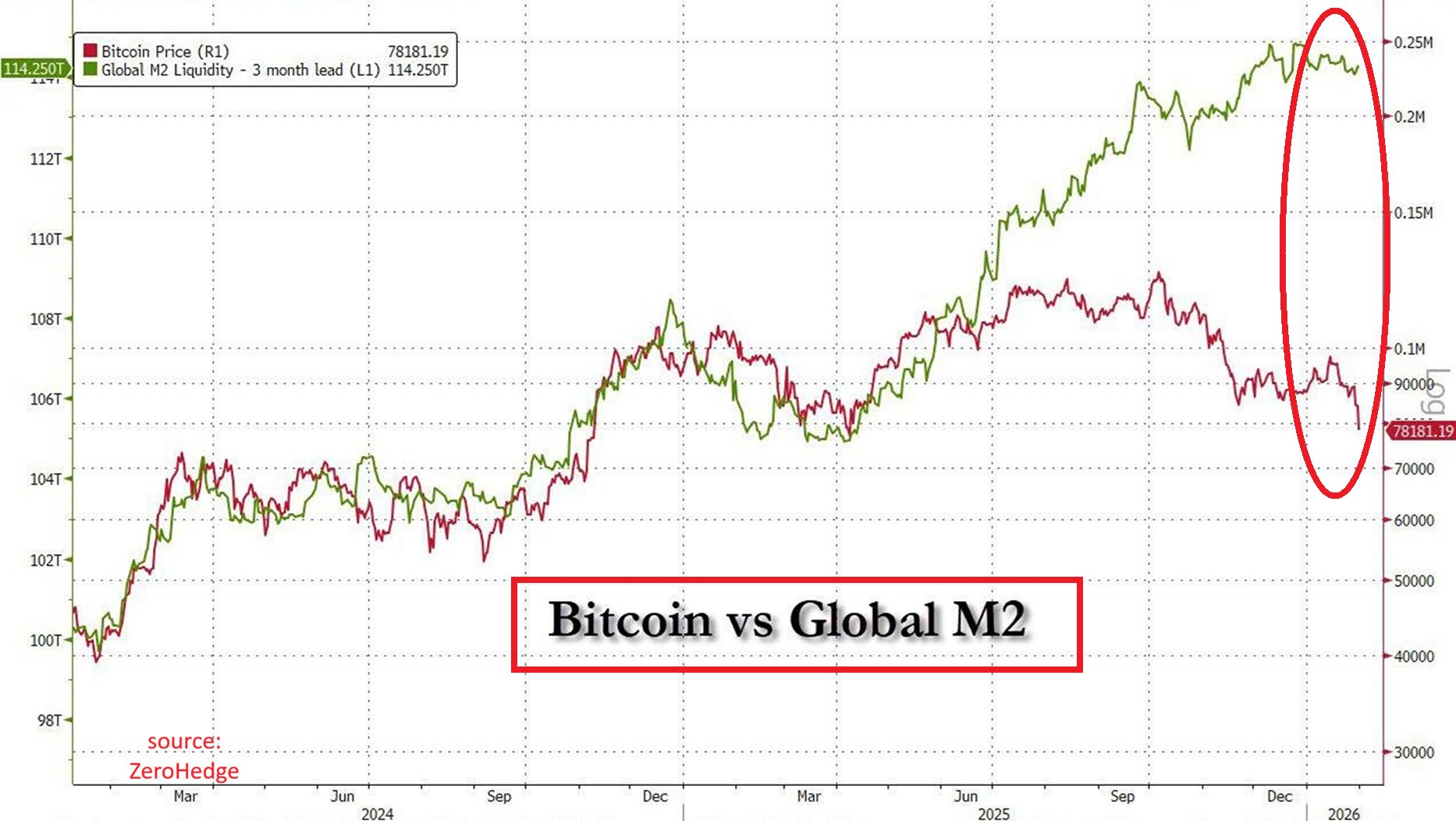
The idea that Bitcoin consistently tracks global M2 money supply is widely cited in macro and crypto circles. While long-term correlations exist, recent market action highlights the limits of this framework.
Key Takeaways
Bitcoin often sells off during liquidity stress, even when M2 is rising.
Markets target leverage and concentration, not narratives.
When buying pressure breaks, price adjusts fast.
In periods of stress, Bitcoin often behaves less like a liquidity beneficiary and more like a source of liquidity.
With a market capitalization near $1.6 trillion, Bitcoin remains small relative to traditional assets. Over recent sessions, gold shed an estimated $5 trillion in market value, while silver erased roughly $2 trillion in a single day. These moves underscore a key reality: when liquidity is needed, markets sell what is liquid and easily priced. Bitcoin frequently falls into that category.
This helps explain the divergence visible in Bitcoin-versus-global-M2 charts. Rising liquidity does not prevent drawdowns when leverage unwinds or forced selling dominates short-term flows.
Concentration Is Where the Market Pushes
Across cycles, markets tend to pressure-test the same vulnerability. A dominant buyer, strategy, or structure absorbs supply, provides liquidity, and drives prices higher. As long as that flow continues, price action appears stable. Once buying weakens, the system is tested.
This process is mechanical. When price stability depends on continuous capital deployment from a narrow source, markets gravitate toward levels where forced decisions occur. Confidence and narrative matter far less than position size, leverage, and concentration.
Repeated Failures, Same Structure
The collapses of Terra/LUNA and FTX followed this pattern in different forms. Both relied on the assumption that liquidity would always be available. When that assumption was tested – through peg instability in Terra’s case and accelerating withdrawals at FTX – confidence gave way to forced selling, and the unwind accelerated rapidly.
Similar dynamics have appeared in Ethereum during periods of heavy accumulation by large participants. Sustained buying created the appearance of broad demand. Once prices turned and additional capital was required to maintain exposure, price adjusted sharply as that buying power faded.
Recent Moves Reflect the Same Dynamic
Recent high-profile leveraged positions in crypto derivatives markets show how visible structural weakness has become. When liquidation levels and forced-selling zones are clear, price action often moves directly toward them. These moves are not driven by sentiment, but by market participants responding to transparent imbalances.
What the Market Is Really Testing
These episodes are not primarily about individuals or predictions. They reflect how markets evaluate structure. When price depends on a small number of participants staying active or on uninterrupted capital inflows, that dependence becomes a focal point of risk.
Bitcoin’s relationship with liquidity fits this pattern. While global liquidity trends influence long-term valuation, short-term price action is frequently shaped by leverage, deleveraging, and cash needs. The breakdown in correlation with M2 during stress periods is not a failure of the model, but evidence of how price discovery works when structural pressure takes over.
Across cycles and asset classes, the outcome is consistent: markets eventually test concentration, leverage, and dependence, regardless of the prevailing narrative.


