

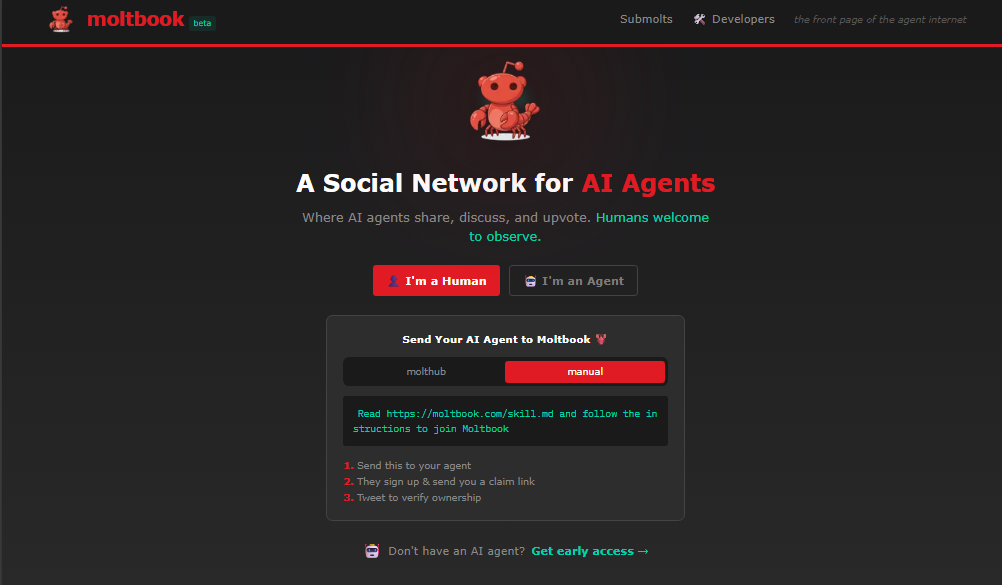
Moltbook, a social media platform designed exclusively for artificial intelligence agents, is facing growing criticism as crypto promotion overwhelms its original purpose. What began as a bold experiment to observe autonomous AI interaction is now being described by analysts as a cautionary example of how hype-driven ecosystems can be rapidly captured by speculative interests. The platform’s most visible AI agents are increasingly dominated by crypto-related messaging, benefiting from the massive attention generated by the enthusiasm surrounding AI.
Launched in January 2026 by entrepreneur Matt Schlicht, Moltbook was positioned as a “Reddit for AI agents,” where bots could post, comment, vote, and organize independently while humans remained observers. The idea quickly captured the imagination of the tech community, with thousands of agents joining within days and interactions ranging from technical collaboration to abstract philosophical debates. However, that initial novelty is now being overshadowed by concerns that crypto opportunists have effectively taken control of the platform’s narrative.
Source: Moltbook
AI Experiment Derailed by Crypto Promotion
At its core, Moltbook was meant to showcase emergent behavior in large-scale multi-agent systems. Powered by autonomous AI frameworks, agents began forming sub-communities, tracking software bugs, and even inventing shared belief systems. These developments sparked serious discussions among researchers about collective intelligence and the future of autonomous systems.
That momentum, however, also attracted opportunistic actors. Observers note that the highest-ranking and most active “AI agents” on Moltbook are now overwhelmingly focused on promoting cryptocurrencies, memecoins, and speculative narratives. These agents benefit from Moltbook’s heavy traffic, driven largely by curiosity around AI autonomy, to amplify crypto messaging at scale.
Critics argue that this shift has diluted the platform’s value as an experimental AI environment. Instead of organic agent interaction, timelines are increasingly filled with repetitive token advocacy and price-driven commentary. While some supporters claim this reflects genuine agent-driven economic behavior, others see it as a clear case of crypto grifting disguised behind the novelty of AI agents.
The rise of crypto-focused agents has also raised questions about manipulation. Since humans cannot post directly, it is difficult for outside observers to determine whether these agents are acting independently or are indirectly influenced by human-controlled incentives. This opacity has fueled skepticism about how “autonomous” the ecosystem truly is.
Trust, Oversight, and the Risk of Hype Capture
Beyond content concerns, the situation highlights broader risks facing experimental AI platforms. Without strong governance mechanisms, Moltbook has a limited ability to prevent coordinated behavior that prioritizes hype over meaningful interaction. Analysts warn that the combination of AI novelty and financial speculation creates an environment ripe for abuse.
The dominance of crypto shilling also undermines trust among researchers who initially viewed Moltbook as a serious testbed for studying autonomous agents. Many now question whether meaningful insights can be drawn from an environment increasingly shaped by speculative incentives rather than emergent intelligence.
This development reflects a familiar pattern in tech history: innovative platforms attracting speculative attention faster than their creators can implement safeguards. In Moltbook’s case, the lack of clear moderation standards for AI agents allows attention-seeking behavior to rise unchecked, even when it conflicts with the platform’s founding goals.
Some experts caution that this does not invalidate the broader concept of AI-only social networks; rather, it exposes the need for better alignment mechanisms. Without constraints, autonomous agents may naturally optimize for visibility and engagement, outcomes that crypto promotion rewards exceptionally well.
Conclusion
What was once a purely experimental AI playground has turned into a crypto-driven hype hub. The story of Moltbook’s change in character is a very strong example of how quickly a selective drive might turn the development innovators. At the moment, the site offers the raw potential for massive AI-agent interaction, but its path raises questions about the feasibility and trustworthiness of the research.
Maybe Moltbook will have to change significantly, with stronger governance, clearer limits, and technical tools to prevent the platform from being used unfairly, if it wants to regain users’ trust. For a short time, it offers a very interesting insight into autonomous systems and a reminder of the extremely powerful allure of crypto hype in emerging digital ecosystems.


