


Alphabet Inc. shares came under pressure on Thursday, sliding 2.43%, as investors focused less on the latest earnings beat and more on valuation, technical signals, and the company’s aggressive long-term spending plans.
Key Takeaways
Alphabet shares fell 2.43% as momentum cooled after a strong run.
Heavy capex plans drew more attention than the earnings beat.
Analysts remain bullish despite short-term technical weakness.
The pullback comes despite another strong quarterly performance, suggesting the market may be pausing after a powerful multi-month rally rather than reacting negatively to fundamentals.
Capital spending plans grab attention
While Alphabet delivered solid financial results, attention quickly shifted to its outlook for investment. The company announced capital expenditure plans in the range of $175 billion to $185 billion, a figure that would be more than double its 2025 spending of $91 billion. The scale of that commitment raised questions about near-term cash flow pressure, even as management positions the spending as essential for long-term growth in AI and cloud infrastructure.
AI growth narrative remains strong
On the earnings call, Alphabet and Google CEO Sundar Pichai highlighted continued momentum in artificial intelligence. The Gemini AI app now has more than 750 million monthly active users, up from 650 million in the previous quarter. The rapid growth reinforces Alphabet’s strategy of pushing AI deeper across its product ecosystem, from search to productivity tools.
Valuation outlook still constructive
Despite the recent dip, Wall Street remains broadly optimistic. According to TipRanks, Alphabet carries a strong buy consensus based on 30 analyst ratings. The average 12-month price target stands at $364.86, with estimates ranging from a $300 downside scenario to a bullish high of $415, suggesting analysts still see meaningful upside from current levels.
Technical analysis signals cooling momentum
From a technical perspective, the chart points to short-term consolidation rather than a trend reversal. On the 4-hour timeframe, the RSI has slipped to around 48, moving below its signal line near 61. This indicates fading momentum after previously approaching overbought conditions.
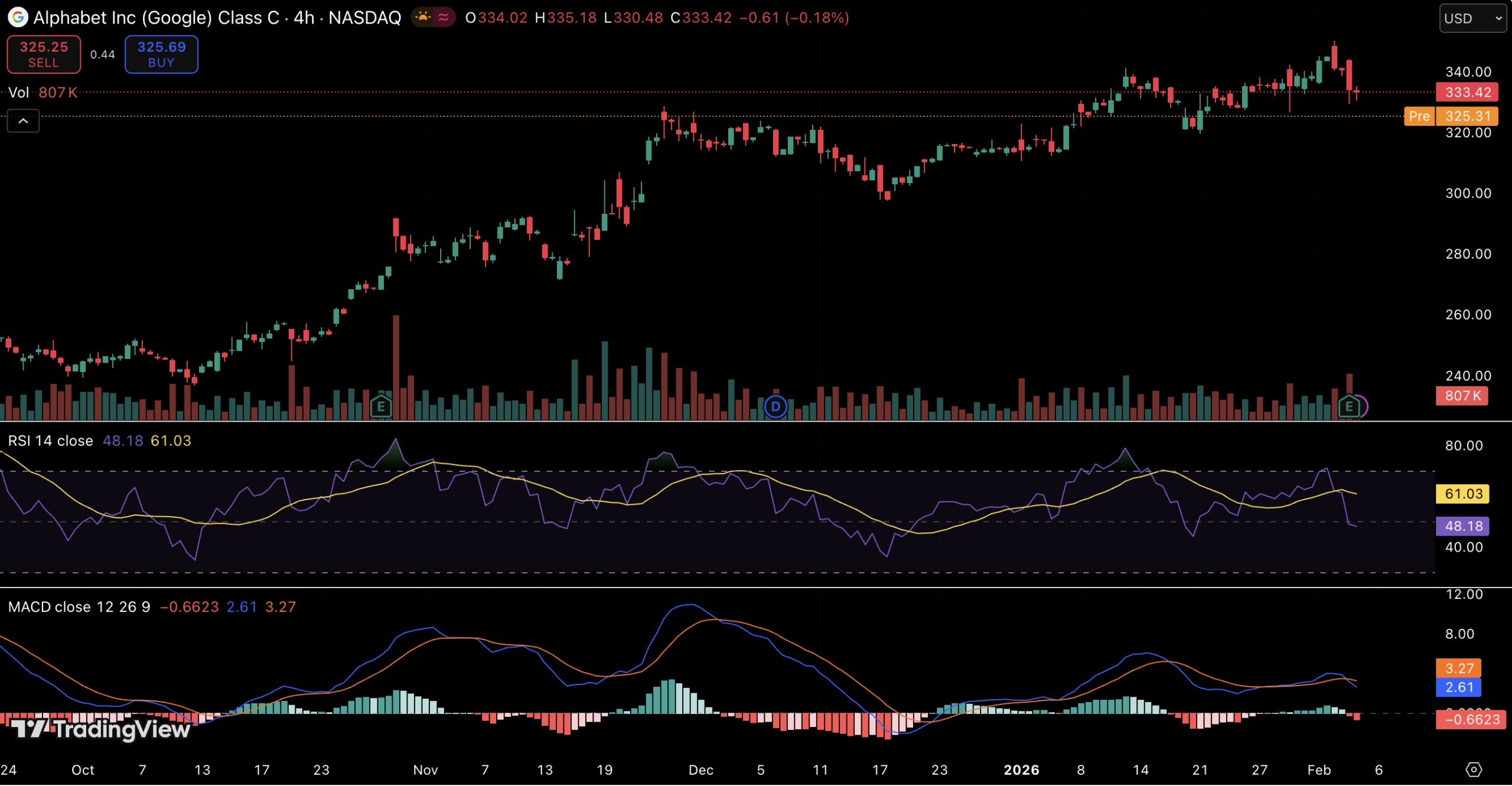
The MACD also shows early signs of weakness. The histogram has turned negative, and the MACD line is starting to roll over below the signal line, often interpreted as a short-term bearish or corrective signal. However, price action remains well above key medium-term support levels, keeping the broader uptrend intact for now.
Overall, Alphabet’s latest move looks more like a pause driven by technical factors and spending concerns than a loss of confidence in the company’s fundamentals or AI growth story.


