

BitMine Immersion Technologies added 32,977 ETH worth approximately $104 million in the final week of 2025, bringing its total Ethereum holdings above 4.14 million ETH. The purchase comes as Ethereum prices remain under pressure and spot ETH ETFs recorded net outflows, highlighting a growing divergence between institutional balance-sheet accumulation and public market flows.
ETH traded at $1,887 on Feb. 6 2026, down roughly 10.95% over the past seven days and more than 50% lower year-to-date, reflecting sustained risk-off pressure across crypto markets.
Ethereum’s market cap stands near $229 billion, down from over $500 billion at its 2025 peak, while on-chain data shows large holders increasing exposure despite technical breakdowns. That divergence frames the current debate: whether institutional accumulation can offset weakening momentum indicators in the near term.
What exactly did BitMine buy, and why does it matter?
The latest purchase lifts BitMine’s holdings above 4.14 million ETH, valued at more than $13 billion and representing roughly 3.4% of Ethereum’s circulating supply. That concentration matters for traders because large treasury-style holders reduce liquid supply, tightening float during periods of renewed demand.
LATEST: ? BitMine has acquired another 32,977 ETH, pushing its total holdings to 4.14 million ETH, worth $13 billion and representing 3.4% of Ethereum's circulating supply. pic.twitter.com/2SeaEr8WQp
— CoinMarketCap (@CoinMarketCap) January 6, 2026
BitMine’s strategy builds on BitMine’s massive ETH holdings, positioning the firm as the largest single “fresh money” accumulator of Ethereum. Exchange supply metrics reinforce the point: ETH held on centralized exchanges has declined by an estimated 6% over the past three months, signaling reduced sell-side liquidity.
Ethereum Price Technicals Remain Weak Despite Institutional Accumulation
From a trading perspective, Ethereum remains technically weak. The 14-day RSI sits near 23, firmly in oversold territory, while ETH has broken below its 200-day moving average at $2,140. Immediate support lies between $1,850 and $1,750. ETH now faces crucial resistance at $2,140 with heavier overhead supply around $2,300.
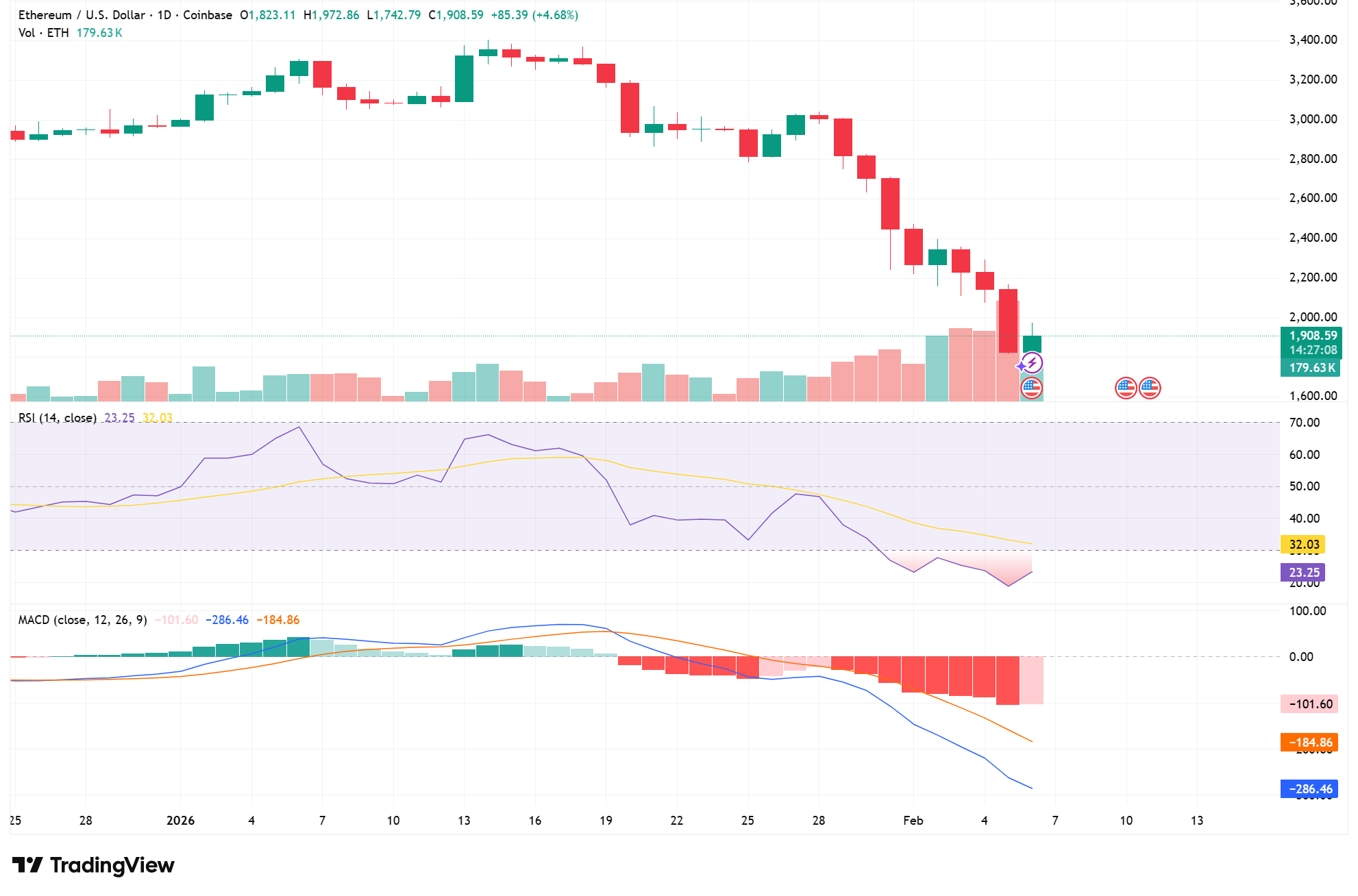
Source: TradingView
Momentum indicators echo caution. The daily MACD remains negative with the signal line still below zero, suggesting downside pressure has not fully exhausted. For short-term traders, a reclaim of $2,000 on rising volume would be the first signal of trend stabilization.
How Realistic Is Tom Lee’s $250,000 Ethereum Price Target
Lee’s $250,000 ETH projection implies a roughly 13,000% gain from current levels, pushing Ethereum’s fully diluted valuation well above $30 trillion. Supporters point to staking yield, Layer 2 adoption, and long-term supply dynamics, themes also explored in a broader bullish Ethereum price outlook.
However, the counterargument is grounded in present conditions. Spot ETH ETFs posted net January outflows, and risk assets broadly weakened as Bitcoin volatility increased. Macro liquidity, not long-term conviction, continues to dominate short-term price discovery.
In the short term $250K is not a realistic target for Etherum.
Risk factors traders should not ignore
BitMine’s accumulation does not eliminate downside risk. Ethereum’s hash-adjusted network activity remains flat, and Layer 2 transaction growth has slowed to low single digits month-over-month, reducing fee burn that supports ETH’s supply thesis.
For investors, the setup is a tension between conviction buying and weak confirmation signals. Monitoring whale wallet flows, ETF fund movements, and a potential RSI rebound above 30 will be critical in assessing whether accumulation translates into a durable price base.
For now, Ethereum sits at a crossroads: heavy institutional accumulation on one side, and fragile technicals on the other. How that balance resolves will likely define ETH’s trajectory through the first quarter of 2026.
Additional market context on crypto technical levels can be found tracking key Bitcoin and Ether price zones, while broader sentiment indicators are reflected in recent Bitcoin technical analysis.


