

Ethereum price is currently navigating a stark divergence between immediate technical weakness and long-term institutional optimism. While Ethereum currently tests a critical psychological support level at just below $2,000 following a sharp correction, analysts from major financial institutions maintain a target $7,500 by the end of 2026.
The second-largest crypto has retreated significantly from last year’s momentum, presenting a conflict between bearish chart formations and bullish fundamental catalysts, including network upgrades, regulatory clarity, and adoption.
#Ethereum downside target will complete at $1,900 level.
ETH reversal then? pic.twitter.com/36iKObD98m
— Elja (@Eljaboom) February 11, 2026
Technical Structure Signals Continued Pressure
Ethereum price action has been brought down by a 40% correction this year, pushing the asset down to the $2,000 psychological floor. This level is crucial as it aligns with the lows observed in May 2025 and serves as a primary defense line for bulls. Recently, Ethereum tested the $2,150 support zone, and the subsequent failure to hold that level has accelerated the move toward $2,000.
Technical indicators exhibit signs of sustained bearish momentum. The Moving Average Convergence Divergence (MACD) remains in negative territory as sellers control the narrative for now. Meanwhile, the Relative Strength Index (RSI) is approaching oversold conditions, a heavy oversold at 28, which can flip at any time.
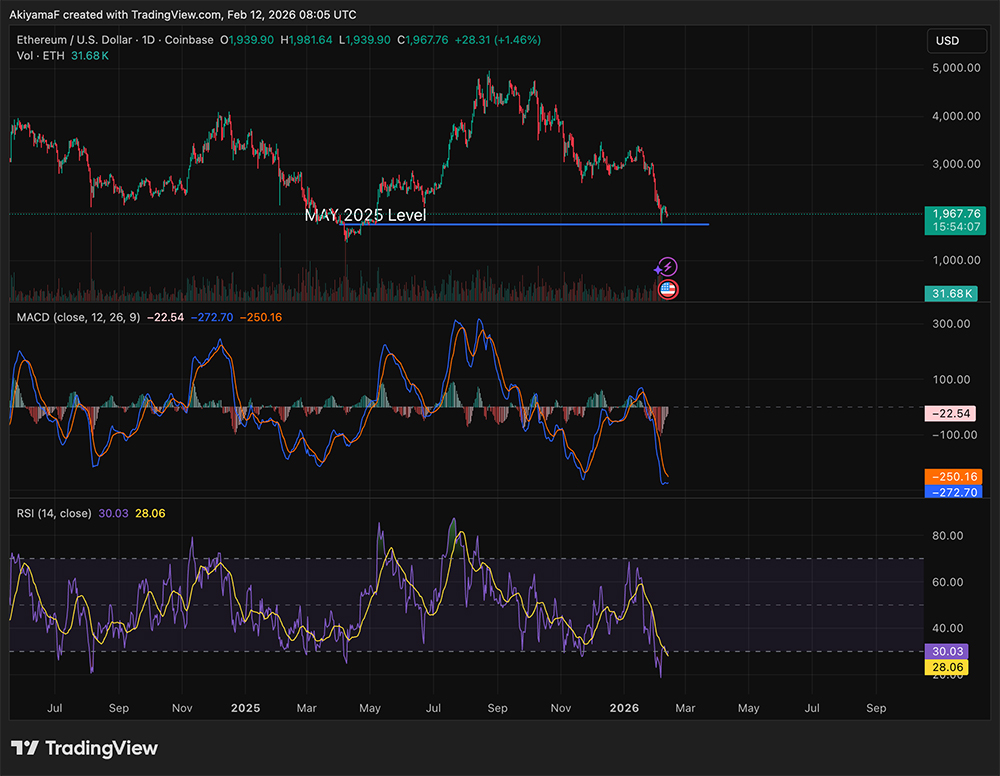
(source – TradingView)
We identify the following key levels:
Immediate Support: $1800 – $2,000 (Psychological & Historical)
Bearish Downside Targets: $1,760 and $1,400 if current support fails.
Key Resistance: $2,690 and $3,000 must be reclaimed to invalidate the downtrend.
Why Analysts Project $7,500 Ethereum Price by 2026
BULLISH:
STANDARD CHARTERED PREDICTS $ETH WILL SURPASS $7500 BY DECEMBER! pic.twitter.com/JBws82tKby
— Coinvo (@Coinvo) August 18, 2025
Despite the grim short-term technicals, institutional outlooks remain aggressively bullish over a multi-year horizon. Standard Chartered has outlined a path for Ethereum to reach $7,500 by the end of 2026. This forecast, while trimmed from an earlier $12,000 prediction, relies on specific fundamental drivers, including the “Fusaka” network upgrade and anticipated 10x throughput increases.
People who never paid 20$ in gas fees to bridge a token from Ethereum mainnet to another chain would never understand how much this Fusaka upgrade means to the average user.
What do you mean I’m paying 0.06$ for the same txn on the same Ethereum L1 now
Greater times ahead, I… pic.twitter.com/7MyBssb7vt
— Sam (Interop Enjoyoor ?) (@sam6170) December 21, 2025
Similarly, Citi projects ETH could hit $5,440 within the next 12 months, citing sustained ETF inflows and rising investor demand. This aligns with broader market sentiment; strictly speaking, Fundstrat’s Tom Lee has forecasted a realistic 2026 range of $4,500 to $7,500, arguing that institutional accumulation often precedes price realization.
Look at this chart closely
Every recovery in $ETH is V-shaped
– symmetric recovery
– faster the decline
– the faster of the recovery https://t.co/hDdtWU4L4f— Thomas (Tom) Lee (not drummer) FSInsight.com (@fundstrat) February 6, 2026
Not only prediction, but the infrastructure supporting this growth is also expanding. We can see ETH adoption is booming as more and more institutions start using Ethereum for the tokenization chain.
? HUGE: $13 trillion BlackRock highlights Ethereum could be poised to benefit from tokenization, with 65% of tokenized assets on the network, in its 2026 Thematic Outlook. pic.twitter.com/9fGF6zBk7u
— Cointelegraph (@Cointelegraph) January 22, 2026
What Could Invalidate the Bullish Setup?
The primary risk to the $7,500 thesis lies in the immediate defense of the $2,000 level. Technical analysis believes that a confirmed break below this floor could trigger a cascade toward $1,760 or even extreme bear targets of $1,000. Additionally, volatility remains a coherent threat; as Ethereum price braces for volatility surrounding macroeconomic meetings, external shocks could decouple price action from long-term fundamental value.
According to Finance Magnates, the high correlation between Bitcoin and Ethereum (70-90%) also means that broader crypto market sentiment will heavily influence ETH’s ability to stabilize.
The divergence between falling prices and rising institutional accumulation: Treasury firms reportedly purchased 2.3 million ETH recently, suggesting a disconnect that active traders should monitor. If the so-called “Clarity Act” passes in Q1 2026 as anticipated, regulatory tailwinds could act as the catalyst that aligns price with these aggressive institutional targets.


