

World Liberty Financial (WLFI) Crypto just changed direction. The project has proposed a new staking-based governance model that requires a 180-day lock-up to gain voting rights. It also introduces tiered access for larger holders.
That shifts WLFI from a basic governance token into something closer to an access asset. By locking liquidity and rewarding long-term participants, the protocol is trying to build stability ahead of its USD1 stablecoin rollout.
It is a move focused on structure and control, not quick speculation.
WLFI Crypto Governance Proposal Explained
The governance proposal tightens control.
To vote, unlocked WLFI must now be staked for at least 180 days. Already locked tokens keep their voting power. That means influence comes from committed capital, not quick flips.
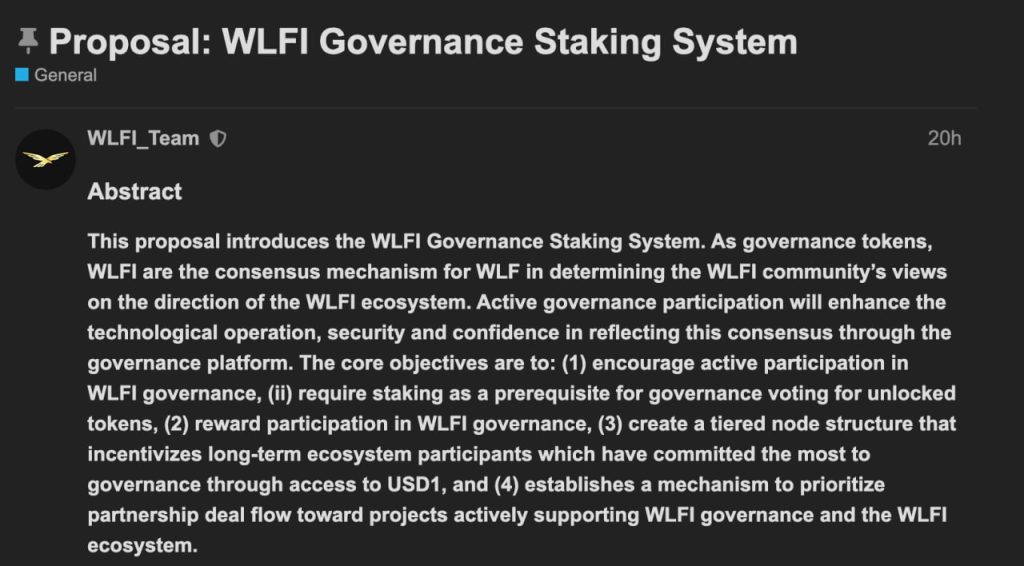
(Source: WLFI)
To limit whale dominance, voting follows a square root weighting model. More tokens still mean more power, but not in a straight line. It softens the impact of massive single holders.
There is also a tiered structure. Large stakers unlock extra access. Higher tiers gain deeper integration privileges and preferred economic incentives.
Active participation matters too. Voting at least twice during the lock period makes holders eligible for rewards, with a targeted 2% annualized yield.
The design favors long-term alignment and structured governance over speculative churn.
Why the Super Node Structure Changes WLFI’s Tokenomics
This redesign is about tightening value capture.
A mandatory 180-day lock for governance pulls supply off the open market. Less circulating liquidity means stronger alignment between large holders and protocol health.
The Node tier directly supports the USD1 stablecoin rollout. Large stakers gain structured access to stablecoin conversions through verified channels, keeping potential spreads inside the ecosystem instead of leaking to outside intermediaries.
The higher Super Node tier goes further, targeting institutional partners that need reliable liquidity rails. Governance influence becomes tied to capital commitment, similar to models seen in established networks where liquidity providers gain structured influence.
The next unlock of the remaining 80% of $WLFI tokens may be closer than expected.
The new proposal aims to mitigate selling pressure and allows those who stake to participate in voting; in upcoming votes, the next unlock could be decided, and only those with their unlocked… pic.twitter.com/HjVhsitxq2
— Clazn (@clazn0x) February 26, 2026
The vote is live, with a seven day window. Watch participation closely. Fast quorum signals that large holders support the pivot. Also, monitor how much supply ends up locked. A high lock ratio reduces float and can support price stability even without heavy retail demand.
If recognizable institutional names emerge as major stakers, it would confirm the shift toward a more structured, institutional focused DeFi model.


