

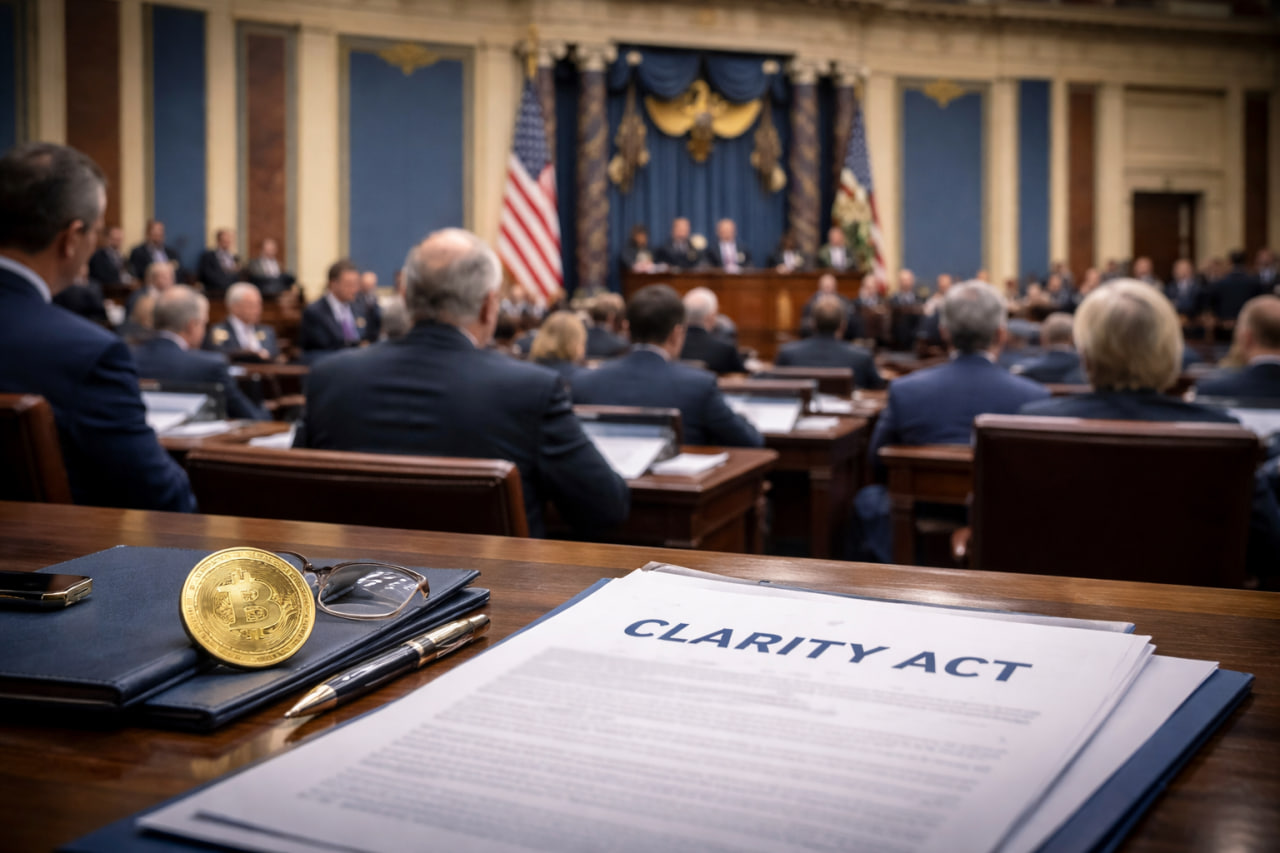
Senate Democrats convened behind closed doors on February 26 to reassess their position on the Digital Asset Market Structure bill, widely known as the CLARITY Act.
Key Takeaways
Senate Democrats reopened negotiations on the CLARITY Act ahead of a March 1 White House deadline.
The bill would split digital asset oversight between the SEC and CFTC.
a16z executives lobbied Republicans, tying crypto regulation to broader AI leadership.
Stablecoin yield rules remain the main obstacle to bipartisan agreement.
The meeting, held just days before a March 1 deadline set by the White House, signals renewed urgency around a framework that would define how cryptocurrencies and stablecoins are regulated in the United States.
The legislation has become a focal point not only for crypto policy but also for America’s broader technology strategy. At stake is whether Washington can finalize a regulatory model that balances investor protection with innovation, as pressure builds from both the financial sector and Silicon Valley.
Senate Talks Show Signs of Movement
The Democratic caucus discussion centered on how to move forward with the Digital Asset Market Clarity Act, which proposes dividing oversight responsibilities between the Securities and Exchange Commission and the Commodity Futures Trading Commission. The goal is to create clearer lines of authority over digital asset spot markets and token classifications.
In the past, several Democrats resisted supporting the bill, citing concerns about market integrity, consumer safeguards, and potential conflicts of interest in the crypto industry. However, Thursday’s meeting suggested that some lawmakers may be exploring a bipartisan compromise as the administration pushes for resolution before the weekend deadline.
White House officials, including Treasury Secretary Scott Bessent, have reportedly urged negotiators to accelerate discussions in order to avoid prolonged uncertainty in the digital asset sector.
a16z Steps Up Political Pressure
At the same time, executives from Andreessen Horowitz, commonly known as a16z, intensified their outreach to Senate Republicans. Co-founder Marc Andreessen and crypto lead Chris Dixon were among those involved in discussions aimed at securing support for the legislation.
According to the firm’s head of government affairs, meetings with Republican lawmakers were productive, with a shared message that the United States must maintain leadership in both digital assets and artificial intelligence.
Beyond private meetings, a16z has committed $50 million toward a newly launched $100 million super PAC, “Leading the Future,” designed to back pro-AI and pro-innovation candidates ahead of the midterm elections. The move underscores how crypto and AI policy are increasingly intertwined in Washington’s political landscape.
Stablecoin Yield Dispute Remains Central
Despite signs of progress, one major sticking point remains unresolved: whether crypto platforms should be allowed to offer yield or rewards on stablecoin holdings.
Traditional banking groups are pushing for strict limitations, arguing that yield-bearing stablecoins could function like unregulated bank deposits. Crypto firms counter that banning rewards would undermine competition and reduce incentives for users to hold dollar-backed digital tokens.
Current drafts circulating in the Senate Banking Committee would prohibit passive interest payments but may allow certain activity-based incentives. That distinction has become the central battlefield in negotiations leading up to the March 1 deadline.
Market Reaction and Legislative Outlook
Prediction markets responded quickly to the renewed activity. On Polymarket, the probability of the CLARITY Act being signed into law in 2026 rebounded to 69 percent, recovering from a 47 percent low earlier this month.
On the legislative front, the Senate Agriculture Committee has already advanced a version of the bill granting expanded spot market authority to the CFTC. Meanwhile, the Senate Banking Committee’s draft remains stalled as lawmakers debate stablecoin yield provisions. A final signature, if negotiations succeed, is targeted for spring 2026.
The outcome of this week’s talks could determine whether the United States establishes a unified digital asset framework before the midterms – or whether crypto regulation remains fragmented amid intensifying global competition.


