

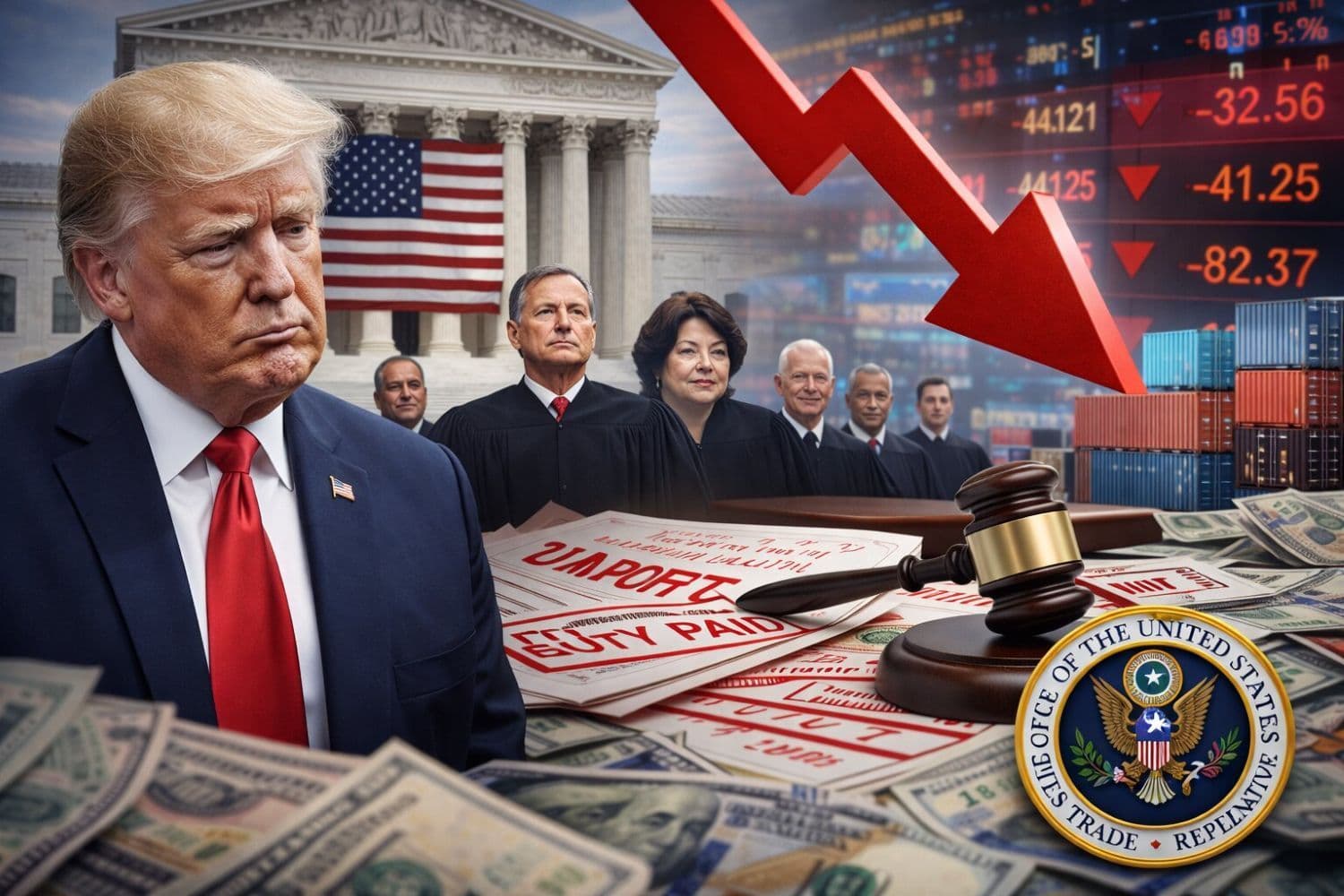
In a landmark decision that severely curtails executive overreach in trade policy, the Supreme Court ruled 6-3 on Friday that President Donald Trump’s sweeping global tariffs are illegal.
What Happened
The high court found that the administration exceeded its statutory authority by using the International Emergency Economic Powers Act (IEEPA) of 1977 to bypass Congress and unilaterally impose taxes on foreign imports.
This ruling effectively topples a central pillar of the administration's "Make America Wealthy Again" trade agenda and represents the most significant legal defeat of President Trump’s second term.
Writing for the majority, Chief Justice John Roberts clarified that while the President possesses broad emergency powers, they do not extend to the unlimited, unilateral imposition of tariffs without specific and clear authorization from Congress.
The Court upheld lower court decisions concluding that the 1977 law, originally designed for regulating transactions during crises was never intended to serve as a permanent revenue-raising tool or a substitute for congressional tax authority.
Potential Liability Of $150 Billion
Justice Sonia Sotomayor, echoing the majority's skepticism, noted that the power to regulate is not the power to tax, affirming that the Constitution grants the "power of the purse" exclusively to the legislative branch.
The U.S. government now faces a potential liability of more than $150 billion in duties collected under the illegal orders since early 2025.
While the ruling may eventually lower costs for consumers by removing the "tariff tax" from supply chains, the immediate effect is a period of intense uncertainty for businesses that had already adjusted their pricing models and inventory strategies to accommodate the duties.
Also Read: CME Group Moves Bitcoin And Ether Derivatives To Round-The-Clock Trading From May 29
The Procedural Road To $150 Billion In Refunds
For the thousands of businesses seeking to reclaim these funds, the path to a refund is expected to be complex and highly procedural rather than automatic.
Legal experts indicate that the timeline for filing varies based on the status of the import entries. Importers of record whose entries are "unliquidated" meaning they were processed within the last 314 days, may be able to seek immediate redress through administrative corrections.
However, for "liquidated" entries where duties have already been finalized, businesses generally have a strict 180-day window from the date of the Supreme Court's ruling to file formal protests with U.S. Customs and Border Protection (CBP).
Filing Deadlines And Documentation Requirements
Many major retailers and small importers have already filed "protective lawsuits" in the U.S. Court of International Trade to preserve their rights, and these cases are expected to be the primary vehicle for securing individualized judgments.
Despite the ruling, the White House still retains authority under other specific trade statutes, such as Section 232 for national security or Section 301 for unfair trade practices.
However, these alternative paths require more rigorous investigations and are more limited in scope, meaning the administration cannot easily or quickly reimpose the same global tariffs struck down today.
Read Next: South Korea Recovers $21M In Bitcoin After Hack, Hunt For Hacker Continues


