


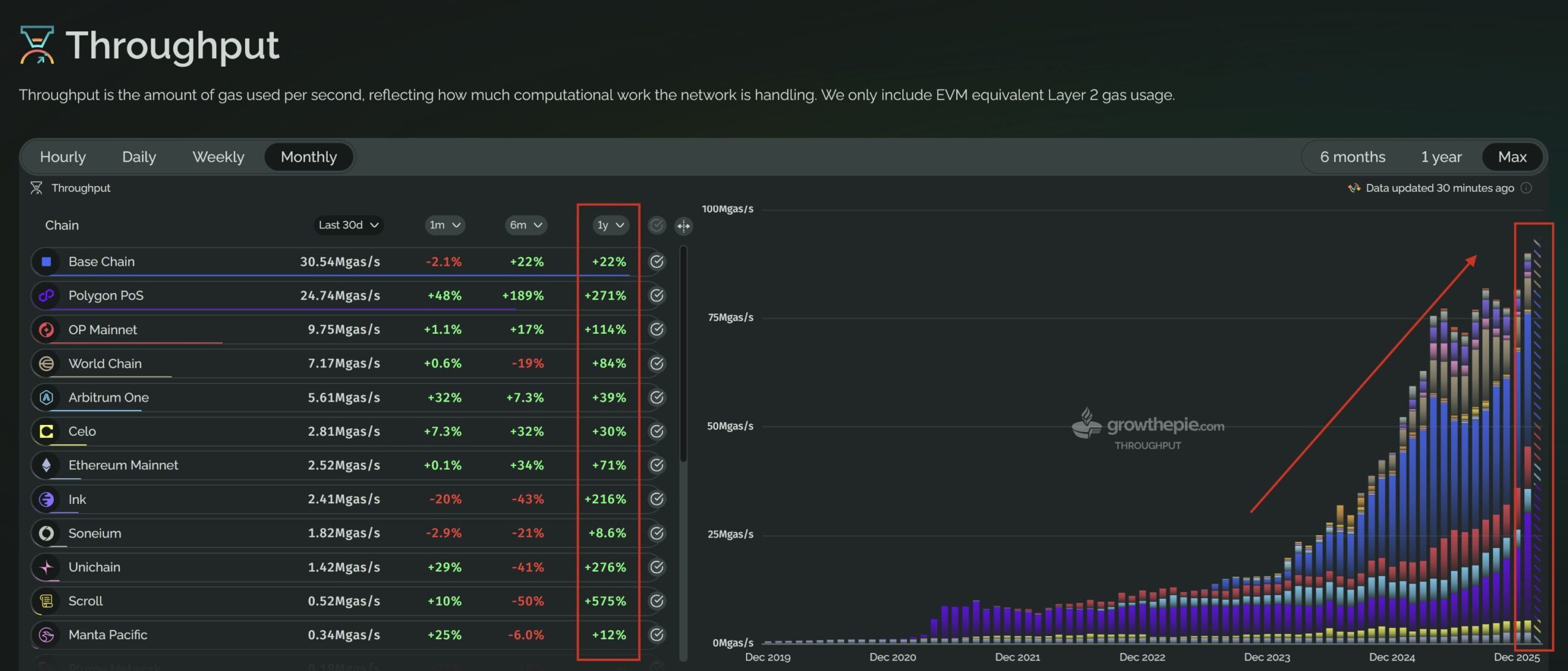
Ethereum's infrastructure is busier than it has ever been. Network throughput - the amount of computational work processed per second - has broken all-time highs, with the combined output of Ethereum's Layer 1 and Layer 2 ecosystem surpassing 100 Mgas/s. That's a number that would have seemed far-fetched just two years ago.
Key Takeaways:
Ethereum’s network throughput has hit an all-time high across L1 + L2s, driven largely by Base and Polygon PoS
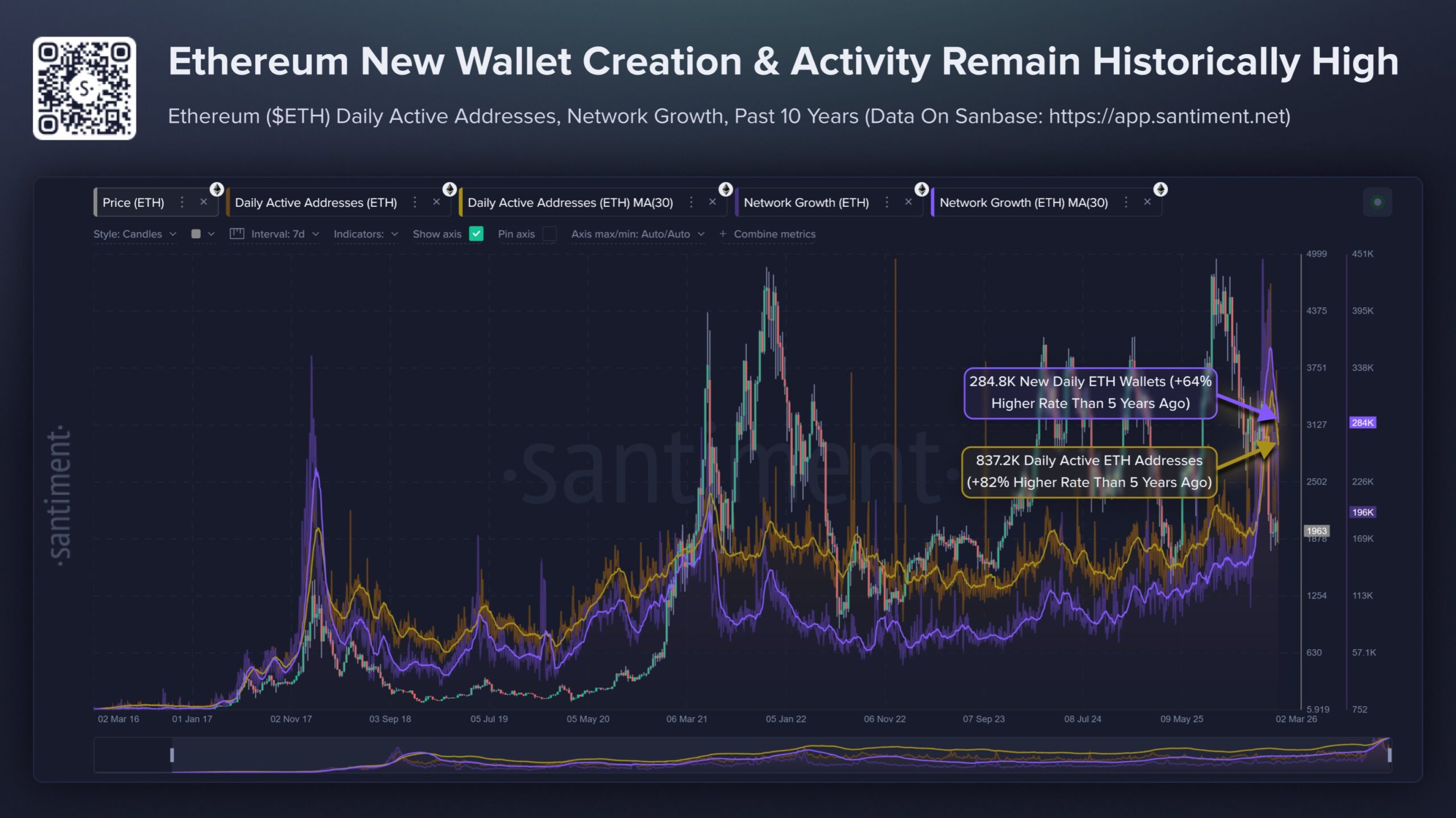
Daily active ETH addresses stand at 837K – up 82% from five years ago
284.8K new wallets are being created every day, +1,967% over the past decade
Despite record network activity, ETH price remains range-bound near $2,000
The data, pulled from growthepie.com, shows Base Chain leading the pack at 30.54 Mgas/s, followed by Polygon PoS at 24.74 Mgas/s. Polygon in particular stands out – up 189% over the past six months and 271% over three years. OP Mainnet, Arbitrum One, and Ethereum’s own mainnet round out the top tier. Ink, a newer entrant, posted a jaw-dropping +216% gain over three years, while Unichain and Scroll are showing momentum with +276% and +575% respectively over the same period.
This isn’t just a vanity metric. Throughput reflects how many swaps, contract calls, transfers, and on-chain actions the network can process in parallel. More throughput means more real economic activity is being settled – and right now, that activity is at record levels.
On-Chain Fundamentals Back It Up
It’s not just gas usage telling this story. On-chain analytics firm Santiment reported this week that Ethereum currently has 837,200 active addresses per day, based on a 30-day moving average. That figure is 82% higher than it was five years ago and over 1,100% above where it stood a decade ago.
New wallet creation is similarly striking. Around 284,800 new ETH addresses are being generated every single day – up 64% from five years ago, and nearly 2,000% from ten years ago. These numbers suggest that adoption, at least at the network level, is not stalling.
Bulls have pointed to these metrics as evidence that Ethereum’s long-term thesis remains intact. The argument is straightforward: real usage is growing, infrastructure is scaling, and the ecosystem is processing more work than ever before. The fundamentals, by almost any on-chain measure, are stronger now than at previous price peaks.
The Disconnect With Price
Here’s the tension: none of this has translated into a corresponding move in ETH’s price.
Ethereum briefly reclaimed the $2,000 level this week – trading around $2,063 at the time of Santiment’s update – but the market remains hesitant. Bulls and bears are openly contesting whether $2K holds as support or continues to function as overhead resistance. The price has struggled to sustain breakouts, and sentiment across crypto Twitter reflects that uncertainty.
This disconnect between on-chain strength and market price isn’t new for Ethereum, but it’s becoming harder to ignore. The network is doing more work than ever. Users are showing up. Developers are building across a growing list of L2s. And yet ETH has significantly underperformed both Bitcoin and several competing Layer 1 tokens over the past 12 months.
Part of the explanation lies in macro headwinds – tighter financial conditions, muted risk appetite, and rotating capital toward AI and other narratives have all weighed on the broader crypto market. But Ethereum specifically has faced questions about its value accrual model since the rise of L2s. If most of the activity is happening on Base or Arbitrum, critics ask, who exactly benefits from holding ETH?
The L2 Question
It’s a debate that has divided the Ethereum community. The bull case holds that L2s are essentially Ethereum’s scaling solution working exactly as intended – they inherit Ethereum’s security, settle on its mainnet, and pay fees in ETH. Rising L2 activity should, in theory, translate into long-term demand for ETH as the base layer asset.
The bear case is less optimistic. With activity increasingly siloed on L2s that run cheaply and efficiently, base layer fee revenue has dropped dramatically since EIP-4844 went live in early 2024. Ethereum’s “ultrasound money” narrative – the idea that ETH becomes deflationary during high network usage – has been difficult to sustain when the L1 itself is less congested than before.
Whether the throughput records being set today eventually find their way into ETH’s price depends largely on which side of that argument proves correct.
What to Watch
In the near term, the $2,000 level will be the focal point for traders. A clean weekly close above it with volume would shift the short-term structure. Failure to hold it opens the door back toward the $1,750–$1,800 range that has acted as support multiple times this cycle.
Longer term, the on-chain picture being painted right now – record throughput, growing wallet creation, sustained address activity – is the kind of data that tends to matter when sentiment eventually shifts. It won’t be what drives the next move. But it may be what justifies it.


